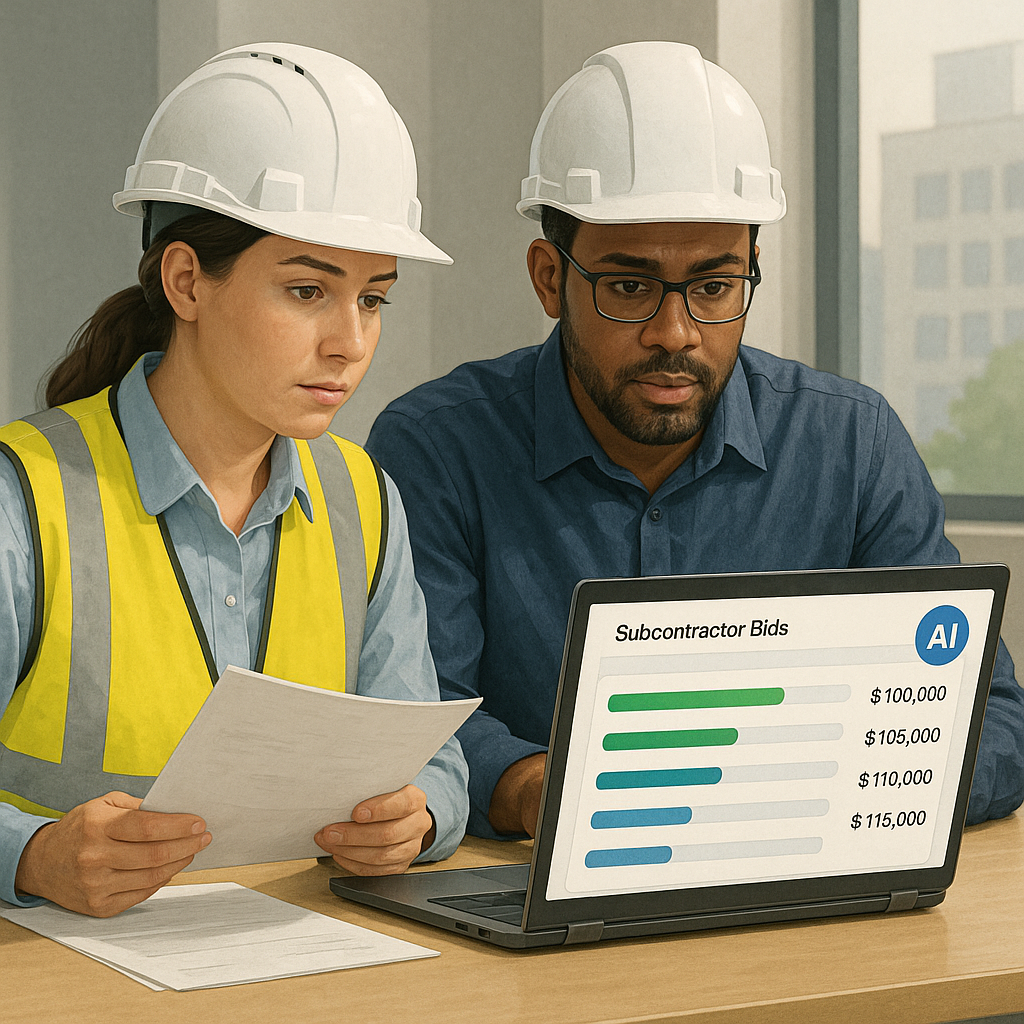
The Sub Bid Nightmare Every Estimator Knows
You’ve been there. It’s 4 PM on a Friday, and your inbox is flooded with subcontractor quotes. HVAC, electrical, plumbing, fire protection — each one in a different format, with scope gaps and questionable exclusions. You’ve got to normalize them all before the bid deadline on Monday.
Sound familiar? Sub bid leveling isn’t just tedious; it’s a productivity killer. On average, it takes estimators six hours to compare and normalize quotes, especially when you’re juggling 5-7 bids for the same trade. And that’s if you don’t miss something critical.
Here’s the kicker: if you mess up, you’re either overpaying or, worse, underestimating — and that’s a great way to lose money on a job.
So, what’s the fix? AI. More specifically, tools like EstimateNext that handle sub bid leveling in a fraction of the time. Let’s break it down.
How AI Tackles Sub Bid Leveling
AI tools aren’t magic, but they’re close. Instead of manually comparing every line item across multiple spreadsheets or PDFs, AI does the heavy lifting. Here’s how:
-
Scope Detection: The AI scans each subcontractor quote and identifies the scope of work covered. It flags missing items, overlaps, and exclusions.
- Example: Let’s say you receive three plumbing quotes for a hospital project. One quote excludes fixtures, another fails to account for labor in specific zones, and the third has no mention of pipe insulation. AI tools can spot these gaps instantly, saving you hours of manual cross-checking.
-
Line-Item Matching: Using semantic search (fancy talk for “it understands context”), the tool maps vendor line items to your BOQ (Bill of Quantities). No more guessing if “3/4-inch conduit” in one quote matches “EMT conduit” in another.
- Actionable Tip: To maximize accuracy, upload your standardized BOQ upfront. Many AI tools let you add custom rules or tolerances, ensuring mismatched terminology doesn’t trip up the process.
-
Ranking and Normalization: Once the AI processes the data, it ranks bids by price, completeness, and compliance. You can instantly see who’s L1, L2, and L3.
- Comparison: Imagine you’re sorting bids manually. You might prioritize pricing first, then work backward to check scope. AI flips this process, ensuring completeness and compliance are factored in before cost rankings.
-
Audit Trail: Every decision is logged, so you have a clear record of how the winning bid was selected. No more back-and-forth with procurement when questions come up later.
- Real-Life Case: A general contractor in Texas used AI to resolve a compliance dispute on a $10 million bid. The audit trail provided indisputable evidence, saving them from potential litigation.
EstimateNext, for example, reduces the time spent on sub bid leveling from 6 hours to just 30 minutes. That’s a 12X speed improvement.
Why It’s Not Just About Speed
You might be thinking, “Sure, it’s faster, but can AI really catch everything?” Good question. Accuracy matters as much as speed, especially when you’re dealing with multi-million-dollar contracts. AI tools like EstimateNext use confidence scoring to highlight any areas it’s unsure about, so you can double-check critical items.
And let’s not forget the human element. AI isn’t replacing your expertise — it’s amplifying it. You still make the final call, but now you’ve got a tool that ensures you’re not making decisions in the 11th hour while running on fumes.
Actionable Step: Use AI confidence scores to prioritize what needs your attention. For example, if it flags exclusions in a high-risk trade like fire protection, you’ll know exactly where to focus your review.
Real-World Results
AI isn’t just a theoretical solution; it’s already reshaping workflows across the construction industry. Here are examples:
-
Mid-Sized MEP Subcontractor: Before switching, they spent three days pricing each package — 24 hours of labor per bid. With AI? They’re down to 4 hours. That means they can respond to 2-3X more bids annually, increasing their win rate without adding headcount.
-
General Contractor: A GC bidding on a high-rise project cut 120 hours on takeoffs and sub bid leveling by using AI. That’s equivalent to hiring a full-time estimator without the payroll cost.
-
Small Residential Builder: A small builder in Florida leveraged EstimateNext to normalize bids for a condo project. The platform flagged a missing scope item (waterproofing) that would have added $75,000 in unexpected costs had it gone unnoticed.
Actionable Tip: Start with a pilot project. Test AI tools on one bid and track how much time and money you save. Most platforms offer free trials, so the upfront investment is minimal.
What About Edge Cases?
You might be wondering, “What if my subcontractors don’t send clean data?” It’s a valid concern. Not every vendor uses neatly formatted Excel sheets or follows your preferred naming conventions. But AI tools are designed to handle messy inputs. They can process PDFs, emails, and even handwritten notes (yes, really).
Real Example: A subcontractor submitted a scanned PDF for a medical facility HVAC system. Despite the format issues, AI parsed the data accurately and flagged missing line items.
Custom Materials or Specs: AI tools let you upload your own catalogs or add project-specific rates, so everything stays consistent with your pricing strategy.
The ROI of AI Bid Leveling
Let’s talk numbers. Say you’re a GC director managing 5 GMP pursuits a year, each involving 7 trades. If you’re saving 5.5 hours per trade on bid leveling, that’s 38.5 hours saved per project. At $130/hour, you’re looking at $5,005 saved per bid. Multiply that across your annual workload, and the ROI becomes impossible to ignore.
For MEP subcontractors, the impact is even bigger. By cutting quote turnaround times, you can respond to 50% more bids. If each win adds $200K in revenue, the math speaks for itself.
Comparison Table:
| Feature | Manual Bid Leveling | AI-Powered Bid Leveling |
|---|---|---|
| Time Spent Per Bid | 6+ hours | 30 minutes |
| Error Rate | High (due to fatigue) | Low (auto-flagging issues) |
| Scalability | Limited | High |
| Cost Per Hour | $130/hour labor | $50-$75/month subscription |
Final Thoughts
Sub bid leveling is one of those tasks everyone hates but can’t avoid. The good news? You don’t have to tackle it alone. AI tools like EstimateNext are transforming how preconstruction teams work, saving time, reducing errors, and boosting profits.
If you’re still wrestling with spreadsheets, it’s time to try something different.


