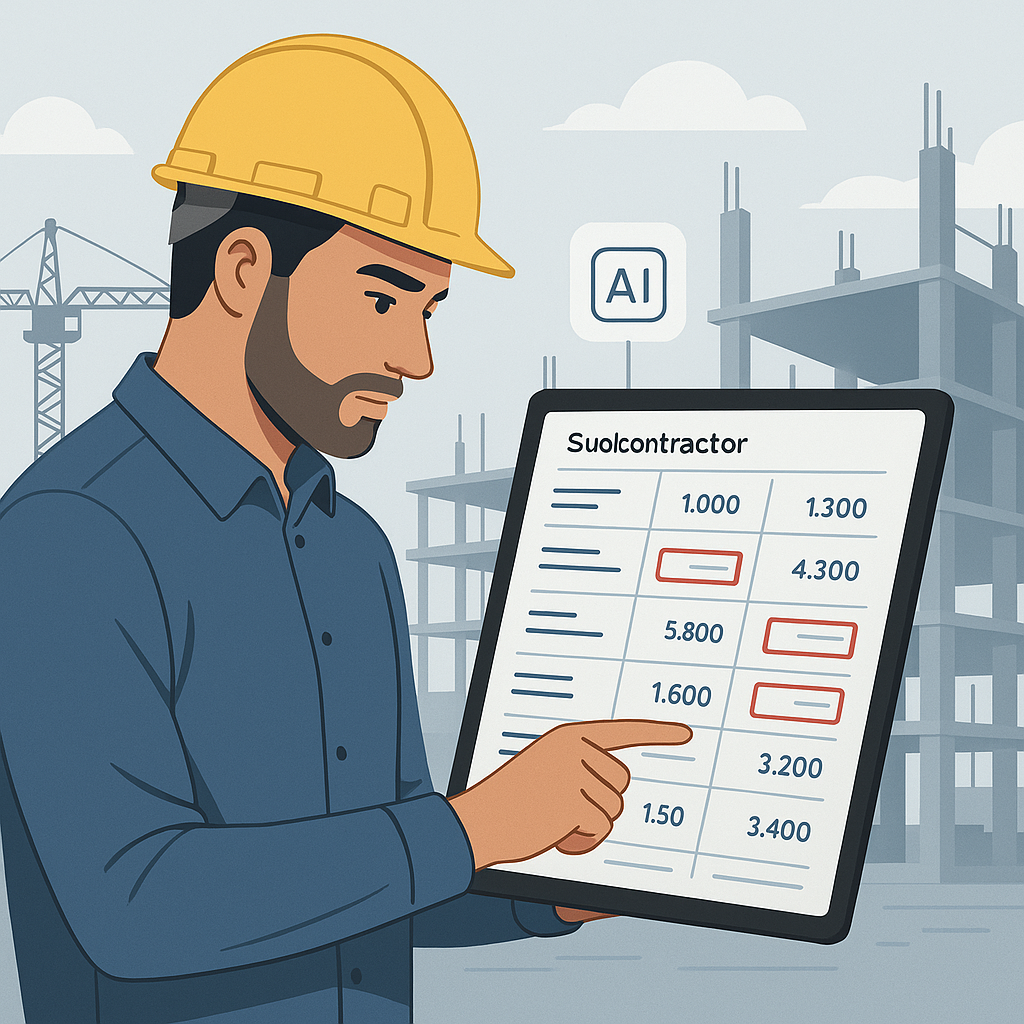
6 Hours to Level Sub Bids? That's 5 Hours Too Many
If you've ever normalized multiple subcontractor bids by hand, you know the grind. You’re cross-referencing scope inclusions, flagging exclusions, and hunting for hidden costs buried in PDF attachments. It’s tedious, error-prone, and—let’s be honest—soul-crushing.
For a typical GC (general contractor), this process takes around 6 hours per bid package. Multiply that by five GMP (Guaranteed Maximum Price) pursuits a year, and you're spending 30 hours annually just to compare apples to oranges. That’s time you don’t have when deadlines are tight and margins are razor-thin.
But here's the kicker: those 6 hours don’t guarantee accuracy. Ever missed a scope gap that came back to bite you post-award? Or worse, awarded to the lowest bidder, only to find out later that their exclusions blew your budget? It happens. A lot.
AI-Powered Sub Bid Leveling: 30 Minutes, Not 6 Hours
This is precisely where AI steps in to save the day. Tools like EstimateNext use AI to normalize 3–7 sub bids in just 30 minutes. How? The platform doesn’t just compare numbers—it parses scope descriptions, detects deviations, flags exclusions, and even ranks bids (L1, L2, L3) with a smart recommendation engine.
Here’s a real-world example: A GC in California tested EstimateNext on a $5M school renovation project. The team saved 5.5 hours on bid leveling and caught a scope exclusion (site prep) that could’ve cost them $120K down the line. That’s not just faster—it’s smarter.
Case Study: Avoiding Disaster on a Hotel Renovation Project
Take another example from a hotel renovation project in Texas. The GC received bids from five subs for electrical work. During manual leveling, a junior estimator overlooked a line item excluding wiring for backup generators. This $90K omission resulted in change orders and delays that ate into project profits. When they later switched to AI-powered bid leveling, the tool flagged similar exclusions on future bids, helping them avoid repeat mistakes.
Why Manual Bid Leveling Fails (Most of the Time)
Let’s break down why the traditional approach is so flawed:
-
Inconsistent Formats: Subs don’t submit quotes in a uniform format. One uses Excel, another sends a PDF, and a third scribbles notes on a scanned BOQ (Bill of Quantities). Reconciling these formats manually is time-consuming and prone to error.
- Example: On a recent $1.2M interior renovation project, one sub submitted a detailed Excel sheet, while another sent handwritten notes scanned into a PDF. The estimator spent hours just converting both into comparable formats before even starting the leveling process.
-
Hidden Costs: Ever seen a sub bury exclusions in the fine print? Happens all the time. Without AI, you’re relying on human eyes to catch these—and humans miss things.
- Data Point: A 2021 study by Dodge Data & Analytics found that 57% of GCs reported scope gaps in awarded bids as the leading cause of unanticipated project costs.
-
Time Pressure: When bids are due in 48 hours, rushing through bid leveling increases the chance of errors. It’s a vicious cycle.
-
Cognitive Bias: We’re wired to favor the lowest number, even when it’s too good to be true. AI tools counteract this by flagging suspiciously low bids as potential risks.
How AI Handles the Hard Parts
AI-powered platforms like EstimateNext automate the grunt work:
-
Scope Parsing: AI reads scope descriptions line by line, highlighting exclusions, inclusions, and discrepancies. For example, if Sub A excludes demolition but Sub B includes it, the platform flags it instantly.
- Actionable Step: Use AI to generate a side-by-side comparison of scope inclusions and exclusions for better visibility.
-
Deviation Detection: Outlier costs (e.g., Sub C’s $180K HVAC bid when others are at $120K) are flagged with a confidence score. You don’t just get numbers—you get context.
-
Ranking and Recommendations: AI ranks bids based on scope completeness, pricing, and historical reliability. It’s not just about the lowest price; it’s about the best value.
-
Audit Trail: Every match, flag, and recommendation comes with an audit trail. If you’re ever questioned on why a certain sub was chosen, you have data to back it up.
Manual Leveling AI-Powered Leveling Requires 6 hours or more per bid package Completes in 30 minutes Relies on human judgment for scope gaps Flags exclusions automatically No audit trail for decisions Full transparency with audit logs
The ROI of Smarter Bid Leveling
Let’s do the math.
- If you’re saving 5.5 hours per bid leveling session and your estimators cost $130/hour, that’s $715 saved per project.
- Multiply that by five GMP pursuits annually, and you’re looking at $3,575 in direct labor savings.
- Factor in avoided scope gaps and change orders, and the ROI becomes even clearer.
For a tool that costs $99/month per seat, the math is brutal—in a good way.
You Might Be Thinking…
“What about small projects? Do I really need AI for those?”
Fair question. AI shines on mid-to-large projects with multiple subs and complex scopes. For a $100K interior fit-out with one or two trades, manual leveling might still cut it. But for anything larger, the time savings alone justify the investment.
“Can I trust AI to catch everything?”
AI isn’t infallible, but it’s far less prone to error than manual processes. Plus, tools like EstimateNext let you review flagged items and override if needed. It’s a safety net—not a black box.
“What if my subs don’t submit clean data?”
AI tools are designed to handle messy inputs. Whether it’s PDFs, Excel files, or handwritten notes, the platform normalizes formats and extracts key data automatically.
“How does AI handle scope revisions?”
Platforms like EstimateNext let you upload revision sets and automatically compare changes, saving hours of rework.
Final Thoughts: Stop Wasting Time
In an industry where every hour counts, spending 6 hours on sub bid leveling is a luxury no GC can afford. AI-powered tools like EstimateNext cut that time by 90%, improve accuracy, and help you avoid costly mistakes. It’s not just about working faster—it’s about working smarter.
If you’re tired of manual bid leveling, EstimateNext can help. Get started free →


