The Hidden Problem Subcontractors Don’t See Coming
Let me guess. You missed another bid deadline because the quote took three days to piece together. Sound familiar? It's not that your pricing was wrong or your scope was off. You just ran out of time.
Here’s the brutal truth: in today’s market, speed matters more than ever. General contractors (GCs) don’t have time to wait for your 72-hour turnaround. By the time your quote hits their inbox, they’ve already moved on. Or worse, awarded the job to someone faster.
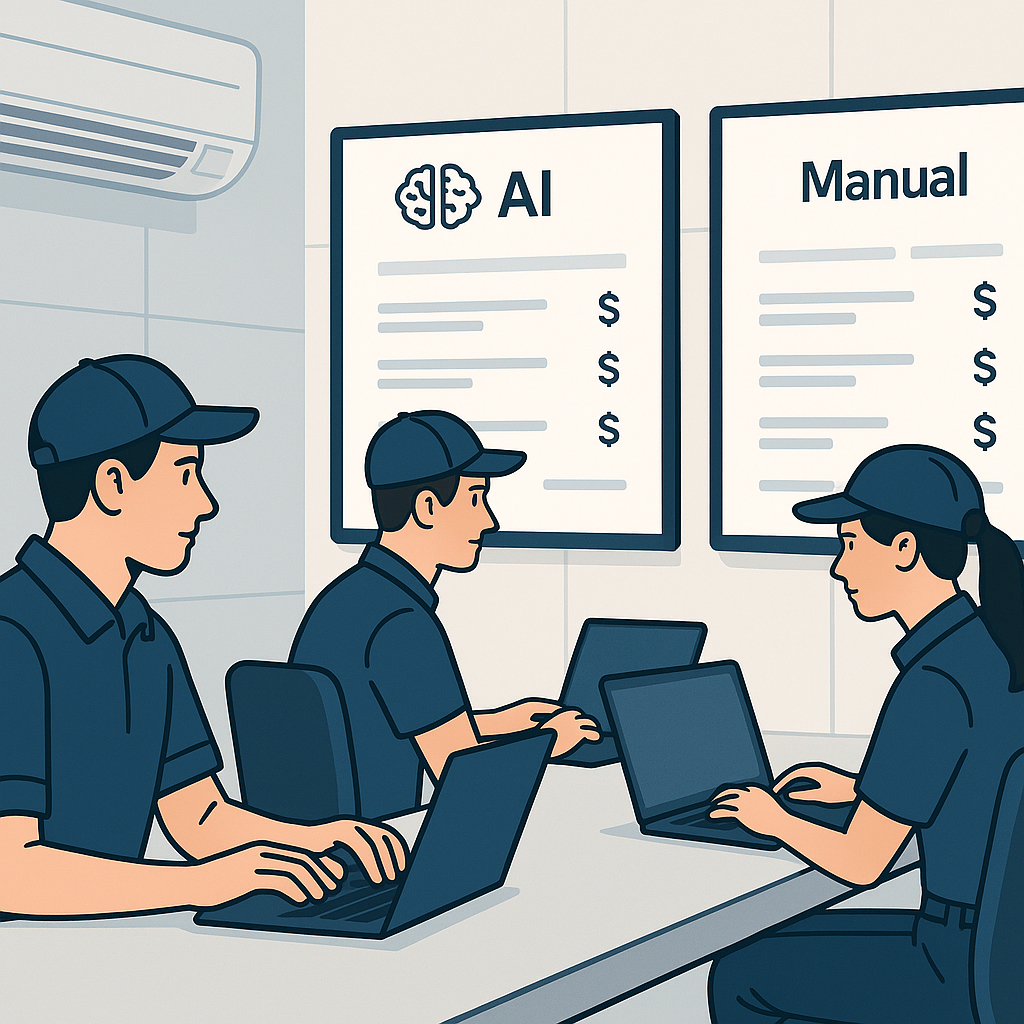
The problem isn’t your team. It’s the tools you’re using. Excel, manual takeoffs, and flipping through rate sheets can’t keep up. That’s where AI-powered preconstruction estimation tools come in.
Case in Point: 4 Hours vs. 72 Hours
Let’s break it down. A typical HVAC subcontractor bidding on a $500,000 tenant improvement project spends:
- 8 hours on takeoffs (measuring duct runs, calculating airflow, sizing registers).
- 16 hours on rate lookups and labor factoring (because every project has nuances).
- 8 hours building the actual quote (pulling it all into a presentable format).
That’s 32 hours—roughly 3 workdays. And that’s assuming no interruptions, no revisions, and no delays.
Now, compare that to AI-powered tools like EstimateNext. With specialist trade modules (HVAC, electrical, plumbing), the same process takes 4 hours:
- Upload the BOQ. Smart parsers handle messy Excel files or PDFs.
- Use the HVAC module to auto-size components and calculate demands.
- Match rates in seconds with AI-driven catalogs (78,000+ items ready to go).
- Generate a professional quote with a few clicks.
That’s an 18X speed improvement. What does that mean for you? Respond to 50% more bids and double your win rate. The math is simple.
Real-World Example: Faster Bids, Higher Wins
Take XYZ Mechanical, a mid-sized HVAC subcontractor. Before adopting AI tools, they were submitting 20 bids per month and winning just 4. After switching to EstimateNext, they increased their bids to 35 per month and now win 10. That’s a 150% increase in revenue opportunities—all because they shaved down their bid prep time.
What’s Slowing You Down?
Still not convinced? Let’s unpack the bottlenecks:
-
Manual Takeoffs: Drawing takeoffs with a scale ruler or even Bluebeam takes forever. Vision AI can extract quantities (duct lengths, register counts) directly from PDF drawings in minutes.
- Example: A plumbing subcontractor used to spend 6 hours manually counting fixtures for a large hotel project. With AI, they completed it in under 30 minutes.
-
Rate Lookups: If you’re flipping through SMACNA or NECA tables, you’re wasting hours. AI tools match rates instantly. No more guesswork.
- Case Study: An electrical subcontractor uploaded custom labor rates into an AI system and cut rate lookups by 85%.
-
Scope Gaps: Ever lose a bid because the GC said your quote wasn’t “complete”? AI-powered sub bid leveling ensures nothing is missed. It cross-references the BOQ with your quote for scope accuracy.
-
Formatting: GCs won’t accept a sloppy Excel sheet. AI tools automatically produce clean, professional bid packages in industry-standard formats.
- Comparison: Subcontractor A submits a detailed, polished bid in PDF format. Subcontractor B sends a basic Excel sheet without notes. Who do you think wins?
The Cost of Staying Manual
Let’s talk dollars. Missing one bid might not seem like a big deal, but multiply that by 10 or 15 a year. If your average win is $200,000, losing five bids means you’re leaving $1 million on the table.
And that’s just lost revenue. Factor in the wasted labor:
- 32 hours per quote x 30 bids/year = 960 hours.
- 960 hours x $50/hr = $48,000/year spent on manual estimation.
The alternative? AI-powered tools like EstimateNext cost $39 to $99 per user per month. That’s $1,188/year to save $48,000. A no-brainer.
Hard Numbers: How AI Pays for Itself
Let’s say you pay $99/month for an AI estimation tool. That’s $1,188/year. If it saves you 28 hours per bid and you bid 30 times a year, that’s $42,000 in labor savings. Add in the revenue from winning even five extra bids annually, and you’re looking at a total ROI of over $200,000.
Objections: “But AI Can’t Do My Job”
You might be thinking, “Sure, AI is fast, but it doesn’t understand the nuances of HVAC systems.” Fair point. AI isn’t perfect. It’s not going to magically know what duct material you prefer for Class A office spaces.
But here’s the thing: it doesn’t have to. AI takes care of the grunt work—takeoffs, rate matching, formatting—so you can focus on what you do best: applying your expertise.
And if you’re worried about accuracy, tools like EstimateNext include confidence scoring and manual override options. You’re still in control.
Myth-Busting: AI Isn’t Replacing Your Expertise
- Myth: AI will make estimators obsolete.
- Reality: AI works best as a complement to human expertise. It automates the repetitive tasks while leaving strategic decision-making to you.
The Bigger Picture: Why Speed Wins
GCs are under pressure to deliver tighter bids faster. That pressure trickles down to you. If you’re still spending 3 days on quotes while your competitors are turning them around in 4 hours, you’re out of the game.
Competitive Advantage: Faster Turnaround
Imagine this scenario: A GC needs three quotes for a $1 million project. Subcontractor A submits their bid within 24 hours. Subcontractors B and C take 3 days. Subcontractor A not only wins the job but also builds trust with the GC for future opportunities.
AI doesn’t just make you faster—it makes you more competitive. It’s not about replacing your team. It’s about enabling them to do more with less.
Ready to Stop Losing Bids?
If you’re tired of scrambling to meet deadlines and watching jobs slip through your fingers, it’s time to try something new. Tools like EstimateNext are designed to help subcontractors like you bid faster, smarter, and with less stress.
FAQ: What Subcontractors Need to Know About AI
Q1: Is AI reliable for custom rates?
Yes. You can upload your own rate catalogs or define project-specific rates. The system learns from your inputs over time.
Q2: Can I integrate AI tools with my current software?
Most AI platforms, including EstimateNext, integrate seamlessly with tools like Procore, Bluebeam, and Excel.
Q3: What if my drawings are messy?
AI tools handle messy PDFs, scanned documents, and even revision sets. Confidence scoring highlights low-confidence areas for manual review.
Q4: How long does it take to train my team?
Most users get the hang of it in under two weeks. The interfaces are designed to be intuitive.
Q5: What’s the ROI?
For an HVAC subcontractor, saving 28 hours per bid x $50/hr = $1,400 saved per bid. Multiply that by 30 bids/year and you’re looking at $42,000 in labor savings alone.
Decision Framework: Should You Adopt AI Estimation Tools?
| Factor | Manual Process | AI-Powered Tools |
|---|---|---|
| Speed | 32 hours per bid | 4 hours per bid |
| Accuracy | Prone to scope gaps | Automated scope checks |
| Cost | $48,000/year labor | $1,188/year subscription |
| Scalability | Limited capacity | Bid 50% more projects |
| Presentation Quality | Basic Excel sheets | Polished, industry-standard |
If you’re spending more time, money, and effort on bids than your competitors, it’s time to make the switch.


