The Problem: Time Wasted on Takeoffs
Let’s be honest—manual drawing takeoffs are a time sink. Two estimators spend two full days tracing lines, counting quantities, and cross-checking measurements. That’s 40 hours you could’ve spent sharpening the bid strategy or negotiating better subcontracts.
Here’s the kicker: 40 hours is just for takeoffs. Add rate lookup and bid package prep, and you’re looking at 60–80 hours per project. The math gets brutal, especially when you’re juggling multiple active pursuits.
A Real-World Breakdown
Take a mid-sized general contractor (GC) working on a single high-rise project. If you’re paying two estimators $130/hour, that’s $5,200 sunk into labor—just for takeoffs. Now multiply that by five simultaneous bids. You’re looking at $26,000 tied up in pre-construction costs with no guarantee of winning all five pursuits.
For subcontractors, the strain is even worse. An MEP subcontractor responding to 20 bids per month might spend 72 hours per bid, costing $9,360 in labor just to stay competitive. Factor in volatile material prices and razor-thin margins, and time wasted on manual processes becomes a fast track to unprofitability.
Why This Matters Now
Margins are razor-thin in 2026. Inflation, labor shortages, and volatile material costs are crushing profits. According to a recent McKinsey report, early adopters of AI in construction estimation see 10–20% savings per project. That’s the kind of edge you need to win bids and stay profitable.
Additionally, the construction industry is facing a talent crunch. Experienced estimators are retiring, and younger professionals lack the training to perform manual takeoffs efficiently. Automation isn’t just a nice-to-have; it’s quickly becoming essential for survival.
The Solution: AI-Powered Takeoffs
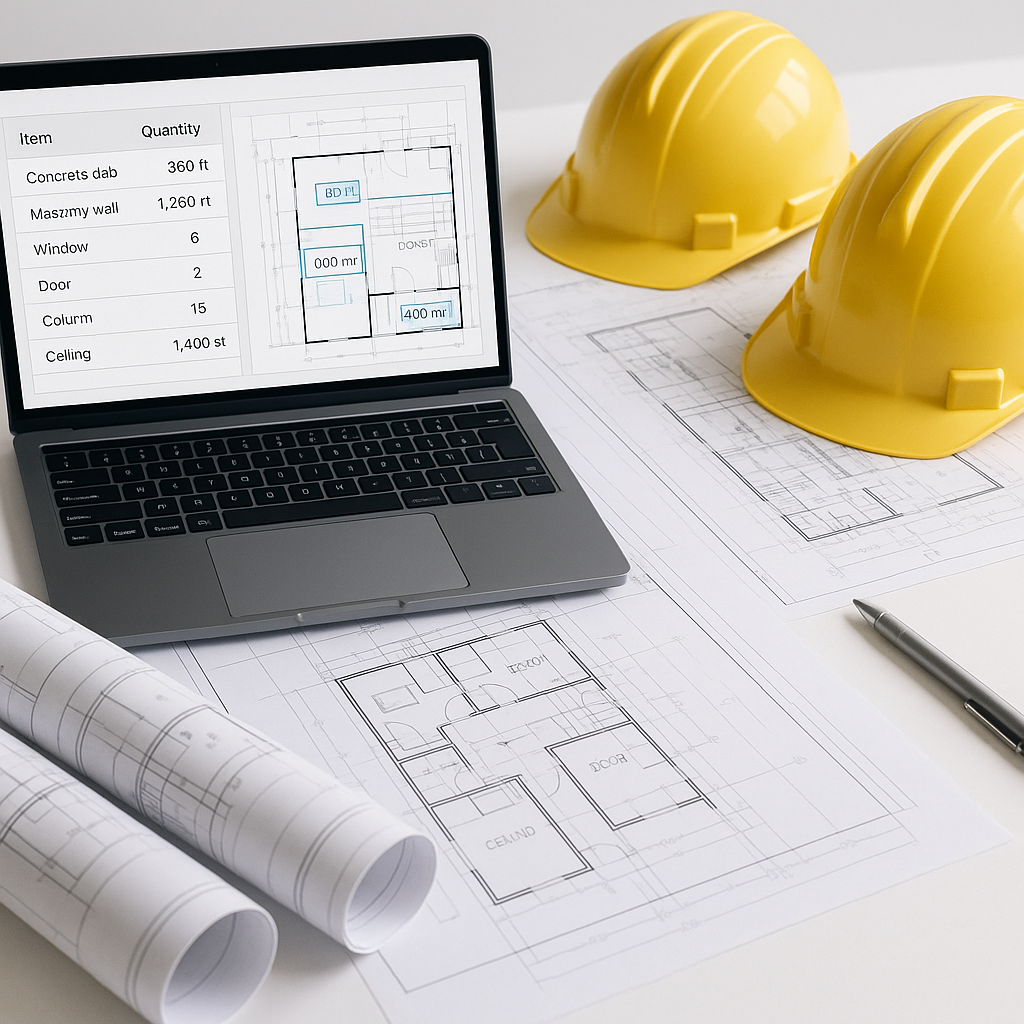
This is where tools like EstimateNext come in. Their Vision AI eliminates manual takeoffs entirely. You upload a PDF, and in 10 minutes, you’ve got quantities for concrete columns, beams, wall areas—you name it.
Think about the implications. Instead of spending two days on takeoffs, you’re done before lunch. That’s not just time saved; it’s flexibility gained. You can respond to more bids, iterate faster, and focus on the work that actually wins projects.
Real-World Example: A Mid-Sized GC
Take the case of a mid-sized general contractor bidding on a high-rise project. Using Vision AI, they cut takeoff time from 40 hours to just 10 minutes. That’s 120 labor hours saved across three estimators—two weeks of payroll avoided. In their own words: “It’s like hiring a full-time estimator without the overhead.”
Subcontractor Case Study
An MEP subcontractor in Chicago adopted EstimateNext for their bid processes. Before AI, they averaged four bid responses per week due to time-consuming manual takeoffs. After implementing Vision AI, they increased their bid capacity to 10 responses per week, doubling their opportunities without increasing headcount. In a single year, they won 15% more contracts, leading to a $1.2 million revenue boost.
How It Works
- Upload Your Drawings: Drag-and-drop your PDFs into the platform.
- AI Extraction: Vision AI scans the drawings, identifies quantities, and flags any low-confidence areas for review.
- Review and Export: Double-check flagged items, then export directly to your BOQ or estimating software.
It’s seamless, intuitive, and designed for speed. Plus, it integrates with tools like Bluebeam and Procore, so it fits right into your existing workflow.
Actionable Steps to Get Started
- Step 1: Audit your current takeoff process. How many hours are you spending, and what’s the cost?
- Step 2: Trial an AI tool like EstimateNext. Most providers offer free demos or trials.
- Step 3: Train your team. AI tools like Vision AI are intuitive, but ensuring your staff is comfortable with the platform will maximize ROI.
- Step 4: Integrate your rate catalogs and standards. Whether you’re using CSI codes or regional formats like CPWD, customizing the AI to match your workflow ensures accuracy.
The Obvious Objection: “AI Can’t Think Like an Estimator”
You might be thinking, “Sure, AI is fast, but it doesn’t understand the nuances of construction.” And you’re partially right. AI doesn’t replace your expertise; it amplifies it.
The AI handles grunt work—takeoffs, rate matching, what-if recalculations—so you can focus on strategy. You’re still the one making judgment calls, negotiating with subs, and deciding on markup. The AI just clears the deck.
A Helpful Comparison: AI vs. Manual Takeoffs
| Feature | Manual Takeoffs | AI-Powered Takeoffs |
|---|---|---|
| Time Required | 40–80 hours per project | 10–30 minutes per project |
| Accuracy | Prone to human error | Confidence scoring ensures precision |
| Scalability | Limited by labor capacity | Unlimited, based on project volume |
| Cost | High labor cost | Subscription-based pricing |
| Flexibility | Fixed workflows | Customizable to markets and standards |
The ROI Math
Let’s break it down:
- GC Director: Saving 40 hours/estimate at $130/hour = $5,200 saved per pursuit.
- MEP Subcontractor: Cutting quote turnaround from 72 hours to 4 hours = 50% more bids responded to.
- India QS: 200+ hours saved/year, 100X cheaper than CostX.
No matter your role, the ROI is compelling. Faster estimates mean more bids. More bids mean more wins. And that’s what drives profitability.
Long-Term Benefits
AI takeoffs don’t just save time; they create scalability. With manual processes, your capacity is limited by team size. AI allows you to handle more bids simultaneously, adapt to fluctuating workloads, and reduce your dependency on labor during crunch periods.
Call to Action
If you’re tired of wasting 40 hours on manual takeoffs, EstimateNext can help. Their Vision AI cuts takeoff time to just 10 minutes, saving you weeks of labor per project. Plus, it integrates seamlessly into your workflow. Get started free →


