The Pain of Manual Rate Lookups
If you’ve ever priced a bid using RSMeans or a CPWD DSR catalog, you know the drill. Thousands of pages, inconsistent categories, and hours spent flipping back and forth to find the right rate for a single line item. It’s tedious, error-prone, and just plain unnecessary in 2023.
Here’s the problem: rate lookup isn’t just about speed. It’s about accuracy. Use the wrong rate—especially for large quantities—and you could be underpricing by tens of thousands of dollars. Or worse, pricing yourself out of a competitive bid.
Still, we see estimators repeating this process every day. Why? Because the tools they’re using weren’t built for today’s pace. Excel sheets and rate manuals are fine until you hit scale. After that, they buckle.
A Real-World Example of Manual Lookups Gone Wrong
Take the case of a mid-size construction firm bidding on a $50 million mixed-use development. They relied on manual rate lookups for key line items, such as labor rates and material costs for reinforced concrete. A single miscalculation—caused by referencing an outdated rate—resulted in a $120,000 shortfall in their bid. They won the project, but the error ate into their already thin margins, turning the job into a financial headache rather than a success story.
How AI-Powered Rate Matching Fixes This
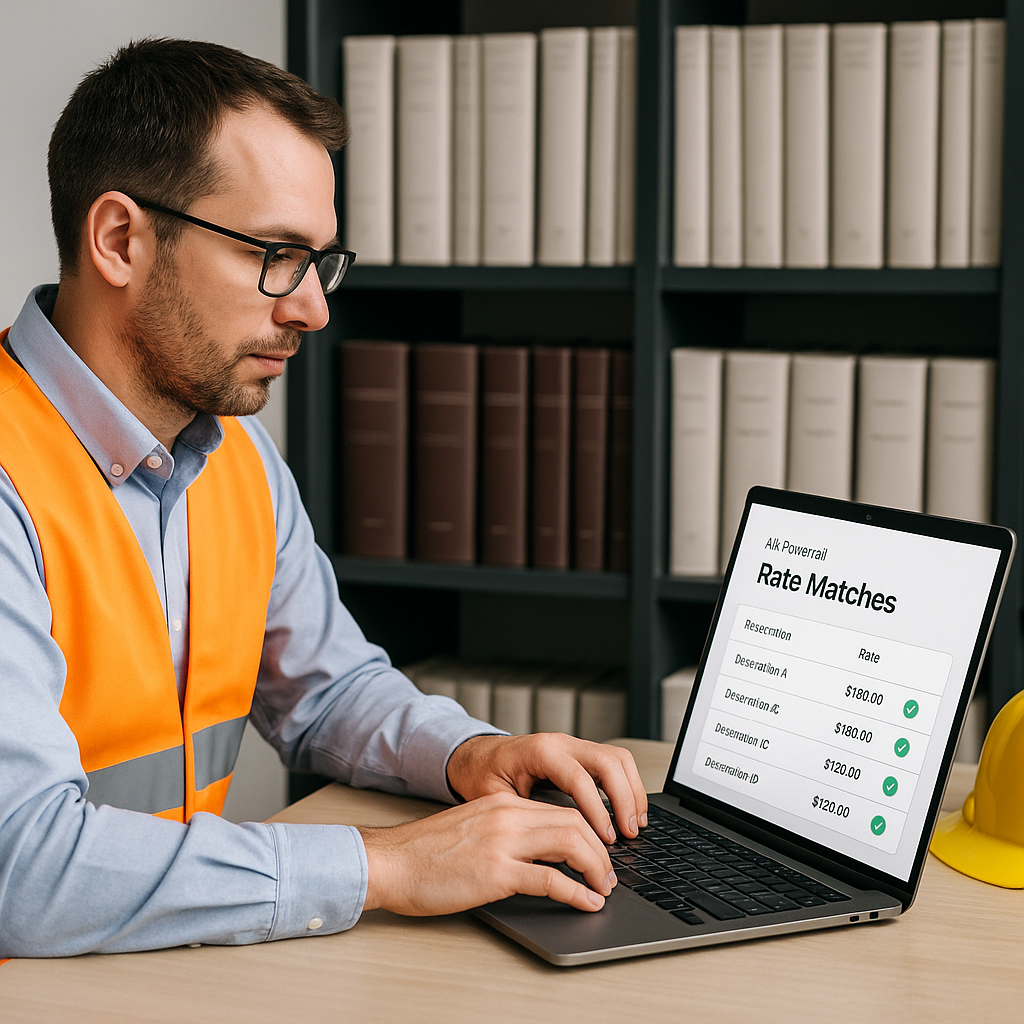
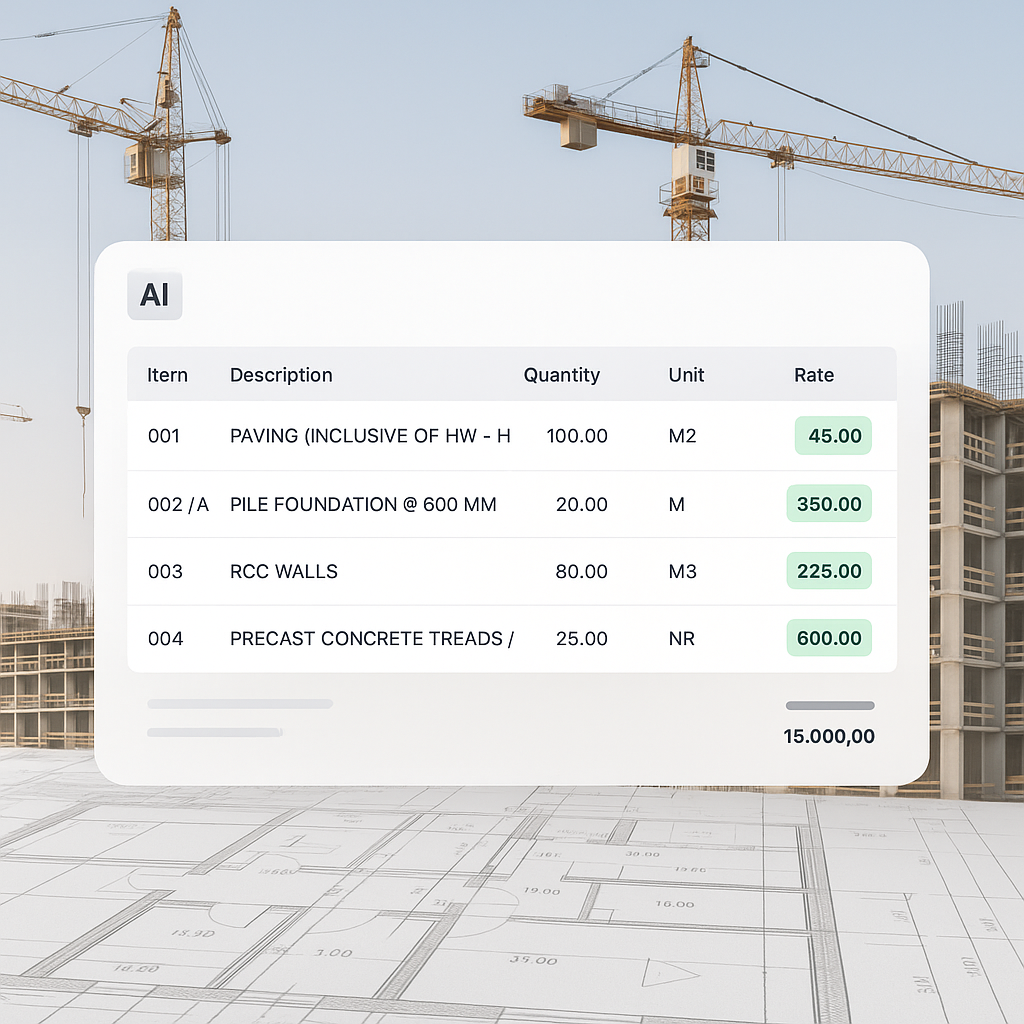
AI changes the game by automating the grunt work. Let’s take EstimateNext as an example. Their platform uses a semantic search engine across 78,000+ Schedule of Rates (SOR) items. Need the labor cost for installing pre-stressed concrete girders? Type it in. You’ll get a match in seconds, complete with material, labor, and equipment breakdowns.
The real magic? AI learns as you use it. Say you’ve got a custom rate for a specific material. Upload it once, and the system integrates it into future estimates. By the third project, most users report significant accuracy improvements—because the platform adapts to your habits.
Actionable Steps to Implement AI Rate Matching:
- Audit Your Current Process: Identify the most time-consuming or error-prone parts of your rate lookup process.
- Choose a Platform: Look for tools like EstimateNext that support custom rate uploads, semantic search, and integrations with your existing systems (e.g., Procore or Bluebeam).
- Train Your Team: Spend time upfront training your estimators on the tool. Most users report that platforms like these have a low learning curve, often under two weeks.
- Iterate and Improve: Use the AI’s feedback loop to continuously refine your rate database and improve future performance.
Real-World Impact: A $1B Rail Project Case Study
A mid-sized general contractor recently used EstimateNext on a $1 billion rail bridge bid. With traditional methods, their team spent 12 hours per estimate just flipping through rate books. AI slashed that to under 10 minutes. Over the course of three months, they saved 356 hours across six bids—time that went toward refining scopes and improving bid accuracy.
The payoff? They won two high-margin projects they wouldn’t have had time to pursue otherwise. By reducing time spent on repetitive tasks, they reallocated resources to focus on strategic decisions, ultimately increasing their win rate by 15%.
Additional Case Study: Regional Builder Adopts AI in Residential Construction
A regional builder in the southeastern U.S. adopted AI-powered rate matching to manage bids for custom residential projects. Before implementing AI, the team spent approximately 20% of their time cross-referencing material and labor costs. Within six months, AI had cut that time in half, freeing up the team to bid on 30% more projects. Their win rate increased by 10%, and they reduced bid errors by 25%, eliminating costly rework.
The Obvious Objection: “But AI Can’t Think Like an Estimator”
You’re right. AI doesn’t replace your judgment. It doesn’t know your local subs or how to negotiate. But it amplifies what you can do. It handles the repetitive, mechanical tasks so you can focus on the decisions that actually win bids.
It’s like hiring an assistant who never sleeps. Sure, you’ll still need to review the outputs—but now you’re starting from 90% done, not 0%.
Human-AI Collaboration in Action
Consider this scenario: An estimator working on a hospital project needs rates for specialized HVAC systems. The AI provides a base cost derived from catalog data. The estimator then adjusts for local labor rates and supplier quotes. The result? Faster, more accurate estimates that reflect real-world conditions.
The ROI: Why It’s a No-Brainer
Let’s talk numbers. An average estimator earns $130/hour (fully loaded). If rate lookups take 12 hours per estimate, that’s $1,560 in labor costs per project. With AI, those 12 hours shrink to minutes. Multiply that by the five to eight GMP pursuits a GC typically handles per year, and you’re looking at $62,400 in annual savings for just one estimator.
And that’s before you factor in the bids you didn’t have time to chase—or the errors you avoided.
Expanded ROI Example
For a firm with a team of five estimators, the potential savings climb to over $300,000 annually. Add the increased accuracy, reduced rework, and higher win rates, and the investment in AI tools often pays for itself within the first year.
What If Your Rates Are Custom?
This is a common concern. Not every project fits neatly into a predefined catalog. Custom materials, regional variations, and client-specific specs all complicate the process.
Good AI platforms solve this by letting you upload your own rate books or define project-specific rates. Once uploaded, these rates become part of the system’s searchable database. And because AI retains context, it can suggest matches even when the terminology doesn’t line up perfectly.
For example, if your catalog calls it “lightweight aggregate concrete” but the BOQ says “LWA concrete,” the AI still knows they’re the same. No more manual cross-referencing.
Why Now?
Construction margins are thinner than ever, hovering around 5% globally according to McKinsey. Inflation and supply chain issues have only compounded the pressure. Every dollar counts. Every hour saved matters.
AI-powered tools like EstimateNext aren’t just nice-to-haves anymore. They’re survival tools. In a market where bids are won or lost on razor-thin differences, being faster and more accurate isn’t optional. It’s the price of staying competitive.
FAQ
1. How accurate are AI-powered rate matches compared to manual lookups?
AI tools like EstimateNext are highly accurate, often reducing errors by up to 80%. However, the accuracy depends on the quality of your input data—so a quick review is always recommended.
2. Can I use AI tools with existing software like Procore or Bluebeam?
Yes. Most AI platforms, including EstimateNext, integrate seamlessly with popular preconstruction tools. You can export estimates directly into your existing workflows.
3. What happens if the AI doesn’t find a match?
If there’s no direct match in the catalog, the system defaults to a hierarchy: tenant history, user-defined rates, country-level matches, and finally AI-driven suggestions. You can also manually override and save your choice for future use.
4. Is it worth the learning curve?
Absolutely. Most users report being fully comfortable with the platform within two weeks. The time savings after that make the initial effort well worth it.
5. Can AI handle regional rate variations?
Yes. By allowing users to upload custom rate books and account for regional specifics, AI platforms can adapt to local conditions and provide highly contextual results.
Decision Framework: Manual vs. AI Rate Matching
| Feature/Factor | Manual Rate Matching | AI-Powered Rate Matching |
|---|---|---|
| Time Required per Lookup | Hours | Minutes |
| Error Rate | High | Low (up to 80% reduction) |
| Scalability | Poor | Excellent |
| Adaptability to Custom Rates | Manual adjustments required | Seamless integration |
| Cost Savings | None | Significant |
Call to Action
If you’re tired of wasting hours on manual rate lookups, EstimateNext can help. Get started free →