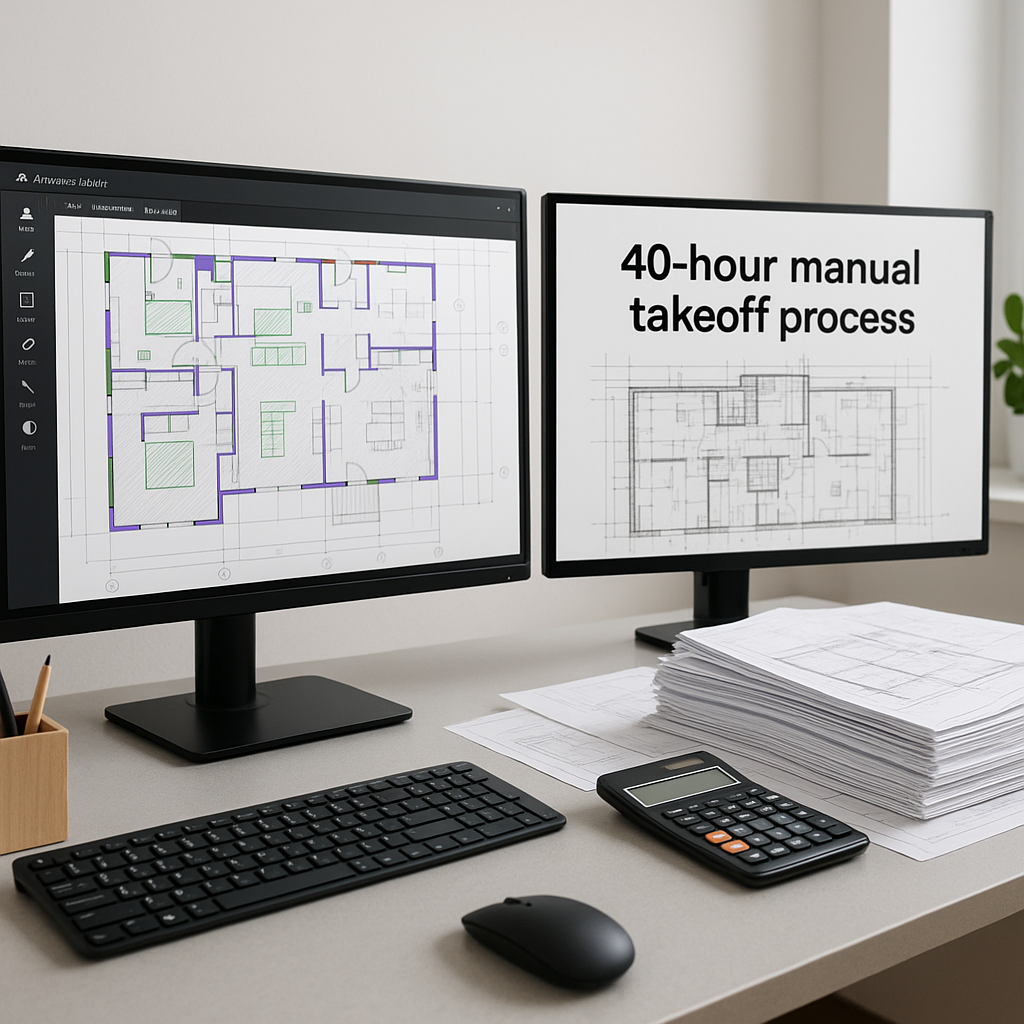
The Reality of Manual Takeoffs: 40 Hours You’ll Never Get Back
Every estimator knows this grind. You get a 200-page drawing set, crack open your favorite measurement tool, and spend the next 40 hours tracing walls, counting doors, and rechecking every dimension. Two estimators. Two full days. For one bid.
And here’s the kicker: after all that time, you’re still not 100% confident it’s accurate. Maybe you missed a revised drawing or scaled something wrong. The problem isn’t you; it’s the process. Manual takeoffs are slow, error-prone, and frankly, outdated.
Real-World Example: The 40-Hour Problem
A medium-sized general contractor (GC) bidding on a $20 million medical office building shared that their team of two estimators spent 38 hours completing the manual takeoff for the project. Despite their effort, they had to recheck their work twice after discovering that a drawing revision had been overlooked. This delay pushed their bid submission dangerously close to the deadline, with no time left for strategic pricing adjustments. This is a common scenario in the construction world, and the costs of such inefficiencies go beyond just lost time—they can hurt your bottom line.
The AI Alternative: 10 Minutes to Extract Quantities
AI-powered tools like EstimateNext are flipping this workflow on its head. Their Vision AI can scan a drawing set, extract quantities, and generate a takeoff in 10 minutes. That’s not marketing fluff—it’s real. Case in point, a mid-sized GC recently saved 120 hours on a high-rise bid by automating their takeoff process. Source: EstimateNext case study
Take another example: a subcontractor specializing in drywall installations used AI to process a 150-page drawing set in under 15 minutes. They reported a 95% accuracy rate on the initial output, which required only minor adjustments. Compare this to the 25 hours they would have spent doing the same task manually.
How It Works
AI takeoff tools work by analyzing digital blueprints or PDFs directly. Using machine learning models trained to recognize architectural symbols, scales, and annotations, the tools extract quantities like linear footage, square footage, and counts for specific items like doors or windows. The system flags any low-confidence areas for human review, ensuring that no critical details are missed.
Why Speed Isn’t the Only Win
Sure, cutting your takeoff time from 40 hours to 10 minutes is a game-changer. But the benefits go deeper:
1. Fewer Errors
AI tools don’t "forget" to include a revision or accidentally click the wrong scale. They work with precision and consistency. For example, a roofing contractor shared that transitioning to an AI-based takeoff tool reduced their errors by 30%, eliminating costly change orders caused by missed measurements.
2. More Bids
If your team saves 30+ hours per bid, that’s more time to respond to additional RFPs. More bids = more chances to win. A recent survey by Dodge Data & Analytics found that contractors who adopted preconstruction technology were 25% more likely to bid on additional projects.
3. Better Margins
Faster takeoffs free up senior estimators to focus on value engineering, subcontractor negotiations, and strategic pricing. These are the tasks that actually impact your bottom line. For instance, a mechanical contractor used their time savings to negotiate supplier pricing more effectively, resulting in a 5% reduction in material costs for a $5 million project.
The Skeptic’s Objection: “AI Can’t Think Like an Estimator”
I hear this all the time. And you’re right—AI doesn’t have your judgment or experience. But that’s not the point. AI handles the grunt work, so you can stay focused on high-value decisions. Think of it like hiring a junior estimator who works 24/7 without complaints or mistakes.
Human + AI: A Winning Combination
Human oversight is still essential. You’ll need to review the AI-generated takeoff, approve adjustments, and make the final call on scope. But let’s be honest, do you really want to spend your day counting door frames?
How to Get Started Without Overhauling Everything
Switching to AI doesn’t mean ditching your current tools. Platforms like EstimateNext integrate with Bluebeam, Procore, and Excel, so you can export takeoffs directly into your existing workflow. Here’s how to get started:
1. Start Small
Pilot the tool on a single project. Choose a relatively straightforward bid to test the learning curve and accuracy.
2. Train Your Team
Most AI platforms are designed to be user-friendly, but a short training session (often less than two weeks) can ensure your team is confident.
3. Measure Results
Track time savings, error reductions, and overall efficiency improvements. Compare these metrics to your manual process to calculate ROI.
4. Scale Up
Once you’ve seen the benefits on smaller projects, expand usage to more complex bids or across multiple teams.
The ROI You Can’t Ignore
Let’s talk numbers. If you’re a GC preconstruction director, your team’s hourly rate is probably around $130. Saving 40 hours on a single bid means $5,200 in labor costs avoided. Multiply that across 5-8 GMP pursuits annually, and you’re looking at $26K-$41K in savings. All for a tool that costs $99/month.
ROI for Subcontractors
For subcontractors, the math is even better. Faster takeoffs mean 50% more bids submitted, leading to 4-8 additional wins per year. At an average job size of $200K, that’s $800K-$1.6M in incremental revenue. The upfront cost of the software pales in comparison.
Decision Framework: Is AI Right for Your Team?
| Factor | Manual Takeoffs | AI-Powered Takeoffs |
|---|---|---|
| Time per takeoff | 30-40 hours | 10-15 minutes |
| Accuracy | Prone to human error | High, with flagged reviews |
| Scalability | Limited by human capacity | Scalable to any project size |
| Cost | High labor costs | Low software subscription |
| Learning Curve | None | Minimal (< 2 weeks) |
Final Thoughts
If you’re still burning 40 hours on manual takeoffs, it’s time to rethink your approach. AI-powered tools like EstimateNext don’t just save time—they unlock your team’s potential to bid more, win more, and focus on what really matters.


