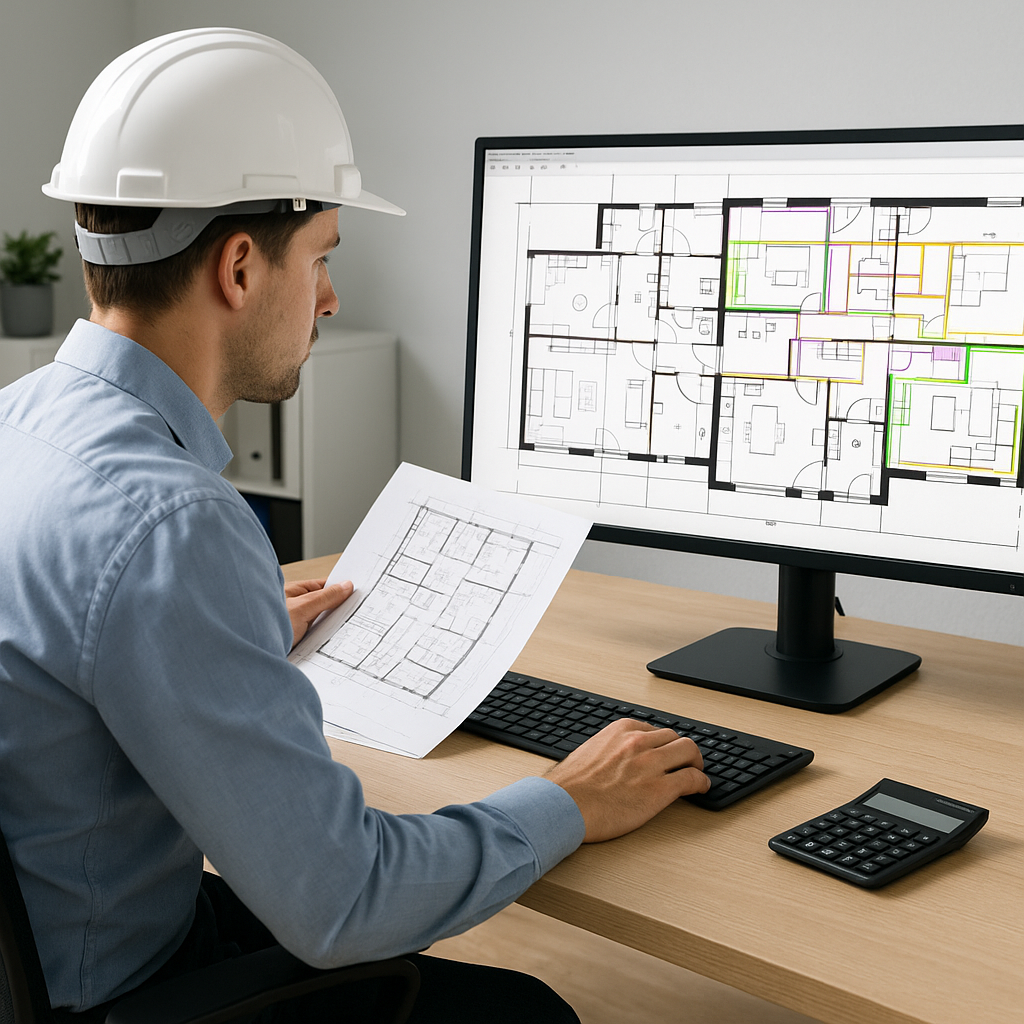
The Problem: Manual Takeoffs Are a Time Sink
If you've ever done a manual drawing takeoff, you know the drill. Two estimators spend two full days flipping through PDFs, measuring room areas, counting fixtures, and rechecking their work. It's tedious, error-prone, and flat-out expensive. On average, it takes 40 hours to complete a takeoff manually.
Takeoffs are the backbone of accurate construction estimates, but they often act as bottlenecks. Consider this: a mid-sized general contractor (GC) juggling five GMP pursuits simultaneously could easily spend 200 hours just on takeoffs. That’s five full weeks of labor dedicated to one task. And what happens when the bid deadline is tomorrow and you’re still stuck on takeoffs? That’s where AI-powered tools come in.
The Solution: Vision AI for Takeoffs
EstimateNext’s Vision AI changes the game. Instead of spending 40 hours on manual takeoffs, Vision AI extracts quantities in just 10 minutes. And it works with any PDF or drawing set — no expensive CAD files required.
Case Study: High-Rise Bid Saved 120 Hours
Take the example of a mid-sized GC bidding on a high-rise project. Using Vision AI, they completed their takeoffs in record time—120 hours faster than their traditional method. That’s two full weeks of labor costs avoided. In their words: “It’s like hiring a full-time estimator without the overhead.”
Case Study: Residential Contractor Scaling Efforts
A residential contractor running small-scale projects shared a similar success story. With Vision AI, they completed five simultaneous bids in less time than it previously took to finish one. The reduction in takeoff time allowed them to focus on client relationships and subcontractor negotiations. Source: EstimateNext Blog
What Makes It Work?
Speed
Vision AI processes drawings 10X faster than manual methods. It reads room areas, wall lengths, and fixture counts directly from PDFs. For example, a $1 billion rail bridge project that would typically take weeks for takeoffs was completed in just hours thanks to Vision AI’s speed and scalability.
Accuracy
AI tools reduce takeoff discrepancies by up to 80%. Unlike manual methods, Vision AI uses confidence scoring to flag low-certainty measurements so estimators can review them. This hybrid approach ensures both speed and accuracy.
Ease of Use
You don’t need to be a tech wizard to use Vision AI. Training typically takes under two weeks, and the interface is intuitive. If you can use tools like Bluebeam or Procore, you’ll feel right at home.
Scalability
Whether you’re working on a $1 million renovation or a $1 billion infrastructure project, Vision AI adapts to your needs. Its tools are especially effective on large bids where even minor takeoff errors can snowball into major cost overruns. Source: EstimateNext Blog
Real Impact: Time Is Money
Let’s crunch the numbers. A GC preconstruction director earns about $130/hour. Saving 40 hours per project translates to $5,200 saved—per bid. Multiply that by five GMP pursuits a year, and you’re looking at $26,000 in labor savings. Source: McKinsey Report
But the benefits don’t stop at labor savings. Consider the ripple effects:
- More Bids: With reclaimed time, you can pursue more projects.
- Improved Negotiations: Spend more time analyzing subcontractor bids and negotiating rates.
- Internal Process Improvements: Streamline workflows and reduce bottlenecks in your preconstruction department.
Concrete Example: Scaling Efficiency
A GC that traditionally handled five bids annually was able to scale up to 12 bids using Vision AI. The tool didn’t just save time—it unlocked growth opportunities that would have been impossible with manual methods.
The Obvious Objection: “AI Can’t Think Like an Estimator”
It’s true—AI doesn’t replace your expertise. It won’t make judgment calls or negotiate with subs. But it handles the grunt work: takeoffs, rate matching, and what-if recalculations.
Example: Human-AI Collaboration
Think of it like this: AI clears the deck so you can focus on steering the ship. For example, an estimator working on a complex healthcare facility used Vision AI for the initial takeoffs. The saved time allowed them to dedicate more effort to value engineering and subcontractor coordination, ultimately reducing project costs by 5%.
Edge Cases: What If My Project Is Complex?
You might be wondering, “Does this work for my $1 billion rail bridge or $1 million renovation?” Absolutely. AI tools scale to any project size. They’re especially effective on larger bids where minor takeoff errors can snowball into major cost overruns.
Comparison: Manual vs AI Takeoffs
| Metric | Manual Takeoffs | AI-Powered Takeoffs |
|---|---|---|
| Time per Project | ~40 hours | ~10 minutes |
| Accuracy | Prone to 20-30% errors | Up to 80% error reduction |
| Cost per Project (Labor) | $5,200 (at $130/hour) | $150-$300 (software cost) |
| Scalability | Limited to team capacity | Unlimited |
| Integration | Manual export/import | Seamless API integrations |
Call to Action
If you're tired of wasting 40 hours on manual takeoffs, EstimateNext can help. Its Vision AI cuts that to just 10 minutes. Get started free →


