Why Rate Matching Is Your Real Estimation Bottleneck
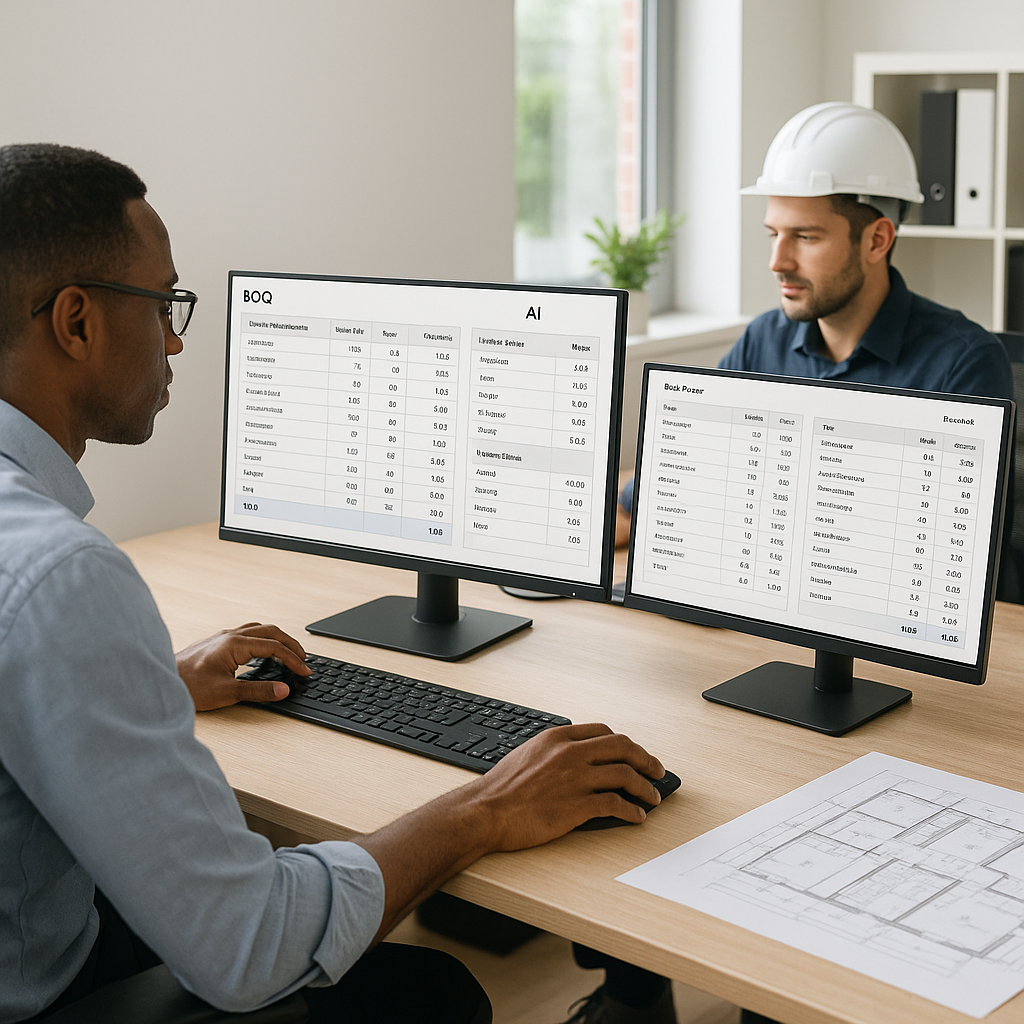
Let’s be honest: preconstruction estimation is often a mess. You’ve got hundreds, sometimes thousands, of BOQ (Bill of Quantities) line items to price. And unless you’re just winging it (which we’ve all been guilty of at some point), every one of those items needs to be matched to a rate. Labor, materials, equipment—it all has to be accurate, or you’re eating into your margins.
Here’s the problem: traditional rate matching is painfully slow. In my experience, flipping through 2,000-page rate books like RSMeans or CPWD DSR can eat up an entire day, sometimes two. Multiply that by five GMP pursuits a year, and you’ve burned two full weeks just finding rates. That’s brutal math.
But it’s not just about speed. Manual rate lookup introduces errors. Ever matched a rate for a reinforced concrete column only to realize later it was for the wrong grade? That mistake can cost tens of thousands—and good luck explaining it to your boss.
The AI Fix: Semantic Search Across 78,000+ SOR Items
This is where AI-powered tools like EstimateNext change the game. Instead of flipping through PDFs or struggling with Excel formulas, you type in what you need—say, “install pre-stressed concrete girders.” The AI pulls a match in seconds from its database of 78,000+ SOR (Schedule of Rates) items, including CPWD DSR, RSMeans, and other catalogs.
Why Semantic Search Matters
Unlike traditional keyword searches, semantic search understands context. For example, if your BOQ calls it a “column with 40 MPa compressive strength,” the AI knows to look for rates under “high-strength reinforced concrete.” It doesn’t just match words; it matches meaning. This reduces the risk of human error, like selecting the wrong grade or specification.
Real-World Impact
EstimateNext conducted a case study showing that estimators saved 12 hours per bid just on rate matching alone. Across five GMP pursuits a year, that’s 60 hours saved—or $7,800 annually, assuming a $130/hr labor cost. For larger firms handling 20-30 bids a year, those savings multiply exponentially. Source.
Case Study: A General Contractor’s Perspective
A mid-sized general contracting firm in Texas implemented EstimateNext for a $25M commercial office project. Previously, matching rates for all BOQ items took their estimation team over 18 hours. With the AI tool, it was completed in just under 3 hours. Not only did this free up time for quality checks, but it also reduced their error rate by 40%, as validated by post-project audits.
What About Custom Rates?
You might be thinking, “This is great for standard catalog rates, but what about custom materials or finishes?” Fair point. This is a common edge case, especially for high-end fit-outs or specialty projects.
How AI Handles Custom Rates
Here’s how EstimateNext addresses this challenge: you upload your custom rate catalog into the system, and the AI integrates it seamlessly. The next time you need that bespoke marble countertop rate, it’ll be ready to match without manual input.
Learning Over Time
One of the most impressive features of AI tools is their ability to learn. By the third or fourth project, these systems become even more accurate because they adapt to your specific needs. If you reject a mismatched rate, the AI remembers and avoids similar errors in the future. Approve a rate? It prioritizes similar matches going forward. Essentially, it’s like hiring a junior estimator and training them, except this one doesn’t ask for a raise.
Example: Specialty Interiors Firm
A boutique interiors firm in NYC often works with exotic materials like reclaimed wood and custom brass finishes. After uploading their rate database into EstimateNext, they saw a 50% reduction in time spent pricing custom items. More importantly, the AI flagged discrepancies in supplier quotes, saving the firm $15,000 on a single project.
Why Speed Matters More Than You Think
Let’s talk deadlines. Missing a bid submission because you couldn’t price the BOQ in time isn’t just embarrassing—it’s expensive. For subcontractors, every missed bid is a missed revenue opportunity. If you’re a $200M MEP (Mechanical, Electrical, and Plumbing) firm responding to 60 bid packages a year, cutting your quote turnaround from three days to four hours means responding to 50% more bids. That’s potentially eight additional wins, or $1.6M incremental revenue annually.
General Contractors: The Competitive Edge
For general contractors, faster rate matching offers a competitive edge. It gives you more time to:
- Negotiate with subcontractors: Better rates mean better margins.
- Refine your markup strategy: Spend time analyzing rather than scrambling.
- Submit more bids: More opportunities equal more potential wins.
Data-Driven Example
A 2019 study by McKinsey found that firms using advanced analytics and AI in their preconstruction processes reported up to 20% higher win rates. For a $500M general contractor, that could translate to an additional $100M in contracted work annually.
The Obvious Objection: “But AI Can’t Think Like an Estimator”
I get this pushback all the time. You might be thinking, “Sure, AI is fast, but it doesn’t understand the nuances of construction.” That’s partially true—but it’s also missing the point.
AI as a Tool, Not a Replacement
AI doesn’t replace your expertise; it amplifies it. You’re still the one making judgment calls, negotiating with subs, and deciding on markup. The AI handles the grunt work—rate matching, takeoffs, what-if recalculations. It’s a tool, not a replacement.
Human-AI Collaboration
Think of it like this: AI is your assistant, not your boss. It does the repetitive, error-prone tasks, leaving you free to focus on the strategic aspects of estimation. And because the AI learns from your input, it gets better over time, becoming an even more valuable resource.
Comparison Table: Manual vs. AI-Powered Rate Matching
| Aspect | Manual Rate Matching | AI-Powered Rate Matching |
|---|---|---|
| Speed | 1-2 days per bid | 1-2 hours per bid |
| Error Rate | High (human error) | Low (contextual matching) |
| Scalability | Limited by human capacity | Scales effortlessly |
| Learning Curve | Steep (requires experience) | Moderate (improves with use) |
| Cost Efficiency | Labor-intensive | Saves ~$7,800 annually per estimator |
Call-to-Action
If manual rate matching is slowing down your bids, AI can help. Get started free →.


