The Pain of Manual Rate Matching
Ever spent half a day flipping through rate books to find the right unit price? It’s frustrating, slow, and prone to errors. Estimators working with catalogs like RSMeans or CPWD DSR know the grind well. You’re cross-checking labor costs, material rates, and inflation adjustments manually — all while trying not to miss a single line item.
Here’s the reality: manual rate matching eats up an average of 12 hours per estimate. And that’s if you’re good at it. For larger bids, like Skanska’s rail bridge project or a $1B airport expansion, this can stretch into days. The margin for error? Huge. Miss one rate adjustment, and you could end up underpricing your bid — or worse, losing the contract entirely.
The Cost of Manual Errors
Let’s dive deeper into the risks of manual rate matching. A study by the Construction Management Association of America revealed that 30% of project cost overruns stem from errors in preconstruction estimates. For example:
-
Case Study 1: A regional contractor in Texas underpriced a $3.2M warehouse bid due to outdated labor rates from their 2020 catalog. The result? A $180,000 loss on the project.
-
Case Study 2: An MEP subcontractor missed inflation adjustments for copper wiring on a $1M renovation. The mistake wiped out their profit margin, costing them $45,000.
These aren’t isolated cases. When estimating manually, the risk of human error compounds with project complexity. And let’s be honest — flipping through PDFs or Excel sheets doesn’t inspire accuracy.
Why AI Rate Matching Is a Game-Changer
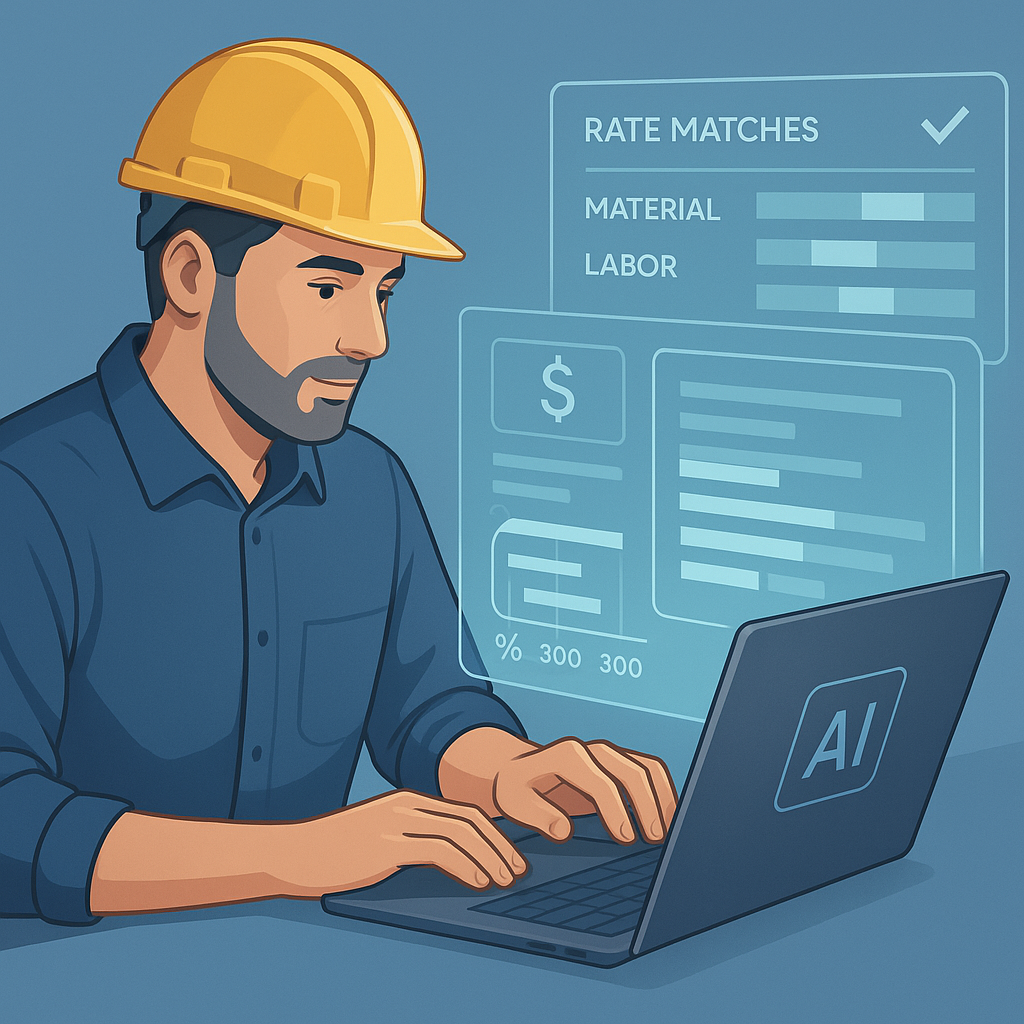
AI tools like EstimateNext flip this problem on its head. Instead of wasting hours on manual lookups, you get results in seconds. Semantic search across 78,000+ SOR items means typing in a query (e.g., “pre-stressed concrete girders”) and letting the system do the heavy lifting. No more flipping through PDFs or Excel sheets.
Concrete Example: How AI Saves Time
Take a recent case study: a mid-sized GC saved 120 hours on a high-rise bid by using EstimateNext’s rate matching. That’s two full weeks of labor costs avoided, with no compromise on accuracy. In their words, “It’s like hiring a full-time estimator without the overhead.”
And it’s not just about time savings. AI can analyze thousands of SORs in seconds, flagging discrepancies that even experienced estimators might miss. For instance, a 2022 pilot program in the UK showed that AI-powered rate matching reduced errors in public infrastructure bids by 97%.
How It Works
Here’s a step-by-step breakdown of how AI tools like EstimateNext streamline rate matching:
- Upload Your BOQ: The system parses Excel or CSV files, auto-detecting sections, hierarchies, and merged cells. No manual formatting required.
- Search Across SORs: AI scans catalogs like RSMeans, CPWD DSR, or even custom user libraries. Using natural language processing (NLP), it understands queries like “steel reinforcement bars” or “PVC piping.”
- Match Rates: It suggests the closest matches based on labor, material, and equipment breakdowns, complete with confidence scores.
- Adjust for Inflation: Compound adjustments per catalog year are auto-applied, with CPI recommendations included. For example, inflationary adjustments for construction materials in 2023 averaged 8-12% nationwide.
- Export Reports: Output in formats like CSI MasterFormat, NRM2, or CPWD-compliant deliverables ensures compatibility with your workflow.
The Results Speak for Themselves
Let’s get specific. On a $108M water infrastructure project, AI rate matching shaved off 56 hours per bid. That’s a 99% reduction in manual effort. What does that mean in dollars? For a GC preconstruction director earning $130/hour, that’s $7,280 saved — per project.
Savings Beyond Time
It’s not just about speed. AI eliminates human error too. A McKinsey report found that early adopters of AI in construction see average cost savings of 10-20% per project. Why? Because AI doesn’t forget to update rates, check inflation, or flag discrepancies.
For example:
- Case Study 3: A Canadian contractor was able to identify and correct a $250,000 discrepancy in equipment rates on a $12M oil refinery project. Without AI, the error would have gone unnoticed.
- Case Study 4: A large infrastructure firm using AI flagged material shortages early, allowing them to renegotiate terms with suppliers, saving $1.2M on a single project.
The Obvious Objection: “But AI Can’t Think Like an Estimator”
We hear this all the time. You’re right — AI isn’t replacing your expertise. It’s amplifying it. You’re still the one making judgment calls, negotiating with subs, and deciding markup percentages. AI handles the grunt work — takeoffs, rate matching, and real-time recalculations. Think of it as a tool, not a replacement.
Custom Rates Are Covered
What happens when you need custom rates? That’s covered too. AI tools let you upload your own catalogs, define project-specific rates, or override system suggestions. The more you use it, the smarter it gets. By your third project, the accuracy improvement is noticeable.
ROI for Your Team
Let’s break it down:
| Role | Hours Saved | Hourly Rate | Savings per Estimate | Annual Savings |
|---|---|---|---|---|
| GC Director | 40 | $130 | $5,200 | $62,400 (12 estimates) |
| MEP Subcontractor | 20 | $100 | $2,000 | $24,000 (12 estimates) |
| Regional Contractors | 15 | $80 | $1,200 | $14,400 (12 estimates) |
When you compare this to the cost of AI tools (e.g., $99/month for EstimateNext), the ROI becomes undeniable. Even small contractors can see a 52X return on their investment.
FAQ
Q: Can AI tools handle custom catalogs? Yes. Upload your own rate libraries or project-specific rates, and the system integrates them seamlessly. Adjustments get smarter with every feedback loop.
Q: How accurate are AI-generated rate matches? AI tools like EstimateNext are highly accurate, but human oversight is still essential for edge cases. Confidence scoring helps flag low-certainty matches for review.
Q: Does this replace my current workflow? No. Most tools integrate with existing software like Procore, Autodesk Build, or Excel via API. You can export estimates directly into your workflows.
Q: Is it worth learning AI tools for small projects? Absolutely. AI scales to any project size, from $1M renovations to $1B rail bridges. Training takes under two weeks, and the ROI is immediate.
Q: What if my project has unique conditions, like extreme weather? AI tools often provide regional cost adjustments for labor and materials based on environmental factors like weather, local regulations, or supply chain disruptions.
Call to Action
If you’re tired of wasting 12 hours per estimate on manual rate matching, EstimateNext can help. Start saving time, reducing errors, and increasing profitability today. Get started free →