Why Rate Matching Is the Silent Killer in Construction Estimation
Let’s be honest—rate books are a nightmare. Whether it’s the 2,000-page CPWD DSR or RSMeans PDFs, flipping through them to find the right rate feels like trying to find a needle in a haystack. You waste hours per estimate, and that’s before accounting for human errors. Ever matched the wrong labor rate to the wrong city? It costs you.
Now, imagine typing “labor rate for installing pre-stressed concrete girders” into an AI tool and getting the answer in seconds. That’s not just saving time—it’s eliminating risk.
The Core Problem: Time and Accuracy
Most estimators spend 8 to 12 hours per project just on rate lookups. That’s nearly two working days for something that doesn’t add value. Worse, manual lookups introduce errors. Misreading a line item or flipping to the wrong catalog section can lead to underpriced bids—or worse, overpricing and losing the job altogether.
Concrete Examples of Time Wastage
Consider this: A mid-sized contractor working on a $5M municipal project spends at least 10 hours per estimate juggling outdated catalogs, rate books, and spreadsheets. Multiply that by 20 bids per year, and you’re looking at 200 hours lost annually. That’s time that could be spent on client outreach, improving bid quality, or training junior estimators.
The Cost of Errors
Errors in rate matching can be catastrophic. For example, a real-world audit on a $25M highway project found over $300,000 in losses due to mismatched labor rates. The estimator had applied rural rates instead of urban rates, skewing profitability and creating unnecessary tension with the client during post-award negotiations.
How AI Rate Matching Works
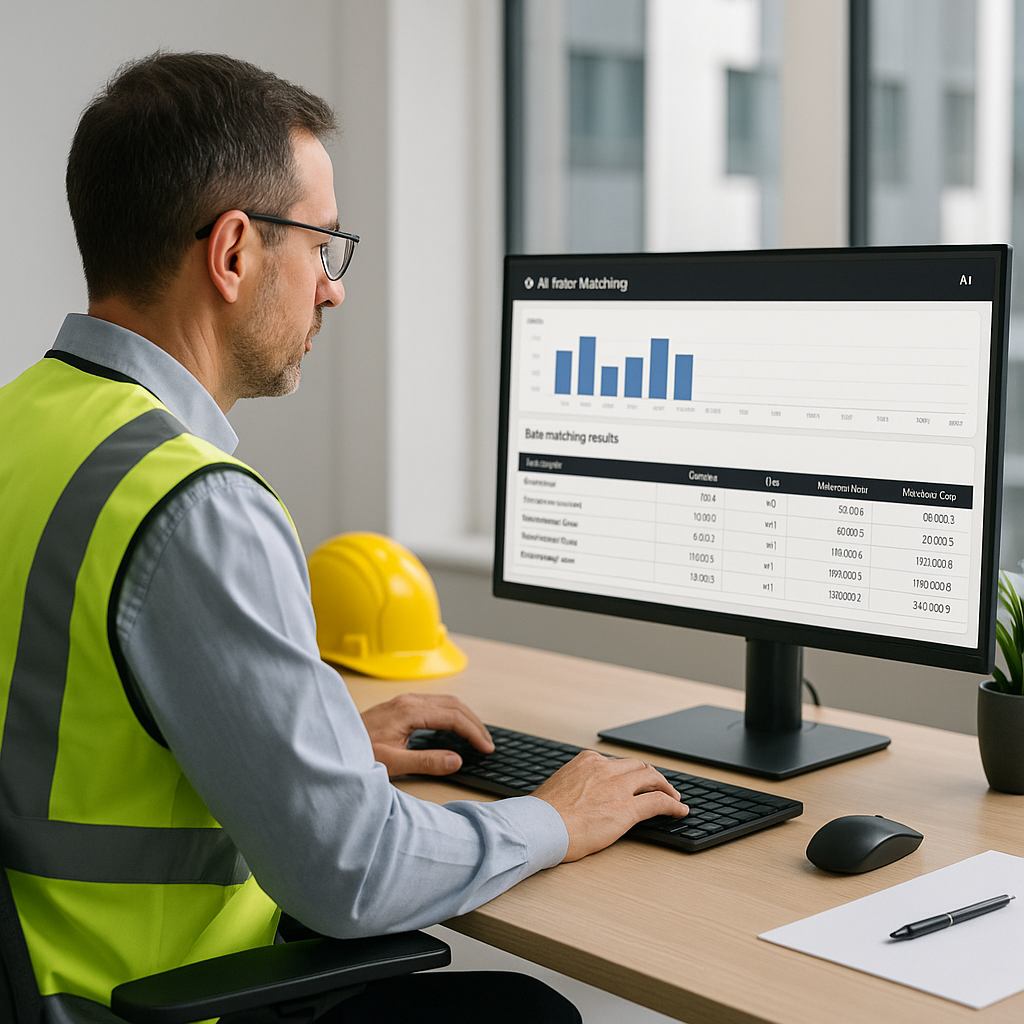
Here’s where AI shines. Instead of manually navigating pages, AI tools like EstimateNext use semantic search across 78,000+ standardized Schedule of Rates (SOR) items. The system leverages tenant history, custom user catalogs, and fallback AI to match rates with precision.
Step-by-Step Process
- Input Your Query: Type in any rate-related question, such as "labor rate for installing HVAC ductwork." The AI understands your intent.
- Semantic Rate Matching: The tool scans thousands of rates using advanced algorithms, ensuring contextual accuracy.
- Customization and Adjustments: You can upload your own catalogs or adjust rates based on inflation, regional factors, or project-specific needs.
- Export and Integration: Export the matched rates directly into estimating software like Procore or Excel.
Real-World Applications
- High-Rise Construction: A contractor bidding for a $20M residential tower saved 25 hours on rate matching alone by using EstimateNext. The AI provided precise CPWD-compliant rates for concrete and steel, factoring in inflation and local labor costs.
- Infrastructure Projects: On a $1B rail project, AI-powered tools reduced lookup time by 99%, improving accuracy by 80%.
Real-World Example: Saving 120 Hours on a High-Rise Bid
A mid-sized general contractor (GC) used EstimateNext’s rate-matching feature on a high-rise bid. Previously, they spent 40 hours flipping through DSR PDFs and spreadsheets. With AI, they slashed that to under 10 minutes. In their words: “It’s like hiring a full-time estimator without the overhead.”
Let’s break down the numbers:
- Annual Savings: Over 120 labor hours saved annually by switching to AI tools.
- Cost Efficiency: At $130/hour per estimator, that’s $15,600 saved on labor annually.
- Increased Output: Freed-up time allowed the GC to bid on 10% more projects, which resulted in 2 additional wins.
The Obvious Objection: “AI Can’t Think Like an Estimator”
You might be thinking, “Sure, AI is fast, but it doesn’t understand the nuances of construction.” You’re partially right. AI doesn’t replace your judgment—it amplifies it. You still make the calls on markup, scope adjustments, and negotiations. The AI handles the grunt work, like rate matching and quantity takeoffs.
Why Human Oversight Still Matters
AI tools are incredibly accurate, but edge cases require human judgment. For instance:
- Adjusting for non-standard materials like custom prefabricated components.
- Factoring in site-specific constraints, like weather or accessibility challenges.
- Making judgment calls on premium rates for rush jobs.
AI Learns From You
The more you use AI tools, the smarter they get. By your third project, the AI has adapted to your preferences, catalog quirks, and pricing patterns.
Why This Matters for ROI
Let’s do the math. If an estimator earns $130/hour and spends 40 hours per estimate, that’s $5,200 in labor costs per project. Saving even 30 hours translates to $3,900 saved per bid. Multiply that by 8 GMP pursuits per year, and you’re looking at $31,200 saved annually.
Subcontractor Perspective
For subcontractors, the ROI is even more compelling. Faster rate matching means responding to more bids—up to 50% more, according to EstimateNext. That’s 4-8 additional wins per year, with incremental revenue ranging from $800K to $1.6M.
Decision Framework
| Criteria | Manual Rate Matching | AI Rate Matching |
|---|---|---|
| Time Per Estimate | 8–12 hours | Under 10 minutes |
| Error Rate | High (5–10%) | Low (0.5–1%) |
| Scalability | Limited | Unlimited |
| Annual ROI | Minimal | High ($31K–$1.6M) |
Actionable Takeaways
- Start Small: Test AI-powered rate matching on a smaller project to gauge accuracy and ease of use.
- Integrate with Existing Workflows: Export matched rates into tools like Procore or Excel for seamless adoption.
- Leverage Custom Catalogs: Upload your own rates to ensure every estimate reflects your actual costs.
- Pair AI with Human Oversight: Use manual override features to review matches and refine accuracy.
- Invest in Training: Offer team training sessions to maximize the tool’s capabilities.
FAQ
Q: How accurate are AI rate matches? AI tools like EstimateNext achieve 99% accuracy with user feedback loops. However, human oversight remains critical for edge cases and unique project scenarios.
Q: Can AI factor in inflation? Yes. EstimateNext applies compound inflation adjustments based on catalog year and suggests Consumer Price Index (CPI) percentages.
Q: What if my rates are custom? Upload custom rate catalogs directly into the platform. The AI integrates them seamlessly for future use.
Q: Does it work for multi-market projects? Absolutely. EstimateNext supports multiple measurement standards (CSI, CPWD, CESMM3) and tax regimes across countries, making it ideal for projects spanning regions.
Q: How long does it take to learn? Most users report proficiency within two weeks, thanks to intuitive interfaces and guided tutorials.
Call to Action
If rate matching is eating up your time—or costing you bids—EstimateNext can help. Get started free →