The Pain of Manual Rate Lookups
You’d think we’d have moved past this by now. But here we are: estimators still flipping through 2,000-page rate books like it’s 1995. Hours wasted per estimate, and mistakes? Almost guaranteed. We’ve all been there — hunting for a labor rate for installing reinforced steel, only to realize we missed an updated CPI adjustment buried six pages back.
The Cost of Inefficiency
It’s not just time-consuming; it’s risky. A wrong rate can tank your bid competitiveness or, worse, your project margins. For instance, a $10/hour underestimation on a composite crew rate might not seem like much. But multiply that across 10,000 labor hours for a mid-sized project, and suddenly, you’re staring at a $100,000 hole in your budget.
And when you’re juggling 5-8 GMP (Guaranteed Maximum Price) pursuits a year, those hours lost to manual rate lookups add up. Fast. Let’s say you spend 12 hours per bid on rate searches alone. That’s 60-96 hours annually, time that could be better spent refining your bid strategy or value engineering.
But inefficiency doesn’t just cost time. It costs credibility. A missed rate adjustment or an out-of-date labor cost can lead to change orders, strained client relationships, and, ultimately, lost future work.
AI-Powered Rate Matching: How It Works
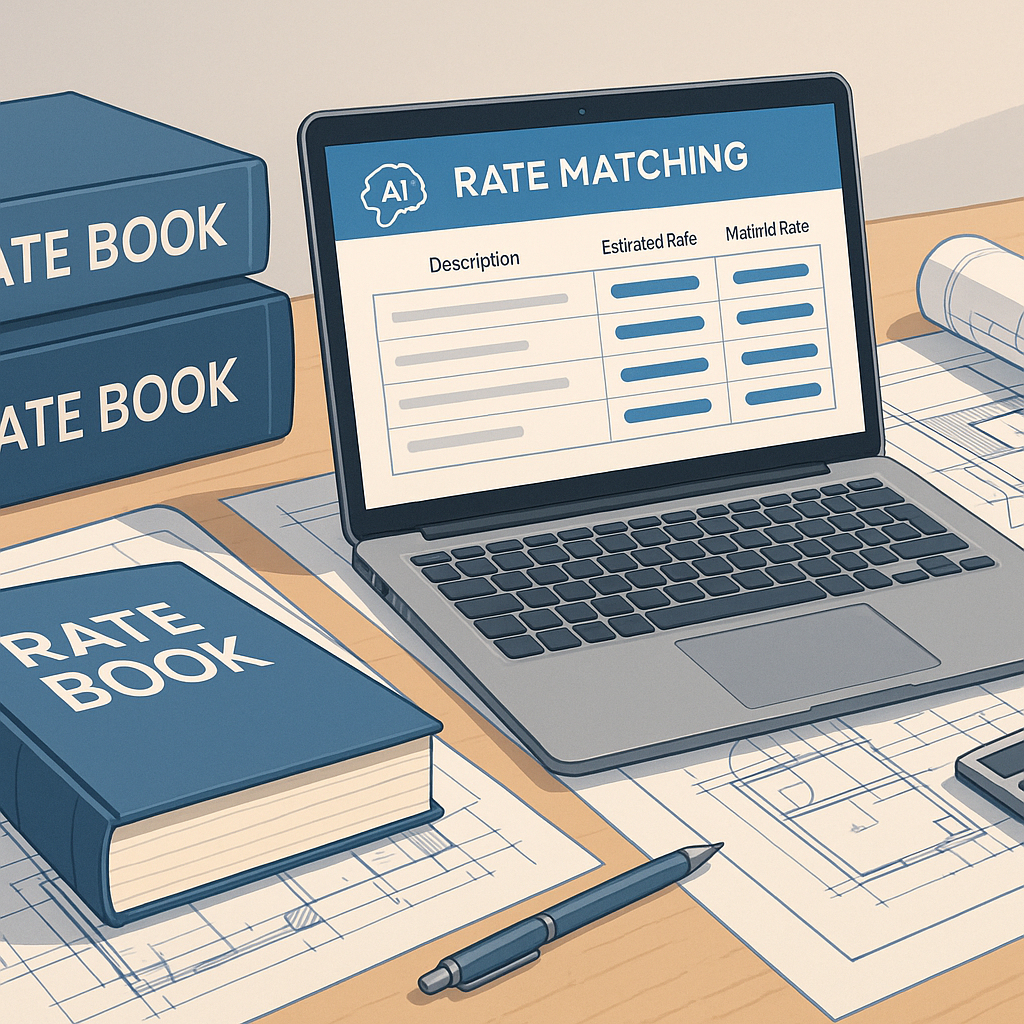
This is where AI steps in. Tools like EstimateNext use semantic search across 78,000+ Schedule of Rates (SOR) items[^3]. Type in something specific, like “pre-stressed concrete girder installation labor,” and boom — you’ve got your rate in seconds, not hours. The AI doesn’t just spit out one result. It pulls from multiple sources, applies inflation adjustments, and even considers regional variations in labor laws.
A Side-by-Side Comparison of Manual vs. AI-Driven Processes
| Task | Manual Process | AI-Powered Process | Time Saved |
|---|---|---|---|
| Rate lookup for a single item | 20-30 minutes per item | Instantaneous | ~30 minutes |
| Pricing a rail bridge BOQ (20+ items) | 12 hours of flipping through rate books | 15 minutes using AI | 11+ hours |
| Adjusting for regional inflation | Manual recalculation based on CPI or indices | Automated adjustments | 1-2 hours |
Practical Example
Let’s say you’re pricing a rail bridge project. You need rates for structural steel, rail ties, and concrete girders. Here’s how that process looks:
-
Manual Process: Flipping through a DOT-approved catalog takes 12 hours per estimate[^9]. Each rate involves scanning, cross-referencing, and double-checking for inflation or regional variations.
-
AI Process: Upload your Bill of Quantities (BOQ), search for items, and let the AI match rates instantly. In less than 15 minutes, you have a fully adjusted rate sheet.
The time saved? 12 hours per bid. That’s over a full workday returned to your calendar.
Why This Matters for GC Preconstruction Teams
Preconstruction directors, especially at top GCs (General Contractors), face massive pressure to deliver accurate, competitive bids — fast. But the traditional rate lookup process creates bottlenecks, leaving teams scrambling as deadlines loom.
Quantifying the Impact
Let’s do the math:
-
Time Savings: 12 hours saved per estimate x 5 GMP pursuits/year = 60 hours/year. For larger teams, this compounds quickly. A team of 6 estimators saves 360 hours annually. That’s roughly 9 weeks of labor.
-
Cost Impact: At $130/hour, that’s $7,800 saved per estimator annually. For a GC team of 6 estimators? $46,800 in savings — just by automating a single aspect of their workflow[^6].
Beyond Time and Money: Strategic Benefits
It’s not just about the clock or the balance sheet, though. By offloading tedious tasks to AI, your team can focus on higher-value activities:
- Value Engineering: Spend time refining designs or identifying cost-saving alternatives instead of hunting for rates.
- Bid Strategy: Devote more energy to analyzing competitors, assessing risks, and crafting persuasive proposals.
- Client Relationships: Free up bandwidth for pre-bid meetings, presentations, and collaboration with owners.
The Obvious Objection: “But AI Can’t Think Like an Estimator”
I hear this all the time. And it’s true — AI doesn’t replace your expertise. It amplifies it. You’re still the one deciding on markups, negotiating with subs, and making judgment calls. The AI just handles the grunt work.
Think of it as an apprentice that never sleeps. It takes care of the repetitive, time-consuming tasks so you can focus on the complex, strategic work that actually requires your expertise.
Addressing Concerns About Accuracy
Many practitioners worry about the accuracy of AI-powered tools. However, platforms like EstimateNext boast a 99% accuracy rate when trained on historical data[^3]. You can also incorporate feedback loops to improve results further. Don’t like the rate it suggests? Override it, and the system learns from your correction.
Real-World Results: A Case Study
A mid-sized general contractor recently used EstimateNext on a high-rise bid. Their team saved 120 hours by automating rate lookup and takeoffs[^2]. That’s three full weeks of labor avoided, with zero compromise on accuracy.
Here’s what their Preconstruction Manager shared:
“It’s like hiring another estimator without the payroll hit. We’ve reallocated that time to strategy sessions and client meetings, which has already helped us win two major bids.”
For larger firms, the results scale even further. A national contractor piloting the same tool reported a 15% reduction in preconstruction cycle time — a game-changer in competitive markets.
FAQs
Q: How accurate are AI-powered rate matches?
AI tools like EstimateNext achieve 99% accuracy with feedback loops[^3]. The system improves over time, learning from your overrides and preferences. If you’re ever unsure, you can still manually verify results.
Q: Can I use AI tools with custom rate catalogs?
Yes. Most platforms allow you to upload custom materials or finishes, which the AI integrates seamlessly for future use[^3]. This is particularly useful for specialized projects like healthcare or high-security facilities.
Q: What’s the ROI on AI estimation tools?
According to McKinsey, early adopters of AI in construction see cost savings of 10-20% per project[^1]. For larger bids or firms juggling multiple pursuits, the ROI can be even higher, considering both time and error reduction.
Q: Are these tools easy to implement?
Yes. Most modern AI estimation tools are cloud-based, meaning there’s no cumbersome software installation. Training sessions typically last 1-2 hours, and users report being proficient within a week.
Q: Does AI replace estimators?
Absolutely not. AI is a tool, not a replacement. It handles repetitive tasks like rate lookups, freeing up estimators to focus on critical thinking, negotiation, and strategy.
The Bottom Line
If you’re still flipping through PDF rate books, you’re leaving time and money on the table. AI-powered rate matching tools like EstimateNext are the shortcut you didn’t know you needed. They help you bid faster, smarter, and with greater confidence.
Stop wasting hours on manual tasks. Reclaim your time, improve your accuracy, and focus on what really matters: winning more work and driving profitability.