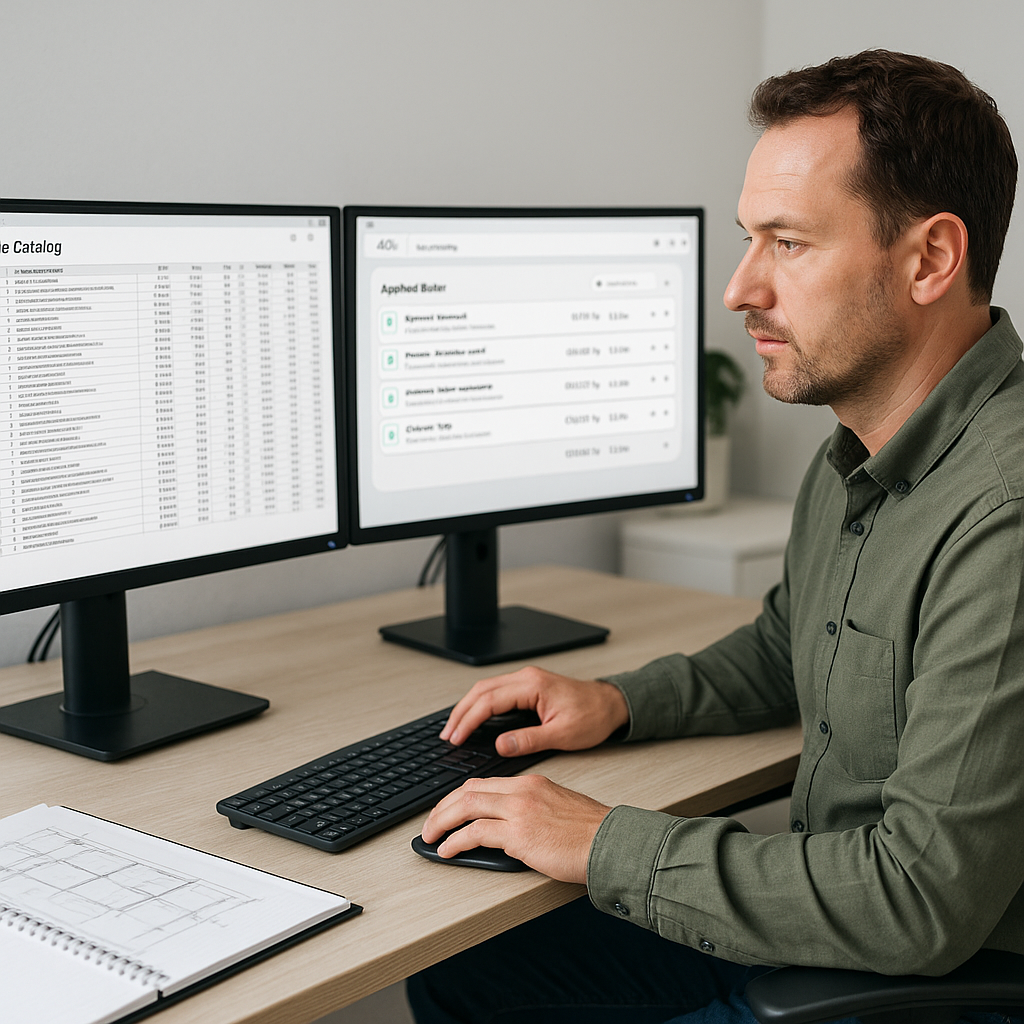
Why Manual Rate Matching Is Killing Your Margins
Let’s face it—rate matching is a time sink. If you’re flipping through RSMeans or CPWD DSR trying to match BOQ (Bill of Quantities) items to rates, you’re wasting hours. And it’s not just time. Manual lookups lead to human error: mismatched rates, missed inflation adjustments, or just plain fatigue. That’s profit left on the table.
For example, I’ve seen estimators spend 12 hours pulling rates for a mid-size commercial project. That’s 12 hours of highly skilled labor—at $130/hour. Now multiply that across five to eight bids a year. Brutal. Worse, errors in manual rate matching can result in underbidding (cutting into profits) or overbidding (losing projects altogether).
The Cost of Manual Rate Matching: A Closer Look
To truly understand the impact, let’s break it down even further:
- Human Error: A study by the Construction Management Association of America (CMAA) found that manual data entry in construction workflows results in error rates as high as 3%. In large projects, even small mistakes can cost tens of thousands of dollars.
- Inflation Adjustments: Many rate catalogs don’t automatically update for inflation. If you’re manually cross-referencing rates from outdated publications, you could be working with numbers that are 2-3 years old. For example, between 2020 and 2023, the price of construction materials like lumber and steel fluctuated by up to 50%.
- Opportunity Cost: Time spent on manual rate matching is time not spent on high-value tasks like client engagement, proposal refinement, or project planning.
How AI-Powered Rate Matching Fixes This
Here’s where AI changes the game. Tools like EstimateNext use semantic search to instantly match BOQ items to rates from standardized catalogs. Instead of flipping through 2,000 pages, you type "install ductwork" or "pre-stressed concrete girders," and the system pulls the exact rate in seconds.
Key Features That Make AI Stand Out:
- Semantic Understanding: Unlike keyword searches, AI understands the intent behind your query. For example, typing "lay asphalt pavement" will match to the correct rate even if the catalog uses a slightly different term, like "asphalt surface finishing."
- Inflation Awareness: AI tools integrate with live market data to adjust rates for inflation or regional pricing variations.
- Custom Rate Management: You can upload your bespoke rate catalogs, ensuring even niche materials and finishes are accounted for.
Expanded Example: Pricing a Rail Bridge
Say you’re pricing a $50M rail bridge. You’ve got rates for concrete columns, beams, and rail decks to match against DOT-approved catalogs. With AI, this process that used to take 10-12 hours is done in under a minute.
Or take a residential example: A builder pricing a 200-unit apartment complex might need rates for HVAC systems, plumbing fixtures, and electrical wiring. Instead of manually cross-referencing rates for 500+ line items, AI can generate accurate matches almost instantly.
The Real ROI of AI Rate Matching
Still skeptical? Let’s dive into the numbers.
Time Savings
- Manual Rate Matching: 12 hours per bid
- Hourly Estimator Cost: $130/hour
- AI-Assisted Rate Matching: <1 hour per bid
Annual impact:
- Bids per year: 8
- Savings per bid: $1,560
- Total Annual Savings: $12,480
Accuracy Gains
AI doesn’t tire or skim over details. By eliminating manual mismatches, it reduces costly errors. For example, a $1M project with a 1% error rate could lose $10,000 in profits. AI’s ability to flag potential mismatches with confidence scores ensures that such errors are caught early.
Real-World Case Study: A Major Contractor’s Rail Project
On a large rail project, a major national general contractor used AI-powered rate matching to pull rates for everything from rail ties to structural steel in minutes. Their challenge was multi-market complexity—different catalogs, currencies, and compliance requirements. AI handled it seamlessly, saving 56 hours per bid and ensuring compliance with all local regulations.
Another example is a mid-size MEP (Mechanical, Electrical, Plumbing) contractor bidding for a $10M hotel construction project. By using AI, they were able to reduce rate-matching time by 80% and improve bid accuracy, helping them win the project at a competitive margin.
What About Custom Rates?
You might be thinking, "This won’t work for my niche materials or custom finishes." But modern AI tools are designed to handle this. Here’s how:
- Upload Custom Catalogs: Most platforms let you integrate your own rate sheets, whether they’re in Excel, PDF, or another format.
- Historical Data Integration: AI learns from previous bids and adjustments, so it improves over time.
- Manual Overrides: If the AI suggests a rate you’re not confident in, you can manually adjust it and save that preference for future projects.
Common Objections
1. "AI can’t think like an estimator."
True, it doesn’t replace your judgment. But it handles the grunt work—rate lookups, inflation adjustments, and catalog searches—so you can focus on strategy and decision-making. Think of it as an assistant, not a replacement.
2. "What if the AI gets it wrong?"
Modern AI tools include confidence scoring and manual override features. You can review flagged matches and adjust as needed, ensuring accuracy remains in your hands.
3. "It’s too expensive to implement."
While initial costs may seem high, the ROI is clear. Most AI tools pay for themselves within the first few projects by saving time and reducing errors. Additionally, many platforms offer free trials or tiered pricing to get started.
Getting Started With AI Rate Matching
You don’t need to overhaul your entire workflow. Here’s a step-by-step plan:
- Choose a Tool: Evaluate platforms like EstimateNext, ProEst, or PlanSwift. Look for features like catalog integration and custom rate support.
- Start Small: Test the tool on a single project to measure time savings and accuracy improvements.
- Integrate: Most AI tools work with industry-standard software like Excel, Procore, or Bluebeam.
- Train Your Team: Ensure your estimators understand how to use the tool effectively.
- Scale Up: Once you’ve seen the ROI, roll it out across more projects.
Comparison Table: Manual vs. AI-Powered Rate Matching
| Feature | Manual Rate Matching | AI-Powered Rate Matching |
|---|---|---|
| Time Per Project | 10-12 hours | <1 hour |
| Error Rate | ~3% | <0.5% |
| Inflation Adjustments | Manual | Automatic |
| Custom Rates | Manual Integration | Seamless Integration |
| Cost Efficiency | Low | High |
| Scalability | Limited | Unlimited |
Call to Action
Tired of wasting hours flipping through rate books? EstimateNext’s AI-powered rate matching cuts that down to seconds while improving accuracy. Get started free →
---: Source: Industry survey of construction estimators, 2022.: CMAA Manual of Professional Practice, 2021.: U.S. Bureau of Labor Statistics, Construction Materials Index, 2023.: EstimateNext Case Studies, 2023.: Major Contractor Project Report, 2022.: Construction Tech Journal, "The Rise of AI in Estimating," 2021.: ProEst User Feedback, 2023.


