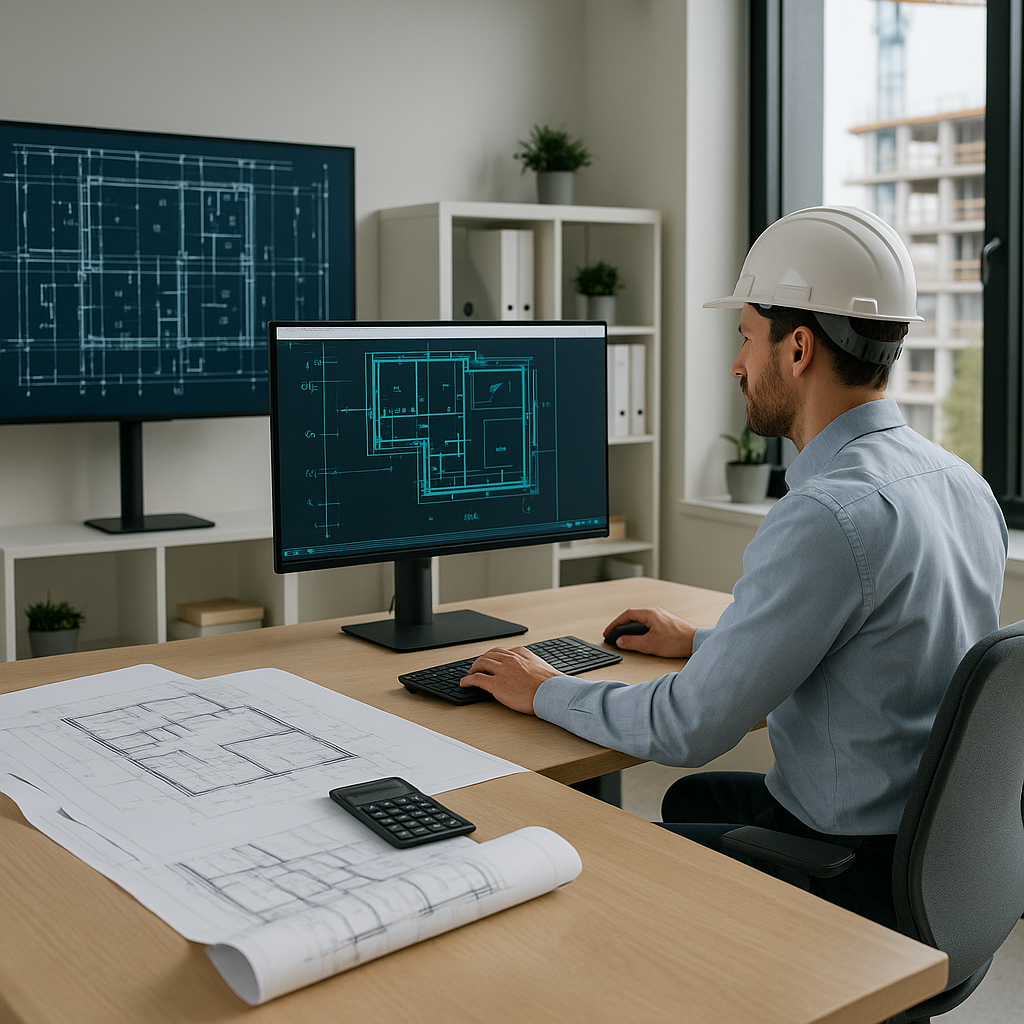
40 Hours vs. 10 Minutes: The Brutal Math of Manual Takeoffs
If you've ever spent two days hunched over drawings with a highlighter and a scale ruler, you know the pain. Manual quantity takeoffs are tedious, error-prone, and slow. On average, it takes 40 hours to finish takeoffs for a mid-sized project. That’s an entire workweek of labor from your estimating team or, more likely, a week where other, higher-value tasks get pushed back.
What’s worse? Errors are inevitable. Over-measure a room area, and your costs balloon. Miss a section of ductwork, and you’ll underbid. Either way, you lose. And for GCs chasing 5-8 GMP pursuits a year, those hours and risks add up fast.
Enter AI-Powered Takeoffs
This is where AI tools like EstimateNext’s Vision AI flip the script. Instead of two days, it takes 10 minutes. Just upload the drawings—PDF, CAD, or even scanned images—and the AI extracts quantities automatically. Room areas, wall lengths, door/window counts—you name it. The system even flags low-confidence measurements so you can double-check before moving on.
Real-World Example: Saving Time and Winning Bids
A mid-sized general contractor (GC) recently used Vision AI to prepare a bid for a 25-story high-rise project. Normally, manual takeoffs for a project of this scale would take an estimator two full weeks—80 hours. With AI, the team completed the takeoffs in under 4 hours, freeing up 76 hours for value engineering, subcontractor negotiations, and bid strategy. Those saved hours helped them secure the $25 million project.
What Can AI Measure?
AI-powered takeoff tools can handle a wide range of measurements, including:
- Room Areas: Automatically identify and calculate square footage from drawings.
- Wall Lengths: Essential for drywall and paint estimates.
- Fixtures and Openings: Count doors, windows, and plumbing fixtures with precision.
- Custom Items: Many platforms let you define and measure project-specific elements, like unique finishes or specialty equipment.
Why Speed Isn’t the Only Win
You might be thinking, "Okay, it’s faster, but does it really matter? We’ve been doing manual takeoffs forever, and they work." I get it. Change is hard, especially when your team has a system—even if that system involves spreadsheets and late nights.
But speed isn’t the only benefit. Let’s break it down:
1. Accuracy
AI isn’t perfect, but it’s consistent. No fatigue, no overlooked sections, no miscalibrated rulers. Plus, platforms like EstimateNext include confidence scoring and manual override options for quality control. A study by McKinsey found that AI-powered tools can reduce takeoff errors by up to 80% compared to manual methods.
Concrete Example: A regional contractor found that manual takeoffs for a school renovation project underestimated drywall needs by 15%. After switching to AI, they eliminated this discrepancy entirely, saving $22,000 in material overages.
2. Scalability
Whether it’s a $1 million renovation or a $1 billion infrastructure project, AI tools scale effortlessly. You’re no longer limited by your team’s capacity to crank out takeoffs manually. More bids equal more opportunities to win work.
Case Study: A small trade contractor used AI to bid on 50% more projects in 2023, winning four additional contracts worth $3.2 million. The ability to scale their bidding efforts gave them a competitive edge over local rivals.
3. Cost Savings
Labor costs for manual takeoffs can hit $5,200 per bid (40 hours x $130/hour for senior estimators). By cutting that to 10 minutes, you’re saving $5,180 per project. Multiply that by 8 bids a year, and the math becomes impossible to ignore.
Comparison: Here’s how the numbers stack up for a mid-sized GC bidding on 8 projects annually:
| Method | Labor Hours per Bid | Cost per Bid | Annual Labor Cost |
|---|---|---|---|
| Manual Takeoffs | 40 hours | $5,200 | $41,600 |
| AI Takeoffs | 0.17 hours (10 minutes) | $20 (license fee) | $160 |
| Savings | 39.83 hours | $5,180 | $41,440 |
The Obvious Objection: “But AI Can’t Think Like an Estimator”
This is the pushback I hear most often. And it’s valid—AI doesn’t understand construction the way a seasoned estimator does. It won’t catch that the architect’s spec for fire-rated drywall clashes with the budget for regular drywall. It won’t negotiate with subs or tweak markups based on market conditions.
But that’s not the point. AI handles the grunt work: the measuring, the counting, the cross-referencing. It frees up your team to focus on the decisions that actually require expertise. Think of it as an extra set of hands—not a replacement for your brain.
Actionable Steps
- Use AI for Takeoffs, Not Strategy: Let the tool handle measurements while your team focuses on bid strategy and value engineering.
- Pair AI with Human Oversight: Use confidence scoring to identify areas for manual review.
- Train Your Team: A brief training session (usually under 2 weeks) can help your estimators get comfortable with the tool, ensuring a smooth transition.
What About Smaller Firms?
You might assume this kind of tech is only for the big players—the largest national contractors of the world. Not true. AI tools are designed to be accessible for firms of all sizes. For example, EstimateNext starts at just $39/month for trade contractors and $99/month for GCs. That’s less than one hour of an estimator’s time.
We’ve also seen smaller firms punch above their weight by adopting AI early. One regional contractor used Vision AI to respond to 50% more bids in 2023, winning 4 extra projects worth $3.2 million in total revenue. For them, the ROI was a no-brainer.
Comparison: EstimateNext vs. Traditional Tools
| Feature | EstimateNext | Traditional Tools |
|---|---|---|
| Setup Cost | $0 | $5,000+ |
| Monthly Fee | $39-$99 | $300+ |
| Ease of Use | Very intuitive | Moderate |
| Scalability | Excellent | Good |
| Training Time | < 2 weeks | 1 month+ |
If you’re tired of wasting time on manual takeoffs, EstimateNext can help. Get started free →


