AI-Powered Preconstruction Estimation: How It Works
Manual takeoffs are slow and tedious. Preconstruction teams often spend significant time measuring line lengths, counting windows, and recalculating areas for every project. This process is not only time-consuming but also prone to errors.
AI-powered tools are transforming this workflow by automating takeoffs and reducing the time and effort required. Let’s explore how this technology works and the benefits it offers.
The Problem: Manual Takeoffs Are a Bottleneck
In a typical preconstruction scenario, teams receive large sets of drawings, often hundreds of pages long. Their task is to extract quantities—such as wall areas, concrete volumes, and door counts—and use them to prepare estimates. This process involves:
- Manual Measurement: Measuring each element, such as walls and beams, which can take a significant amount of time even with digital tools.
- Error Checking: Ensuring no lines or calculations are missed, as errors can impact the accuracy of bids.
- Rework for Revisions: When drawings are updated, the process often needs to be repeated, adding to the workload.
This manual approach can consume many hours for a single project, creating bottlenecks and limiting the number of bids a team can handle.
The Solution: AI-Powered Takeoffs
AI-powered tools streamline the takeoff process by using Vision AI to automatically extract quantities from drawings. Here’s how the process works:
- Upload Your Drawing Set: Users upload PDF drawings into the platform.
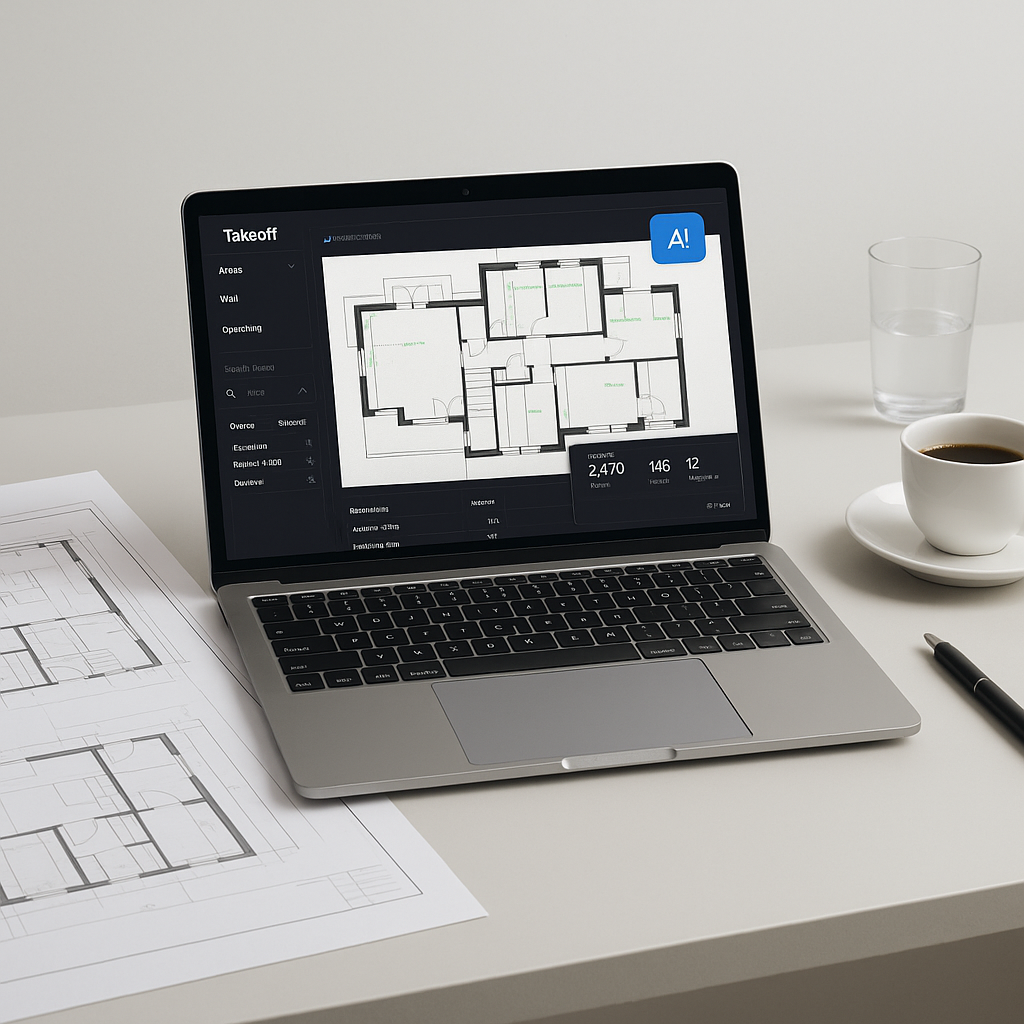
- AI Analyzes the Drawings: The system identifies and extracts quantities such as room areas, wall lengths, and door/window counts.
- Outputs Ready for Use: The platform generates a complete quantity takeoff, which can be exported for pricing or further analysis.
This automation significantly reduces the time required for takeoffs, allowing teams to focus on other critical tasks.
Benefits of AI-Powered Takeoffs
AI-powered tools offer several advantages beyond time savings:
- Reduced Errors: Automated systems can catch details that might be overlooked in manual processes, improving accuracy.
- Simplified Revisions: When drawings are updated, AI tools can quickly reprocess the changes without starting from scratch.
- Increased Capacity: Faster takeoffs enable teams to respond to more RFQs, potentially increasing their win rate.
Common Questions About AI Takeoffs
Q: Are AI takeoffs accurate?
AI tools are generally accurate, but their performance depends on the quality of the input data. Human oversight remains important for reviewing edge cases and flagged areas.
Q: Can AI handle small projects?
Yes, AI scales to projects of all sizes. Smaller projects often benefit proportionally more from the time savings.
Q: Does AI integrate with existing software?
Most AI tools integrate with popular preconstruction platforms, allowing seamless export of takeoffs into existing workflows.
What to Watch For
While AI-powered takeoffs offer significant advantages, there are some considerations:
- Low-Confidence Areas: Some measurements may require manual review to ensure accuracy.
- Input Quality: Poorly scanned or incomplete drawings can affect the system’s performance.
- Human Expertise: AI is a tool to enhance, not replace, human skills and judgment.
Final Thoughts
AI-powered tools are revolutionizing preconstruction estimation by automating takeoffs, reducing errors, and saving time. By adopting these technologies, teams can focus on pricing competitively and increasing their bid capacity. If you’re looking to streamline your estimation process, exploring AI solutions could be a valuable step forward.