The Real Problem with Manual Rate Lookup
Every construction estimator knows this drill: you’re deep into a BOQ, and you hit a line item that stops you dead. Maybe it’s a custom material or an unfamiliar service — something that isn’t in your usual go-to catalog. What happens next? You spend hours flipping through a thousand-page rate book (or several), cross-checking vendor PDFs, and hoping you’ve landed on the right rate.
It’s not just time-consuming. It’s error-prone. One wrong rate can make your bid uncompetitive or even unprofitable. A 2023 McKinsey report found that a significant percentage of construction projects worldwide run over budget, often due to estimation errors.
This is where AI-powered rate matching can save the day. Tools that automate the grunt work allow you to focus on higher-value tasks. And no, this isn’t just buzzword hype. Let’s walk through how it works — and why it matters.
How AI Rate Matching Works
At its core, AI rate matching is about speed and precision. Instead of manually searching for rates across multiple sources, the AI does it for you. Here’s a simplified breakdown:
-
BOQ Upload
You upload your BOQ in Excel, CSV, or even PDF format. The AI auto-detects line items, hierarchies, and merged cells — no need for cleanup. -
Semantic Search
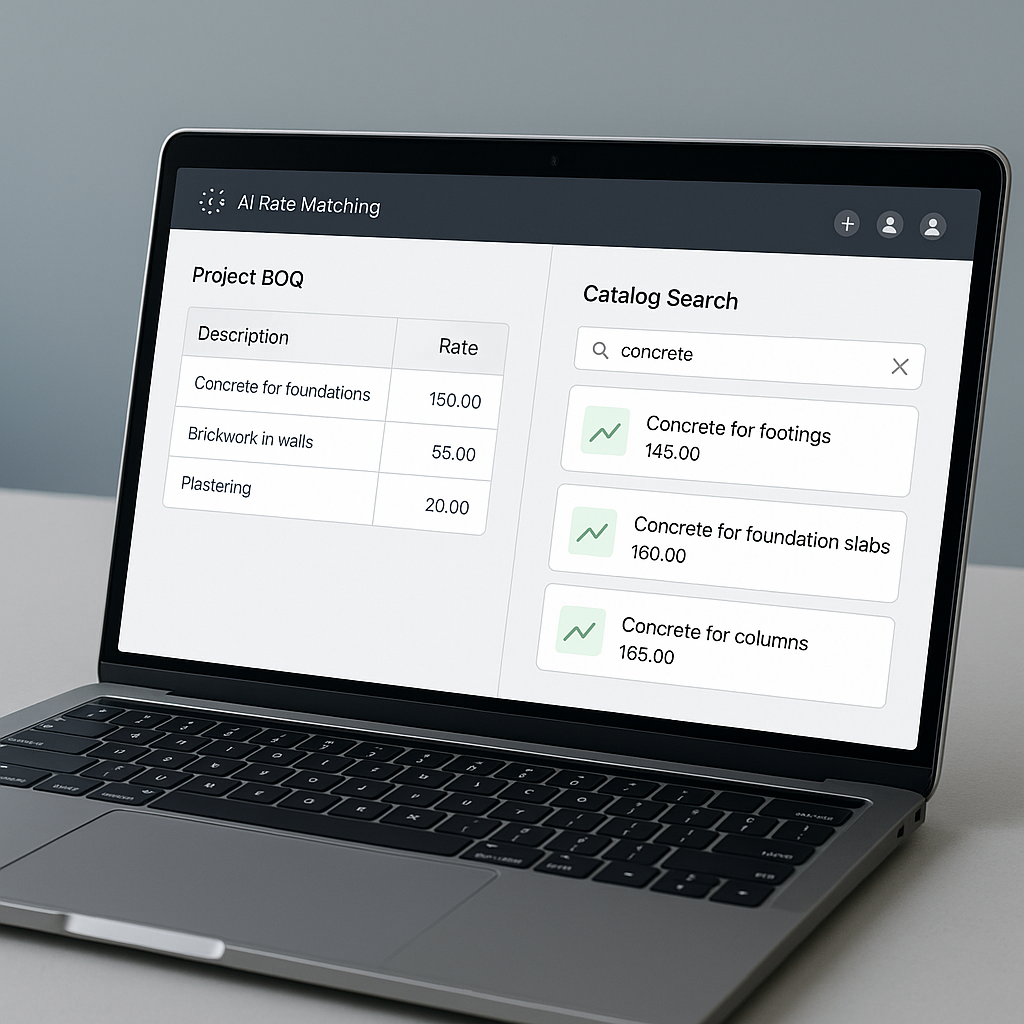
The AI scans your BOQ line items and matches them against a database of rates. For example, let’s say your BOQ includes “Install 4-inch PVC pipe.” The AI identifies this as a plumbing task and searches for labor, material, and equipment rates specific to your region. -
Accuracy Filters
The system applies multiple filters: tenant history, user-defined catalogs, country-specific standards, and an AI fallback for unusual items. If you’ve customized your catalog, the AI prioritizes those rates first. -
Real-Time Feedback
Not convinced by a suggested rate? Override it. The AI learns from every adjustment and gets smarter with each project. -
Output
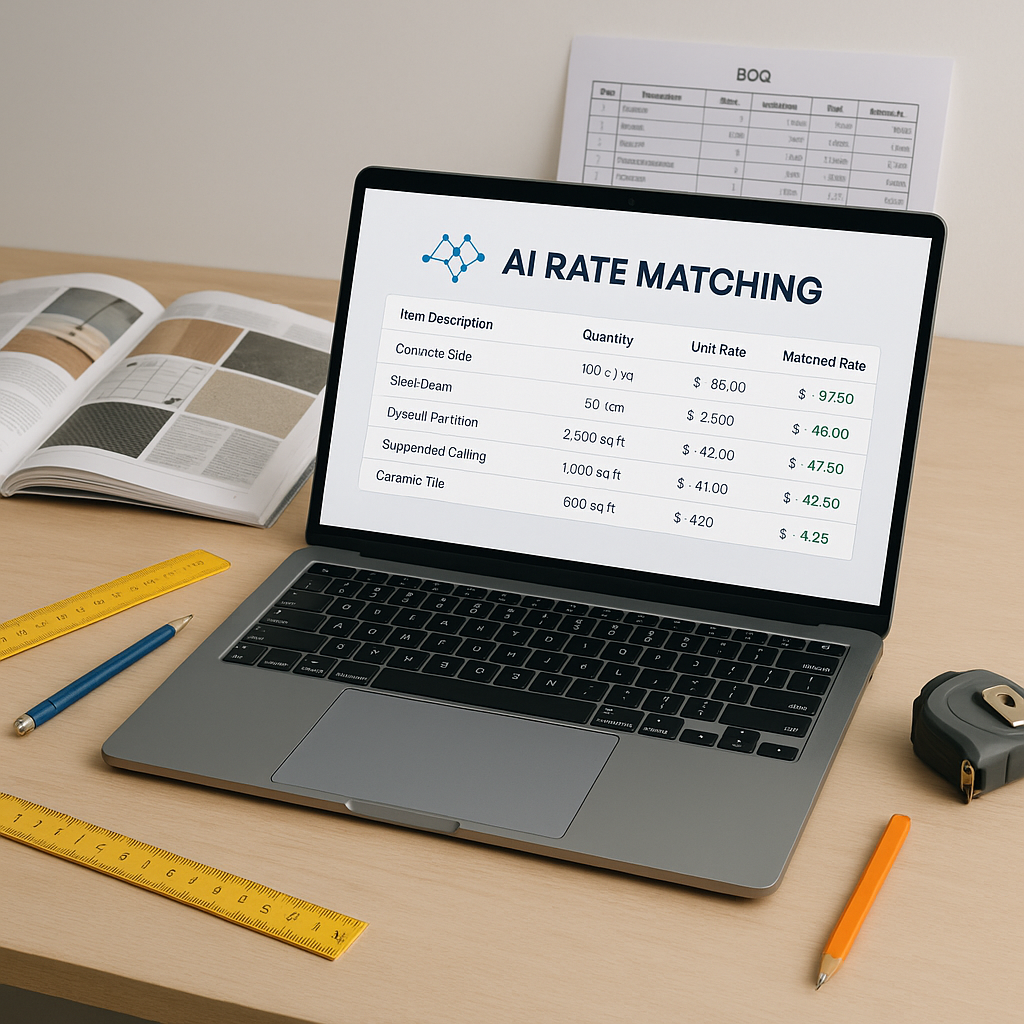
The matched rates are integrated back into your BOQ. You get a fully priced bid package, complete with a breakdown of material, labor, and equipment costs. No flipping through DSR PDFs or RSMeans books.
Why This Matters
Let’s get real. The time savings alone are significant. Manual rate lookup can take hours per estimate, especially for large projects. AI reduces this significantly. But it’s not just about speed — it’s about reducing errors. AI doesn’t get tired or distracted. It doesn’t accidentally pick the wrong rate because the text was blurry on page 873 of a scanned PDF.
Illustrative example — A general contractor bidding on a commercial project used AI rate matching. They reduced the time spent on estimation and improved their bid accuracy. This allowed them to reinvest time into bid strategy and subcontractor negotiations — the tasks that actually win jobs.
Common Skepticisms (and Answers)
You might be thinking, “Sure, AI is fast, but does it really understand how construction works?” Fair question. AI doesn’t replace your expertise; it amplifies it. You’re still in control. The AI just handles the repetitive, low-value tasks, so you can focus on the nuanced decisions.
Another concern is, “What if my rates are custom?” No problem. Good AI tools let you upload your own rate catalogs. The system integrates them seamlessly, so your estimates always reflect your real costs.
What to Watch For
AI isn’t perfect. No system is. Here are a few things to keep in mind:
-
Garbage In, Garbage Out: If your BOQ is messy or your rate catalogs aren’t updated, the AI can’t perform miracles. Clean data is key.
-
Regional Variations: Make sure the tool you choose supports your region’s standards and currencies. For example, some tools work across CSI, CPWD, and CESMM3 standards — but not every tool does.
-
Learning Curve: There’s a slight learning curve, but most platforms are designed for ease of use. Expect to spend some time getting your team up to speed.
FAQ
Q: Can AI handle small projects?
A: Absolutely. AI tools scale to any project size, from small renovations to large infrastructure projects.
Q: Is AI accurate?
A: AI-powered rate matching is highly accurate, but human oversight is essential. Think of it as a second pair of eyes.
The Bottom Line
Manual rate lookup is outdated. It’s slow, error-prone, and frankly, a waste of your team’s talent. AI-powered rate matching solves this problem, cutting time from your process and improving accuracy. If you’re not using it, you’re leaving efficiency and potential savings on the table.