The Preconstruction Bottleneck
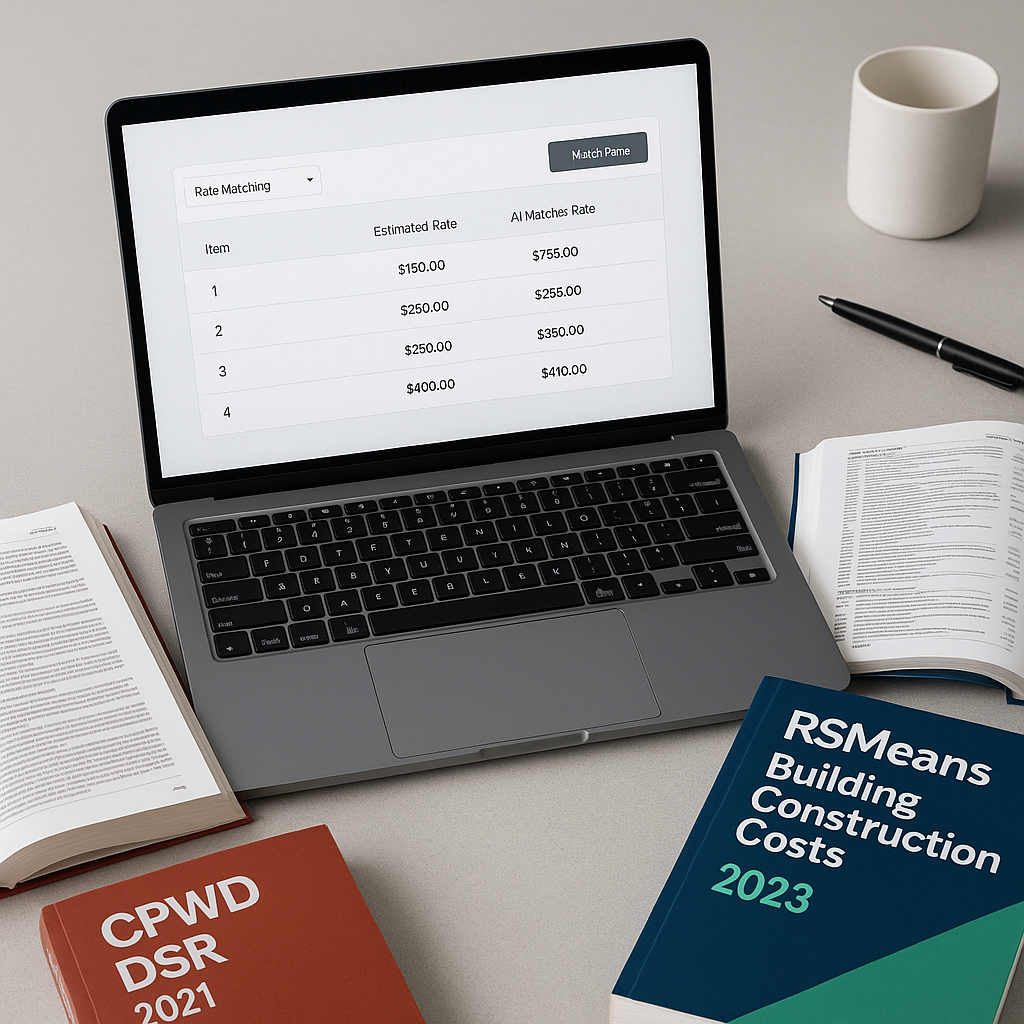
Pricing a bid package for a commercial project often involves handling a detailed Bill of Quantities (BOQ) and matching line items with rates for labor, materials, and equipment. Traditionally, this process requires manually cross-referencing descriptions and units from extensive rate books like RSMeans or CPWD DSR. This manual effort is time-consuming and prone to errors, which can impact the accuracy of estimates and project margins.
How AI Rate Matching Works
AI-powered rate matching tools simplify this process by leveraging pattern recognition and machine learning. Here’s how they typically work:
- Smart BOQ Parsing: Upload your BOQ in formats like Excel, CSV, or scanned PDFs. The system identifies headers, hierarchies, and merged cells.
- Intelligent Search: Enter keywords or phrases (e.g., “RCC slab 150mm thick”), and the AI matches them to the closest items in standardized Schedule of Rates (SOR) databases.
- Fallback Mechanisms: If no exact match is found, the system expands the search to include user-defined catalogs, regional databases, or AI-driven suggestions.
- Custom Catalog Integration: Import your own rates for specific materials or labor, allowing the AI to incorporate them into its suggestions.
This automation significantly reduces the time required for rate lookup and minimizes manual errors.
Why This Matters
AI rate matching tools combine automation with human oversight to ensure accuracy. Users can review and adjust AI-suggested rates before finalizing estimates. Over time, these tools learn from user feedback, improving their accuracy and relevance for future projects.
The ROI of Faster Rate Matching
Illustrative example — Consider a scenario where rate lookup for a 120-line BOQ takes several hours manually. With AI tools, this process can be completed in a fraction of the time. The time saved allows teams to focus on pricing more bids, improving their chances of winning projects and reducing labor costs associated with manual estimation.
Common Questions About AI Rate Matching
Q1: What happens if the AI can’t find the right rate?
A1: Most platforms include fallback mechanisms, expanding searches to additional catalogs or allowing manual input of rates.
Q2: How reliable are AI-suggested rates?
A2: AI tools improve with use. Feedback loops enable the system to learn from user decisions, enhancing accuracy over time.
Q3: Can AI tools integrate with existing software?
A3: Yes, many AI tools integrate with platforms like Bluebeam, Procore, and Excel, streamlining workflows.
Q4: Is AI rate matching worth it for smaller contractors?
A4: Yes, the time savings and improved accuracy can benefit projects of all sizes, from small renovations to large infrastructure developments.
What to Watch For
Even with AI, rate matching requires attention to detail. Common pitfalls include:
- Garbage In, Garbage Out: Ensure BOQs are well-formatted to avoid confusion.
- Overconfidence: Review AI-suggested rates before accepting them.
- Custom Rate Updates: Keep labor and material rate catalogs updated to maintain accuracy.
Conclusion
AI-powered rate matching tools offer a practical solution to the inefficiencies of manual preconstruction estimation. By automating BOQ parsing and rate lookup, these tools save time, reduce errors, and improve overall project estimation accuracy.