Why Manual Rate Lookup Is a Bottleneck
If you’ve ever spent hours flipping through a 2,000-page RSMeans catalog or CPWD DSR rate book, you know the pain. Rate lookup is one of the most tedious parts of preconstruction estimation. Need to find the labor rate for installing pre-stressed concrete girders? You’re lost in a sea of tables, codes, and pages that seem endless. And that’s just one line item — multiply this by hundreds in a BOQ and you have a real productivity challenge.
Manual lookup isn’t just slow; it’s prone to error. One missed multiplier or a wrong unit conversion can throw off your entire bid. Worse, it’s inconsistent. The same estimator might interpret a rate differently depending on how tired they are or how rushed the deadline is. That’s why rate matching is ripe for AI intervention.
How AI Rate Matching Works
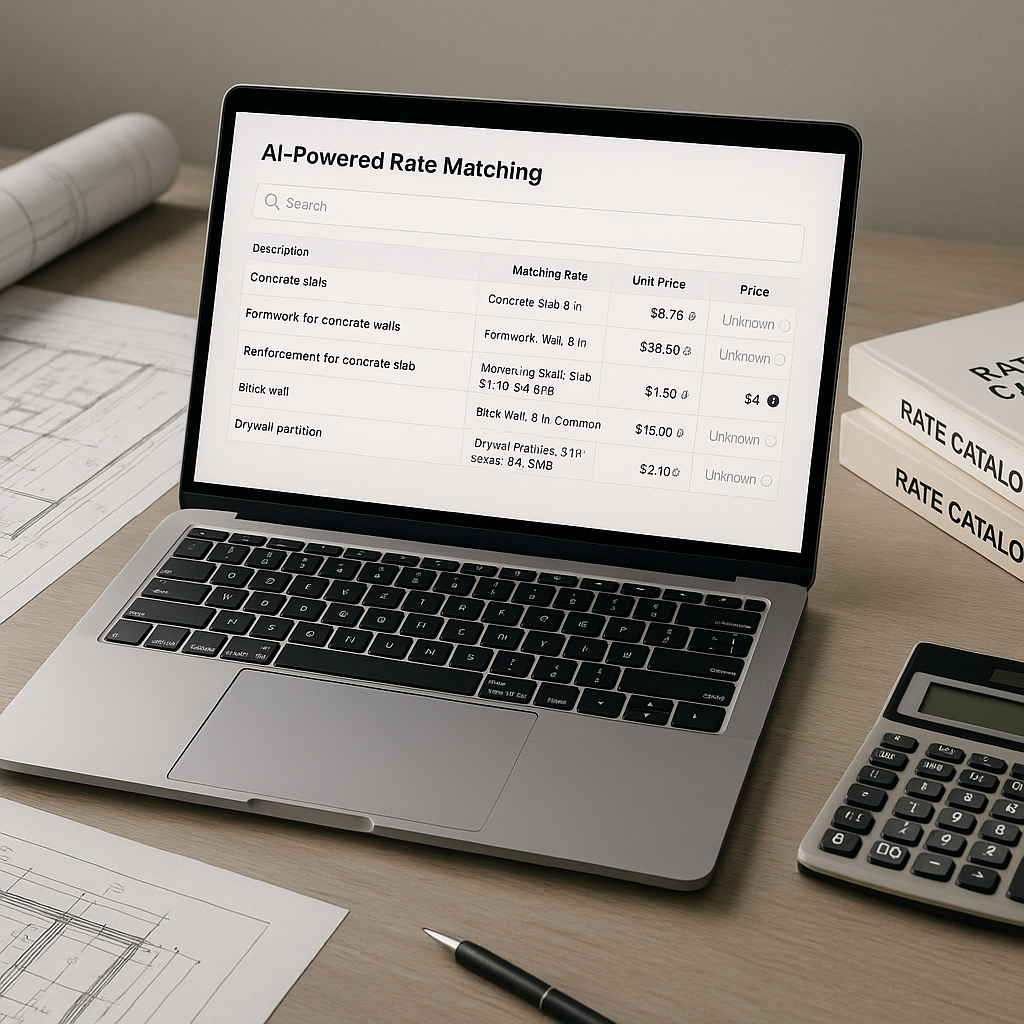
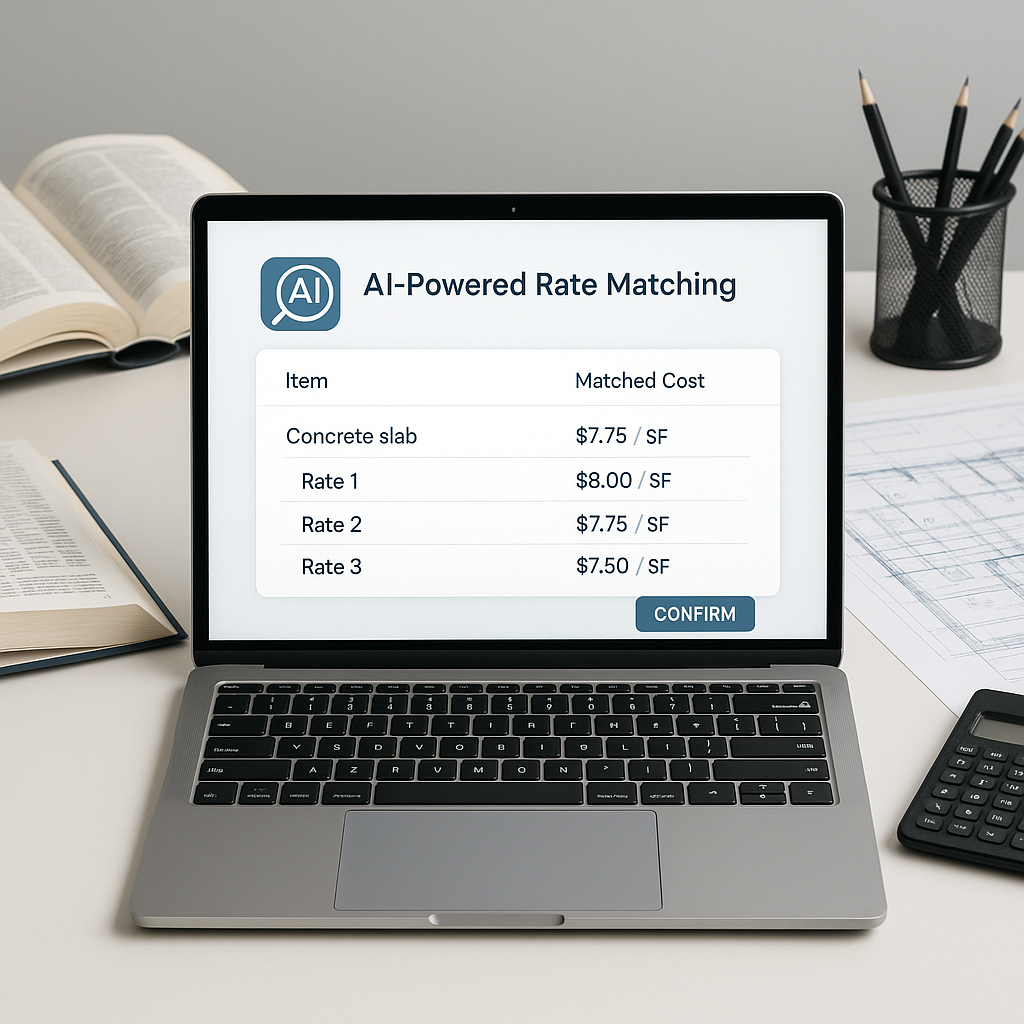
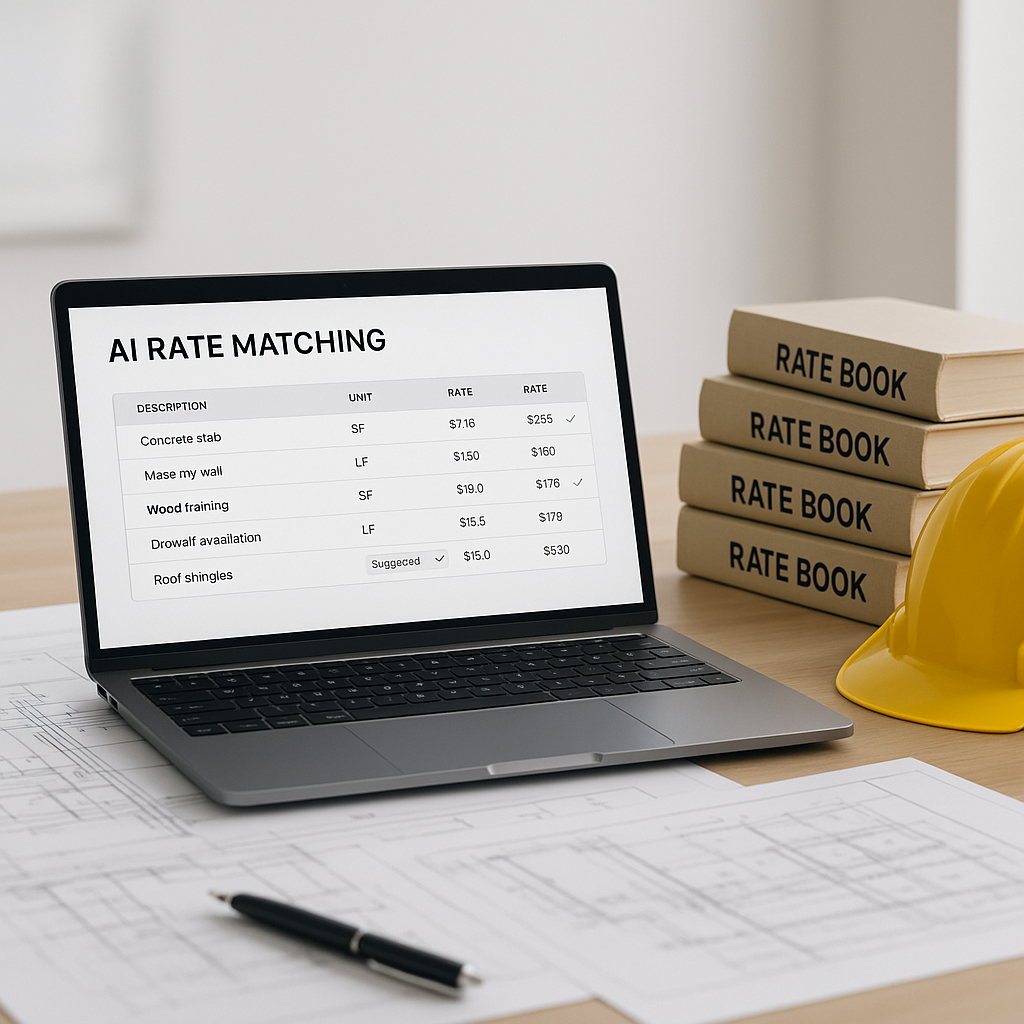
AI-powered rate matching tools turn this bottleneck into a streamlined process. Here’s how it works:
-
Semantic Search Across Catalogs: Instead of flipping through hundreds of pages, you type a keyword or description into the AI tool. For example, if you need the rate for “M10 concrete with pumping,” the AI searches across thousands of SOR items in seconds, pulling the most relevant matches.
-
Contextual Matching: AI doesn’t stop at keywords. It understands context. For example, if you specify a project in a particular region, it prioritizes rates relevant to that location, such as RSMeans for the U.S. or CPWD DSR for India.
-
Custom Catalog Integration: Got your own rate book? No problem. Many tools let you upload custom catalogs, which the AI integrates seamlessly for future projects. This is particularly useful for firms with proprietary pricing.
-
Audit Trail: Every matched rate comes with an audit trail — where it was sourced from, any adjustments made, and who approved it. This transparency builds trust, especially when explaining bids to clients.
Benefits of AI Rate Matching
- Time Savings: Automating rate lookup reduces the time spent on tedious tasks, allowing estimators to focus on higher-value activities.
- Improved Accuracy: By minimizing manual errors, AI ensures more reliable estimates.
- Consistency: AI applies the same logic every time, reducing variability in rate interpretation.
- Scalability: Whether it’s a small renovation or a large infrastructure project, AI tools scale to meet the needs of any project size.
Common Objections (and Answers)
You might be thinking, “Sure, AI is fast, but does it really understand construction?”
The obvious objection is that AI doesn’t replace your expertise. And that’s true — it’s not meant to. AI amplifies your efficiency by handling grunt work, like rate lookup and matching. You’re still the one negotiating with subs, making judgment calls, and deciding on markup.
Another concern is reliability. Can you trust AI to get rates right? Many platforms address this with manual override options. If a rate seems off, you can adjust it instantly — no rigid system forcing bad data.
What to Watch For
Even the best AI tools need clean input data. If your BOQ is messy — merged cells, inconsistent formatting — it can trip up the AI. Many tools handle a lot of this automatically, but it’s good practice to clean your BOQ before uploading. Also, remember that AI learns over time. The more you use it, the smarter it gets at matching rates to your preferences.
FAQs
Q: Can AI rate matching handle custom materials or finishes?
Yes. You can upload custom catalogs, and the AI integrates them for future use. It’s designed for flexibility.
Q: How accurate are AI-matched rates compared to manual ones?
Accuracy improves significantly over time as the system learns from your feedback. Manual overrides are still available for edge cases.
Q: Does this work for smaller projects?
Absolutely. AI tools scale to any project size, from small renovations to large infrastructure builds.
Q: Can I use this with other software?
Yes. Many AI tools integrate with platforms like Procore, Bluebeam, and Excel, making it easy to export matched rates into existing workflows.
Q: What happens if a catalog changes mid-project?
AI tools update catalog data regularly. You can also manually upload updated catalogs to ensure rates stay current.
Conclusion
If manual rate lookup is slowing down your bids, AI-powered tools can help. Save time on every estimate and reduce costly errors by integrating AI into your preconstruction workflow.