The Problem We All Know Too Well
If you've ever worked in preconstruction estimation, you know the pain of rate lookup. Flipping through extensive rate books or scrolling endlessly through PDF catalogs is a time-consuming process. For general contractors, it's not just slow—it’s costly. Every minute spent hunting rates is a minute not spent refining bids, negotiating with subcontractors, or focusing on winning work.
Rate lookup can take significant time per estimate, especially for mid-size pursuits. For teams handling government projects, the challenge is even greater. CPWD DSR books (India) or RSMeans catalogs (U.S.) include thousands of line items. Missing the right rate—or worse, using the wrong one—can negatively impact margins before the project even begins.
So, what’s the solution? AI-powered rate matching tools are transforming this workflow entirely.
How AI Rate Matching Works
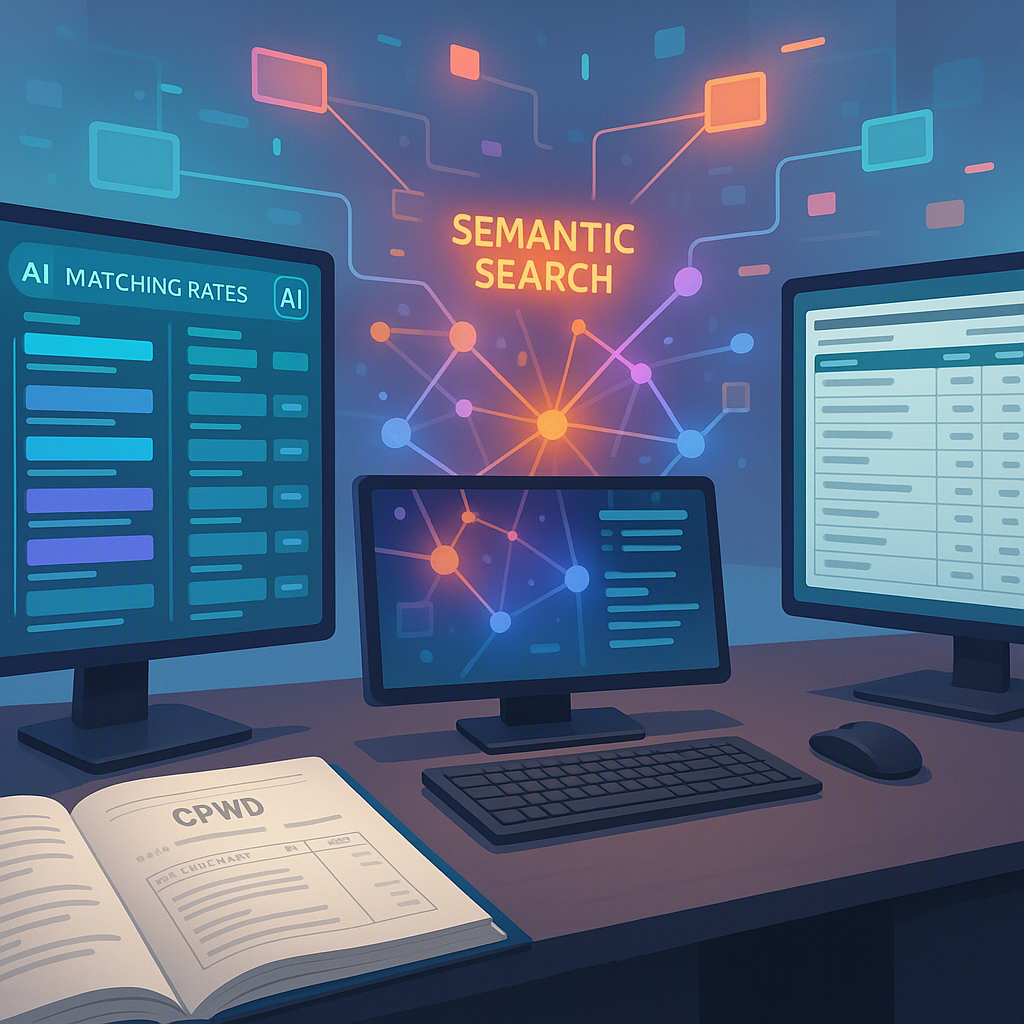
Let’s start with the basics. AI rate matching tools use semantic search to connect your Bill of Quantities (BOQ) to the right rates quickly and efficiently. Instead of manually looking up labor costs for specific tasks, you input the item name into the platform. The AI scans thousands of catalog entries and provides relevant matches in seconds.
Here’s why it works:
- Semantic Search: Unlike keyword search, semantic search understands context. For example, typing “M20 concrete” or “fire-rated gypsum board” yields precise matches, even if the catalog uses slightly different terminology.
- Feedback Loops: The AI improves with use. When you accept or reject a rate match, the tool adjusts its future recommendations accordingly.
- Custom Catalogs: If you have proprietary rates or project-specific adjustments, you can upload them, and the AI integrates them seamlessly into its database.
Step-by-Step Workflow Using AI Rate Matching
Here’s how a typical workflow with an AI rate matching tool might look:
- Upload the BOQ: Start by uploading your Bill of Quantities (BOQ) into the AI tool.
- Search for Matches: The AI will scan its database, which may include standard catalogs like CPWD DSR, RSMeans, or your custom rate files, to find the closest matches for each line item.
- Refine Results: Review the AI’s suggestions and provide feedback. Tools often allow you to accept, reject, or adjust rates directly on the platform.
- Export Final Estimate: Once all rates are mapped, export the completed BOQ with accurate rates for further analysis or submission.
These tools are designed to handle vast amounts of data, such as thousands of Schedule of Rates (SOR) entries, making them highly versatile for various project needs. Moreover, they streamline what would otherwise be a labor-intensive, manual process.
Why This Matters for Preconstruction Teams
Rate lookup isn’t just a time issue—it’s also a matter of accuracy. Manual processes are prone to human error. Misreading a line item, skipping a page, or applying outdated inflation factors can lead to bids that are either uncompetitive or unprofitable.
Key Benefits for Preconstruction Teams
- Time Savings: Automating rate lookup cuts down the hours spent flipping through catalogs or searching PDFs. This frees up estimators to focus on strategy, bid optimization, and collaboration.
- Improved Accuracy: AI ensures that the rates selected are the most relevant and up-to-date, reducing costly errors in estimates.
- Consistency Across Teams: With a centralized AI tool, teams can standardize their rate selection process, ensuring uniformity and reducing discrepancies between team members.
- Better Bid Competitiveness: Accurate and timely estimates improve the chances of submitting competitive bids while protecting profit margins.
Actionable Steps for Teams Considering AI Adoption
- Assess Your Current Process: Identify inefficiencies in your existing rate lookup workflow. How much time is being spent on this task, and how often do errors occur?
- Evaluate AI Tools: Research available AI rate matching platforms. Look for tools that integrate with your existing systems, such as project management or estimating software.
- Start Small: Begin by using the AI tool on a single project or a specific phase of your workflow. Gradual adoption ensures minimal disruption.
- Train Your Team: Provide training sessions to ensure all team members understand how to use the tool effectively.
Practical Benefits of AI Rate Matching
Time Savings
Imagine a contractor working on a large-scale infrastructure project. In a manual workflow, rate lookup for 200 BOQ items might take six hours or more. With an AI-powered tool, the same task could be completed in under 30 minutes. This time savings is not just a convenience—it translates into faster bid preparation, allowing teams to meet tight submission deadlines.
Over the course of a year, even saving a few hours per project can add up to hundreds of hours. This reclaimed time can be redirected toward refining bid strategies, exploring alternative designs, or engaging subcontractors.
Error Reduction
Manual processes are inherently error-prone. A simple mistake, such as misreading a labor rate or applying the wrong inflation factor, can lead to a bid that is either too low (eroding profits) or too high (losing the job). AI tools minimize these risks by:
- Ensuring rates are pulled directly from verified sources.
- Highlighting discrepancies or anomalies in BOQ entries.
- Allowing users to apply inflation adjustments or custom factors with precision.
What’s the Catch?
You might be wondering: Isn’t AI just a glorified calculator? Can it really handle the complexities of real-world estimation?
Addressing Common Concerns
- AI Amplifies, Not Replaces: AI doesn’t replace your expertise—it enhances it. Estimators still make critical decisions, such as setting markup percentages, evaluating subcontractor bids, and negotiating with clients. The AI simply handles the repetitive, time-consuming tasks.
- Human Oversight Is Key: While AI tools are highly accurate, they are not infallible. Most platforms include features for manual review and adjustment, ensuring that you maintain control over the final output.
- Learning Curve: While there is an initial learning period for adopting AI tools, the long-term benefits in terms of time savings and accuracy make the investment worthwhile. Teams can gradually integrate these tools into their workflows and adapt them to their specific needs.
FAQ: Common Questions About AI Rate Matching
Q: Does it work for small projects?
A: Yes. AI tools are scalable and can be used for projects of any size, from small renovations to large infrastructure developments.
Q: What happens if my rates are custom?
A: You can upload proprietary rates or define custom adjustments. The AI can incorporate these into its database for future use, ensuring that your unique requirements are met.
Q: Can it handle inflation adjustments?
A: Yes. Many AI tools allow users to manually input inflation factors or other adjustments to ensure that rates are accurate for the current market conditions.
Q: Is it reliable for government tenders?
A: Absolutely. These tools are designed to comply with standards such as CPWD, CESMM3, and NRM2, making them suitable for government projects.
Q: How long does it take to implement?
A: Implementation timelines vary, but most tools are designed for quick onboarding. With proper training, teams can begin using these tools effectively within a few weeks.
Decision Framework: Is AI Rate Matching Right for You?
| Question | If Yes | If No |
|---|---|---|
| Do you spend more than 2 hours on rate lookup per estimate? | Consider implementing AI tools to save time. | Manual processes might suffice for now. |
| Do you frequently work on government tenders? | AI tools designed for CPWD, RSMeans, etc., can simplify compliance. | Evaluate your existing workflow for inefficiencies. |
| Do you have custom rate catalogs? | Look for tools with custom catalog integration. | Focus on tools with robust default databases. |
| Is your team comfortable with technology? | Minimal learning curve expected. | Provide additional training during adoption. |
Closing Thoughts
Rate lookup is one of the most time-consuming and error-prone aspects of preconstruction estimation. AI-powered rate matching tools offer a solution by automating this process, reducing the time required and improving accuracy.
If your team spends too much time navigating rate books or digital catalogs, it may be time to explore AI solutions. These tools can help you streamline your workflow, enhance the accuracy of your estimates, and ultimately improve your chances of winning more bids.