Top 5 Reasons Preconstruction Estimators Need AI Tools in 2026
If you're in preconstruction, you already know: estimation is a grind. The hours are long, the tools are clunky, and the margin for error is razor-thin. And yet, the industry is still dragging its feet when it comes to adopting AI tools designed to make this process faster, smarter, and less soul-crushing. Why? Some of it is fear of change. Some of it is stubbornness. But a lot of it comes down to not understanding what AI can actually do for the average estimator.
It’s time to clear that up. Here are five reasons why every preconstruction estimator is going to need AI tools by 2026—and why waiting to adopt them could cost your company valuable opportunities.
1. Takeoff Speed: From Hours to Minutes
Takeoffs are the bread and butter of preconstruction, but let’s be honest—tracing lines on a PDF for hours per project is not the best use of anyone’s time. Even with tools like Bluebeam, it’s still a manual slog: calibrating scales, counting doors and windows, and highlighting walls and floors for measurements. Mess up once, and you’re back to square one.
AI tools can significantly reduce this workload. Using Vision AI, you can upload a PDF, and the tool will automatically extract quantities like room areas, wall lengths, and even door counts. Some systems can even identify materials based on patterns or annotations, providing an additional layer of detail without requiring manual input. This automation not only speeds up the process but also improves accuracy by reducing human error.
Actionable Steps:
- Invest in Vision AI Solutions: Look for tools that specialize in parsing construction drawings and extracting detailed quantities.
- Integrate AI with Existing Software: Many AI tools integrate seamlessly with platforms like Bluebeam or AutoCAD, so you don’t need to overhaul your workflow.
- Train Your Team: Implement short training sessions to help your estimators understand how AI takeoff tools work and how to verify outputs effectively.
The real value of this speed isn’t just time savings—it’s the ability to reallocate your team’s efforts to higher-value tasks like strategy, value engineering, and client engagement. In a competitive landscape where deadlines are tighter than ever, this type of efficiency can make or break your bids.
2. Rate Matching: Simplifying a Tedious Process
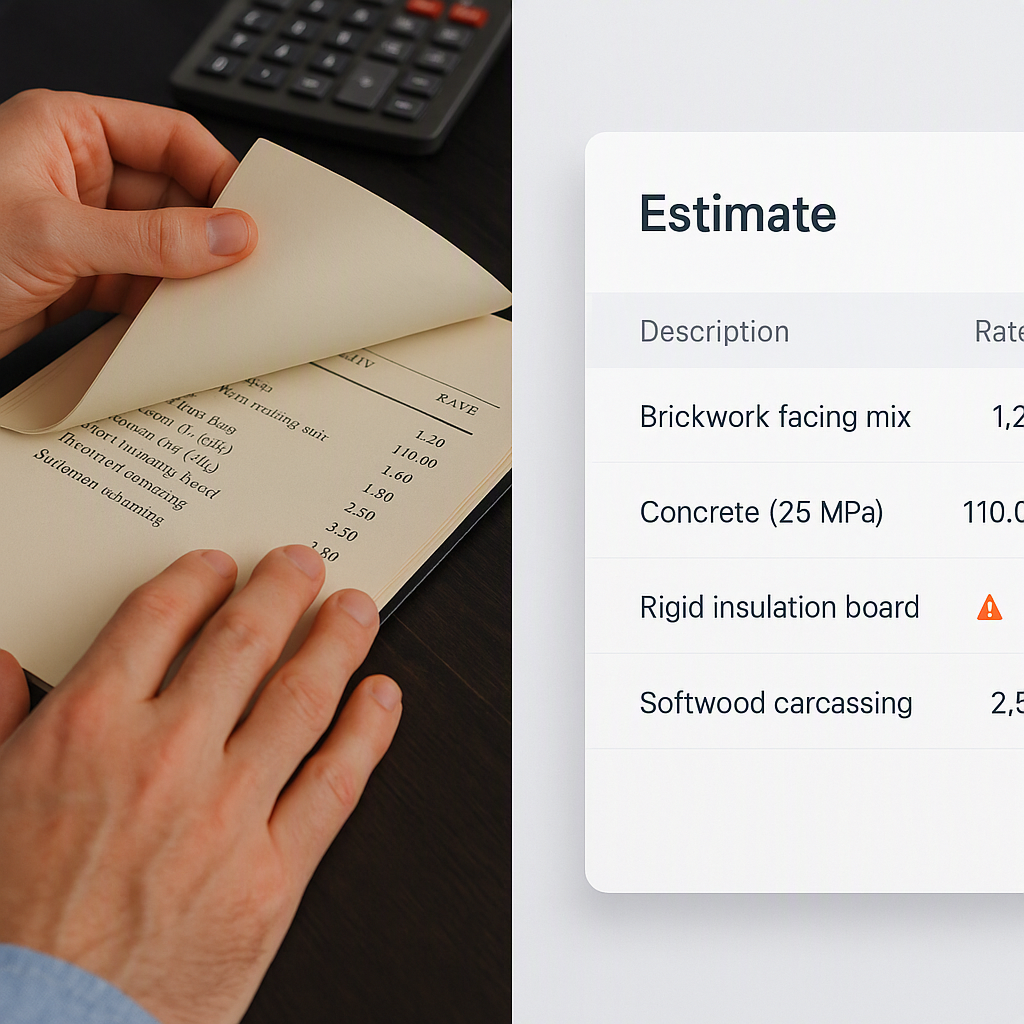
How many hours have you spent flipping through massive rate books like RSMeans or CPWD DSR, trying to find the right rates for your Bill of Quantities (BOQ)? It’s tedious and prone to errors. One wrong lookup can skew your estimate significantly.
AI-powered rate matching tools address this challenge by using semantic search engines trained on extensive datasets. These tools can quickly match your BOQ line items to historical rates, country-level standards, or even custom catalogs you upload. Over time, the system learns from your inputs, improving its accuracy and relevance.
Actionable Steps:
- Upload Historical Data: Feed your AI tool with past project data to create a baseline for rate matching.
- Use AI for Market Trends: Advanced AI tools can also incorporate real-time pricing trends, ensuring your estimates stay competitive.
- Collaborate Across Teams: Share rate-matching tools with procurement and project management teams to standardize cost assumptions across departments.
This isn’t just about speed—it’s about building trust. When you can provide clients with clear documentation of rate sources and an audit trail, negotiations become smoother and more transparent. You’re no longer relying on gut instinct; you’re presenting a solid, data-backed rationale for every line item.
3. What-If Scenarios: Instant Updates Without Spreadsheets
Picture this: you’re mid-bid, and the client asks, “What if we use a different grade of steel?” If you’re still using Excel, that means hours of reworking your entire workbook. Every dependent cell needs to be updated, and one missed formula can disrupt the entire estimate.
AI tools eliminate this hassle. With real-time propagation, you can update one rate, and the system recalculates everything instantly. This reduces the risk of errors and allows you to respond to client changes quickly and confidently.
Actionable Steps:
- Adopt Real-Time Estimation Tools: Choose platforms that offer dynamic updates for material substitutions, labor adjustments, and scope changes.
- Standardize Inputs: Establish a library of pre-approved alternate materials or components to streamline what-if scenarios.
- Run Multiple Variants: Use AI to generate several pricing models at once, allowing clients to explore alternatives without delays.
In a fast-paced industry, the ability to adapt to changes without delays is essential for staying competitive. It also demonstrates flexibility to your clients, which can be a deciding factor in winning bids.
4. Bid/No-Bid Decisions: From Intuition to Data-Driven Insights
Bid/no-bid meetings often rely on gut instincts and anecdotal evidence. Someone might say, “That client never picks the cheapest bid,” while another person argues, “But we’ve worked with them before.” These discussions can be time-consuming and inconclusive.
AI tools can bring structure to this process. By analyzing tender documents and evaluating factors like project size, location, risk profile, and client history, these tools provide data-driven insights to guide your decisions. For example, some AI platforms can assign a probability score to each project based on historical success rates, helping you prioritize bids that align with your strengths.
Actionable Steps:
- Automate Tender Analysis: Use AI to extract key metrics like scope complexity, location challenges, and competitive benchmarks.
- Create Scoring Models: Develop a weighted scoring system for bid/no-bid decisions based on AI-generated insights.
- Track Win Rates: Continuously refine your AI tool by feeding it data from past projects to improve its predictions.
This structured approach helps you focus on bids with the highest likelihood of success, saving time and resources while reducing guesswork.
5. Talent Retention: Reducing Burnout Among Estimators
Manual preconstruction workflows are a major contributor to burnout. Your best estimators often spend their time on repetitive tasks like tracing PDFs and updating spreadsheets instead of focusing on strategic work that wins bids.
In an industry facing a skilled labor shortage, retaining top talent is more important than ever. AI tools can take over the repetitive, low-value tasks, allowing your team to focus on innovation, client relationships, and high-level decision-making.
Actionable Steps:
- Automate Repetitive Tasks: Implement AI for tedious workflows like takeoffs, rate matching, and document updates.
- Upskill Your Team: Provide training in AI tools to enable estimators to transition into higher-level roles.
- Monitor Workloads: Use AI analytics to identify bottlenecks in your team’s workflows and redistribute tasks accordingly.
This not only improves job satisfaction but also enhances your team’s overall productivity. Happier employees are more likely to stay, reducing turnover and ensuring your company retains its competitive edge.
Comparison Table: Manual vs AI-Powered Estimation
| Feature | Manual Workflow | AI-Powered Workflow |
|---|---|---|
| Takeoff Time | Hours per drawing | Minutes per drawing |
| Rate Matching Accuracy | Prone to human error | High accuracy with audit trails |
| What-If Scenarios | Time-consuming updates | Real-time propagation |
| Bid/No-Bid Decisions | Gut-based | Data-driven insights |
| Employee Satisfaction | High burnout risk | Focus on high-value work |
The Bottom Line
AI tools are no longer a luxury—they’re a necessity. From speeding up takeoffs to enabling smarter bid decisions, they’re transforming how preconstruction teams operate. If you’re looking to improve efficiency and stay competitive, adopting AI tools is a step you can’t afford to delay.