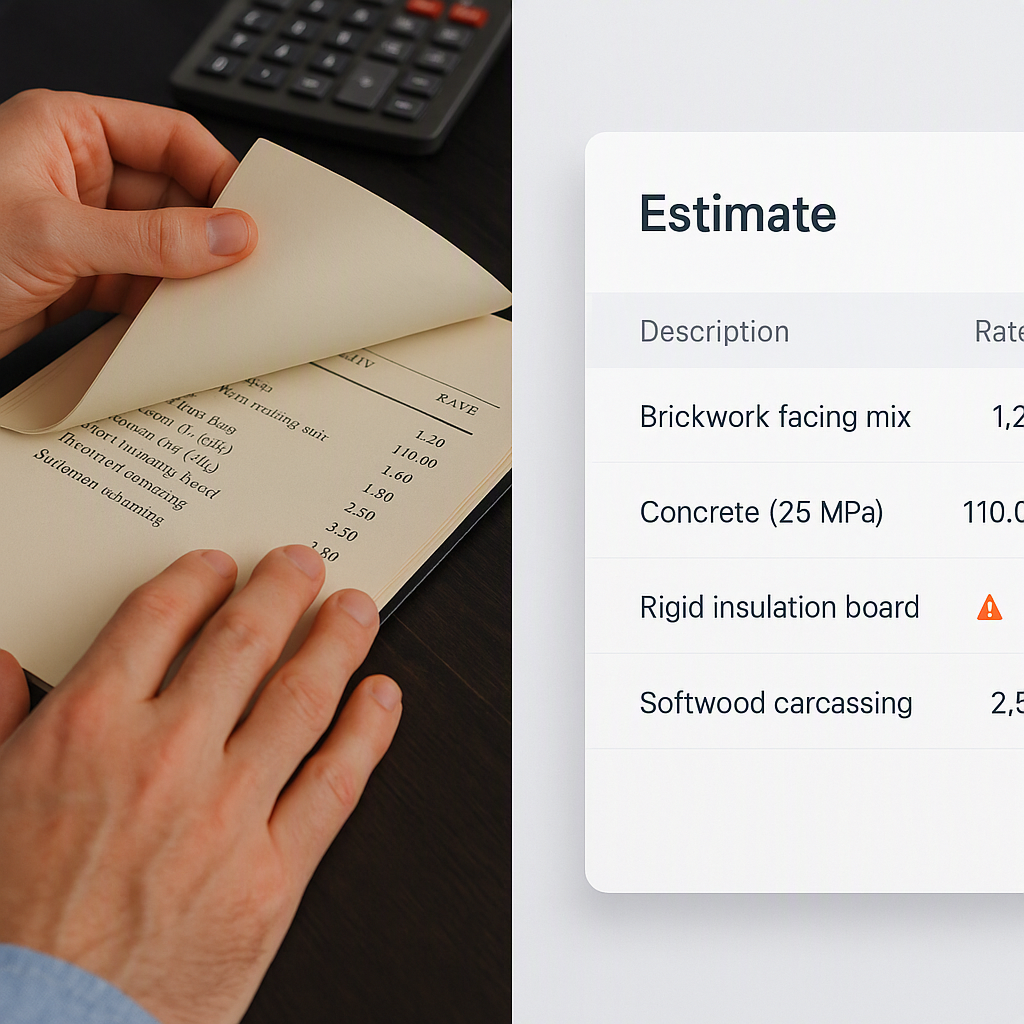
I Used to Trust Manual Rate Lookups
When I started out in construction estimation, flipping through rate books felt like a rite of passage. Whether it was RSMeans or CPWD DSR, you'd grab a physical copy or a massive PDF, bookmark the sections you needed, and spend hours hunting for the perfect match. It was tedious, but it felt like the only way to ensure accuracy.
If someone had told me that AI could do this for me, I would’ve scoffed. How could a machine understand the nuances of labor rates, material costs, or regional variations? Estimation isn’t just about numbers; it’s judgment, experience, and gut instinct. Or so I thought.
The Shift: A Real Problem Forced My Hand
The turning point came earlier this year. I was working on a bid for a multi-million-dollar infrastructure project in India. The BOQ had over 600 line items—everything from reinforced concrete rates to specialized waterproofing systems. The deadline was brutal: two weeks.
I was staring at 19 separate CPWD DSR catalogs, trying to cross-reference rates. Every time I thought I was done, a last-minute change would send me back into the PDFs. At one point, I realized I’d spent 12 hours just flipping between rate sections. That’s when I started looking for alternatives.
EstimateNext caught my attention because it offered AI-powered rate matching across CPWD DSR and state SORs. According to SoftNext Solutions Pvt. Ltd., headquartered in Navi Mumbai, the platform connects rates directly to your Bill of Quantities (BOQ), giving instant updates and saving significant time.
Why This Process Was Unsustainable
Manual lookups work when you’re dealing with a handful of line items. But when the complexity scales up—hundreds or even thousands of items—problems snowball:
- Time-intensive: Matching hundreds of items manually can take days, especially when dealing with multiple catalogs like the CPWD DSR, which contains over 78,000 items according to EstimateNext.
- Error-prone: Misreading or skipping lines becomes increasingly likely as the number of items grows.
- Rigid process: If you need to make changes mid-way, you often have to start over.
In a competitive bidding environment, these inefficiencies can cost you the project.
Why Manual Lookups Lasted So Long
In fairness to my old methods, manual lookups have a certain appeal. You feel in control—you see every rate, every breakdown, and make decisions with confidence. It’s tactile, and you trust it because you’ve done the work yourself.
The Hidden Costs of Manual Lookups
- Human Error: Even experienced estimators can misread rates or apply the wrong ones.
- Limited Scalability: As project sizes grow, manual methods can’t keep up. Larger bids mean more BOQ line items.
- Repetitive Work: The same rates often need to be referenced repeatedly across projects. Without automation, you’re reinventing the wheel every time.
Why This Approach Persisted
Many professionals stick to manual methods because of a lack of trust in alternatives. There’s a belief that automation can’t capture the nuances of pricing or regional variations. However, as platforms like EstimateNext evolve to include specific catalogs like CPWD DSR and RSMeans, this assumption is losing ground.
What AI Rate Matching Does Differently
AI doesn’t replace expertise—it amplifies it. When I uploaded my BOQ to EstimateNext, the tool scanned it, recognized the line items, and matched them against CPWD DSR rates. It even flagged items with low-confidence matches, letting me review them manually.
Instead of 12 hours, rate matching took me under 10 minutes. That’s not an exaggeration—it’s what the tool is built to do. According to a report published by ai505.com on March 7, 2025, Ladder AI, another platform, also offers similar capabilities, demonstrating the growing industry-wide adoption of AI for preconstruction estimation.
Key Features of AI-Powered Tools
- Semantic Search: AI tools like EstimateNext allow you to search for terms like "reinforced concrete M25" and get instant matches, including material and labor breakdowns. Unlike manual keyword searches, semantic search understands the context behind terms.
- Confidence Scoring: Matches are flagged with a confidence score so you can focus your attention on low-confidence items.
- Custom Catalogs: Many tools let you upload your own rate catalogs or modify existing ones to suit your project.
- Scalability: Whether you’re working on a 10-item BOQ or a 1,000-item one, the process takes roughly the same amount of time.
How It Handles Ambiguities
For specialized items—like the waterproofing system I mentioned—the AI suggested similar entries from other catalogs and flagged them for review. While it wasn’t perfect, it gave me a solid starting point that I didn’t have to build from scratch. This flexibility is critical for complex projects.
What I Do Differently Now
I still review every estimate manually, but my workflow has changed drastically. Instead of wasting hours flipping through PDFs, I let AI handle the grunt work. Here’s what my process looks like now:
- Start with AI-powered matching: Upload the BOQ and let the tool handle 80-90% of the rate lookup.
- Focus on edge cases: Spend your time reviewing low-confidence matches or specialized items that require human judgment.
- Use feedback loops: Adjust rates or matches as needed, and let the system learn for future projects.
- Leverage historical data: Over time, these tools build a repository of rates and matches, making future estimations even faster.
Why Being Wrong Cost Me
I’ll admit it: I resisted AI rate matching longer than I should have. If I’d adopted it earlier, I could’ve saved hundreds of hours across multiple projects. That’s time I could’ve spent refining bid strategies, negotiating with subcontractors, or simply not working late.
Trust vs. Consistency
Manual methods feel reliable, but they’re prone to error. AI systems aren’t perfect either, but they’re consistent. And the more you use them, the smarter they get. I’m still learning to trust the process, but the results speak for themselves.
Decision Framework: Manual vs. AI Rate Matching
| Criteria | Manual Lookups | AI-Powered Tools |
|---|---|---|
| Time Efficiency | Hours or days | Minutes |
| Accuracy | Prone to human error | Consistent, but requires manual review |
| Scalability | Poor for large BOQs | Handles thousands of line items easily |
| Flexibility | Limited to catalog format | Adapts to custom catalogs and inputs |
| Learning Curve | None (familiar process) | Short, typically under 2 weeks |
Conclusion
If you’re tired of wasting hours on manual rate lookups, AI-powered tools like EstimateNext can help. They’re fast, accurate, and scalable—everything manual methods aren’t. As SoftNext Solutions Pvt. Ltd. highlights, these platforms connect rates directly to your BOQ, ensuring instant updates and saving precious time on even the most complex projects. The key is to view AI as a complement, not a replacement, to your expertise. Get started free →