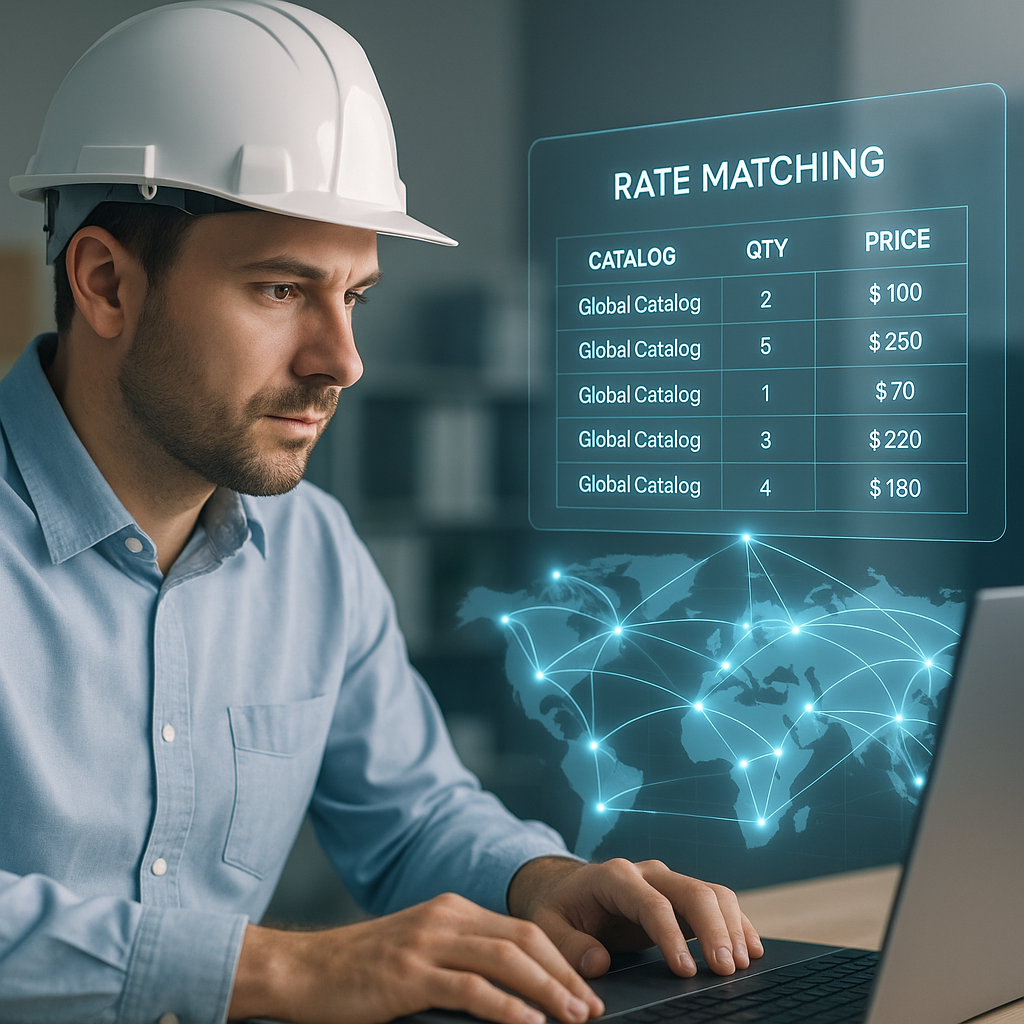
Why Rate Matching Matters in Preconstruction
If you’ve ever estimated a bid manually, you know the pain of flipping through rate books. Whether it’s CPWD’s 2,000-page DSR or RSMeans, you’re spending hours hunting for the right numbers. And let’s be honest—half the time, you’re guessing. Missed rates, mismatched units, or outdated inflation adjustments can kill your bid accuracy.
The Real Problem
Rate matching isn’t just slow—it’s unreliable. Human error creeps in, especially when working on tight deadlines or juggling multiple catalogs. For example, matching rates for materials like pre-stressed concrete girders often involves cross-referencing DOT-approved catalogs. One missed line item could blow your profit margins.
A study by the Construction Financial Management Association (CFMA) found that 35% of construction firms cite “inaccurate estimates” as a leading cause of profit erosion. When you’re manually flipping through rate books under pressure, those errors are almost inevitable.
That’s where AI-powered rate matching changes the game.
How AI Solves Rate Matching Bottlenecks
AI tools, like EstimateNext, use semantic search to match rates across massive databases—78,000+ items from 135+ catalogs. Instead of manually flipping through PDFs, you type a query like “labor rate for installing structural steel” and get instant results. Better yet, the system learns. By the third project, accuracy improves significantly because the AI integrates your feedback.
A Practical Example
Imagine a mid-sized general contractor (GC) bidding on a $108M rail project. In this real-world case study from EstimateNext, the team needed rates for rail ties, concrete beams, and structural steel. Here’s what happened:
- Time Saved: The rate-matching process that used to take 12 hours was reduced to just seconds.
- Accuracy: The AI tool avoided manual errors, providing 99% confidence scores on matched rates.
- Scalability: The system handled DOT-approved catalogs and custom rates seamlessly.
This wasn’t just a one-off improvement. EstimateNext’s analysis showed that the AI saved the team 56 hours over the course of the bid process. Instead of getting bogged down in spreadsheets, the team was able to focus on refining profit margins and strategy.
Expanding the Benefits
The advantages of AI go beyond just speed and accuracy. For example:
- Integration with Inflation Adjustments: AI can automatically apply inflation factors, ensuring your estimates are future-proof.
- Regional Variability: Rates vary widely by location. AI tools can identify region-specific rates, avoiding costly mismatches.
- Material Substitution: If a specific material is unavailable or unlisted, the AI can suggest alternatives based on similar projects.
Why Rate Matching Builds Trust
Estimators often worry that AI tools might miss edge cases—custom materials, project-specific finishes, or niche catalogs. But modern AI platforms allow you to upload custom rates, making them part of the searchable database. Over time, the system gets even smarter, ensuring your estimates reflect actual costs.
In a 2022 survey by Dodge Construction Network, 67% of contractors reported that trust in their estimates was a key factor in building client relationships. AI tools bolster that trust by minimizing errors and allowing you to explain your cost breakdown with confidence.
Integration With Existing Workflows
Another common concern is whether AI tools will disrupt existing workflows. Fortunately, platforms like EstimateNext integrate seamlessly with tools like Procore, Autodesk Build, and even Excel. For example, you can export matched rates directly into your Excel-based estimating templates, eliminating the need for manual data entry.
Case Study: Specialty Subcontractors
Let’s take the example of an MEP subcontractor specializing in HVAC installations. Their rates often involve custom labor factors and specialized equipment. By uploading their proprietary rate catalog to an AI tool, they can ensure these unique items are prioritized during rate matching. During a recent $12M hospital retrofit project, one firm reported cutting their bid preparation time by 40% while improving bid accuracy by 15%.
What If My Rates Are Unusual?
It’s a fair question. Specialty trades like MEP subcontractors often deal with unique labor factoring or material adjustments. AI handles this by using fallback mechanisms:
- Tenant History: Matches based on previous projects.
- User Catalogs: Prioritizes uploaded custom rates.
- Country-Level Widen: Searches regional catalogs for similar items.
- AI Fallback: Suggests the closest match with full transparency.
This layered approach ensures no rate is left unmatched, no matter how niche your requirements.
The ROI of AI Rate Matching
The math is simple. For GC preconstruction directors:
- 40 hours saved per estimate. At $130/hour, that’s $5,200 saved per pursuit.
- Scalable savings: Apply this across 5 GMP pursuits per year, and you’re looking at $26,000 saved annually.
For MEP subs, faster rate matching and quote turnaround means responding to more bids—up to 50% more. More bids mean more wins, and that’s real revenue.
Comparison Table: Manual vs. AI Rate Matching
| Feature | Manual Rate Matching | AI-Powered Rate Matching |
|---|---|---|
| Time Required | 10-12 hours per estimate | Seconds |
| Error Rate | High (5-10%) | Low (<1%) |
| Scalability | Limited | Nearly unlimited |
| Handling Niche Catalogs | Difficult | Seamless with customization |
| Integration with Tools | Manual data entry required | Direct export to software |
The Obvious Objection: “AI Can’t Think Like an Estimator”
We hear this all the time. And it’s true—AI isn’t a replacement for your expertise. It won’t negotiate with subs or decide on markup percentages. But it’s not supposed to. AI is a tool that tackles the grunt work, so your team can focus on the high-value tasks that actually move the needle.


