AI-Powered Preconstruction Estimation: How Rate Matching Works
Manual rate lookup is a common yet time-consuming challenge in preconstruction estimation. Estimators often spend significant time flipping through extensive rate books like RSMeans or CPWD DSR to find the appropriate labor and material rates. This process is not only tedious but also prone to errors, especially under tight deadlines.
AI-powered rate matching offers a solution by automating the search process, saving time and improving accuracy. Here’s a breakdown of how it works and why it’s valuable.
The Problem: Manual Rate Lookup Isn’t Scalable
Rate lookup may seem straightforward, but it quickly becomes complex due to several factors:
- Volume: Rate catalogs like CPWD DSR and RSMeans are extensive, spanning hundreds or even thousands of pages.
- Variability: Rates vary by region, project type, and year, making it critical to find precise matches for competitive bids.
- Integration: Once a rate is found, adjustments for inflation, transportation costs, and site-specific factors may still be required.
This manual process can consume significant time per estimate and introduces the risk of human error, such as misreading data or missing updates.
The AI Solution: Instant, Accurate Rate Matching
AI-powered rate matching addresses these challenges by automating the search and adjustment process. Here’s how it works:
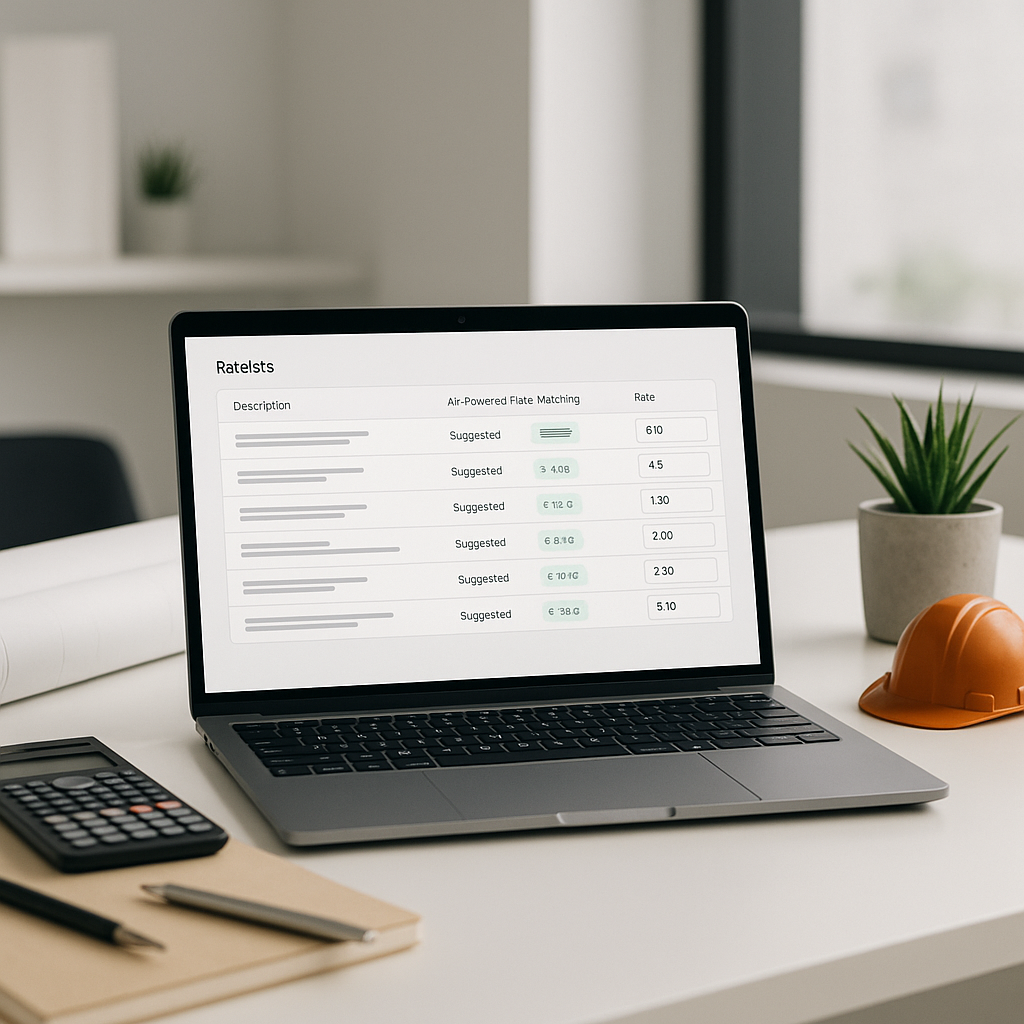
- Semantic Search: Instead of manually searching through pages, users can input queries like “concrete slab labor rate” or “installation cost for 4-inch PVC pipe.” The AI scans its database and provides relevant matches instantly.
- Customizable Catalogs: Users can upload their own rate data or regional adjustments, which the AI integrates seamlessly.
- Learning Over Time: The system improves with use, adapting to feedback and refining its recommendations.
- Audit Trail: Each match includes a detailed breakdown—such as material, labor, and equipment costs—allowing users to verify the data before applying it.
Illustrative example — Suppose you’re pricing a bid for a high-rise project. The AI could identify labor rates for concrete pouring from a catalog, adjust them for your city’s cost index, and factor in transportation costs, all within seconds.
Benefits: Saving Time and Reducing Errors
AI rate matching offers several key advantages:
- Time Savings: Automating rate lookup significantly reduces the time required for estimation.
- Improved Accuracy: Semantic search minimizes the risk of missing rates or miscalculating adjustments.
- Continuous Improvement: The AI learns from user feedback, becoming more effective over time.
Common Questions
Q1: How accurate are AI rate matches?
AI tools pull rates directly from verified catalogs like RSMeans and CPWD DSR. Additionally, the audit trail feature allows users to verify each match.
Q2: Can I use custom rates?
Yes, users can upload their own rate catalogs, and the AI integrates them into future matches. This is particularly useful for firms with proprietary pricing.
Q3: What if the AI suggests the wrong rate?
Users can override any suggestion, and the system learns from this feedback to improve future recommendations.
Q4: Does AI rate matching work for small projects?
Yes, AI-powered tools are scalable and can be used for projects of any size, from small renovations to large infrastructure bids.
What to Watch For
- Input Quality: Ensure that uploaded BOQs and catalog data are accurate and clean for optimal AI performance.
- Regional Adjustments: While the AI applies cost indices automatically, users should verify these adjustments against local conditions.
- Training: Investing time in training your team on the tool’s features can enhance productivity and effectiveness.
Final Thoughts
Manual rate lookup is a time-intensive process that can hinder efficiency and accuracy in preconstruction estimation. AI-powered rate matching offers a scalable, fast, and precise alternative, making it a valuable tool for contractors and estimators alike. By automating rate searches and adjustments, these tools can help streamline workflows and improve bid competitiveness.