AI-Powered Preconstruction Estimation: How Rate Matching Works
Ever spent hours flipping through rate books or PDFs trying to find the right labor rate for a specific task? If you’re a preconstruction estimator, you know how tedious and error-prone this process can be. Rate lookups are a common bottleneck in estimation workflows. But AI-powered tools are changing the game by automating this grunt work.
The Problem: Manual Rate Lookups Are a Bottleneck
Estimating for complex projects often involves working with multiple rate catalogs. Whether it’s RSMeans for U.S. projects or CPWD DSR for Indian tenders, finding the correct rate isn’t just about speed—it’s about accuracy. Manual lookups can lead to wasted time and errors, which can impact project bids and budgets.
For example, finding the labor rate for installing pre-stressed concrete girders might require:
- Scrolling through lengthy PDFs.
- Cross-checking state-specific or city-specific adjustments.
- Recalculating material costs if inflation isn’t factored in.
This process can take significant time and effort, leaving room for mistakes that could affect the overall estimate.
The AI Solution: Semantic Rate Matching
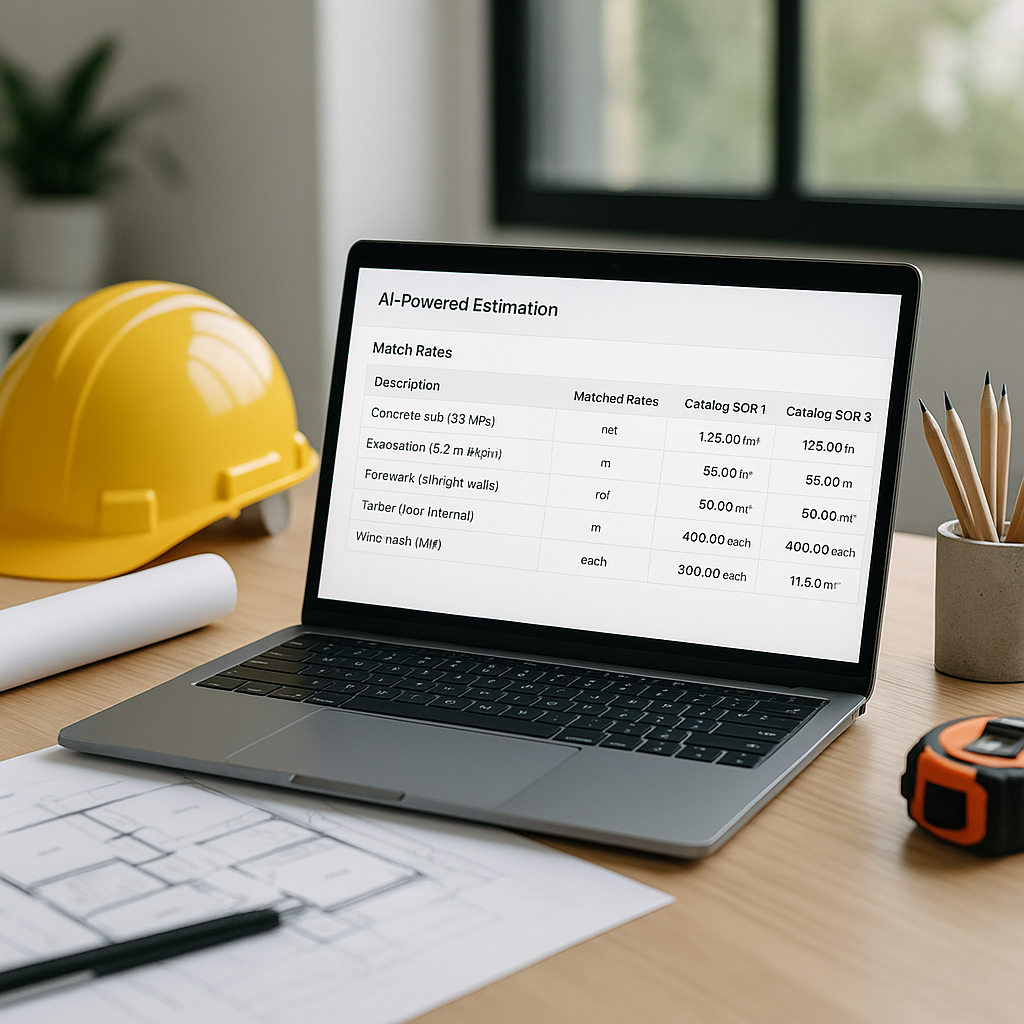
AI-powered rate matching tools simplify this process by using semantic search algorithms to pull rates instantly. Instead of manually searching through catalogs, you can type in a query—e.g., “labor rate for installing pre-stressed concrete girders”—and the system finds relevant matches across multiple sources.
How It Works:
- Semantic Search: AI interprets your query in natural language, not just keywords.
- Catalog Integration: It searches across multiple catalogs, such as RSMeans, CPWD DSR, and state DOT feeds, to find the best match.
- Contextual Adjustments: If inflation adjustments or city-specific factors apply, the system suggests them.
Why It’s Better:
- Speed: Tasks that used to take hours can now be completed in seconds.
- Accuracy: AI reduces human error by cross-referencing catalogs automatically.
- Learning Curve: AI tools improve over time by learning from user feedback.
Common Questions About AI Rate Matching
Q1: Can AI tools handle custom or project-specific rates?
Yes. Many AI tools allow you to upload your own rate catalogs or define custom rates for unique tasks. These rates can be integrated for future use.
Q2: What happens if the AI picks the wrong rate?
AI systems often include manual overrides, allowing users to review and adjust rates as needed. This ensures that critical rates are accurate.
Q3: How reliable is AI for rate matching?
AI reliability improves with usage and feedback. While it automates much of the process, it’s important to cross-check critical rates to ensure accuracy.
What to Watch For: Common Mistakes
- Ignoring Inflation: Some rates may be outdated. Ensure the AI tool accounts for inflation adjustments.
- Skipping Review: AI isn’t perfect. Always review critical rates to avoid errors.
- Overlooking Edge Cases: Not all tasks fit neatly into catalog categories. Use custom rates when necessary.
Why AI Rate Matching Matters
Rate matching isn’t just about saving time—it’s about building trust in your estimates. Accurate, cross-checked rates in your BOQ allow you to price bids confidently, reducing the risk of underpricing or overpricing.
If you’re still relying on manual rate lookups, it may be time to explore AI-powered tools. These tools don’t replace your expertise—they enhance it, allowing you to focus on higher-value tasks in the estimation process.