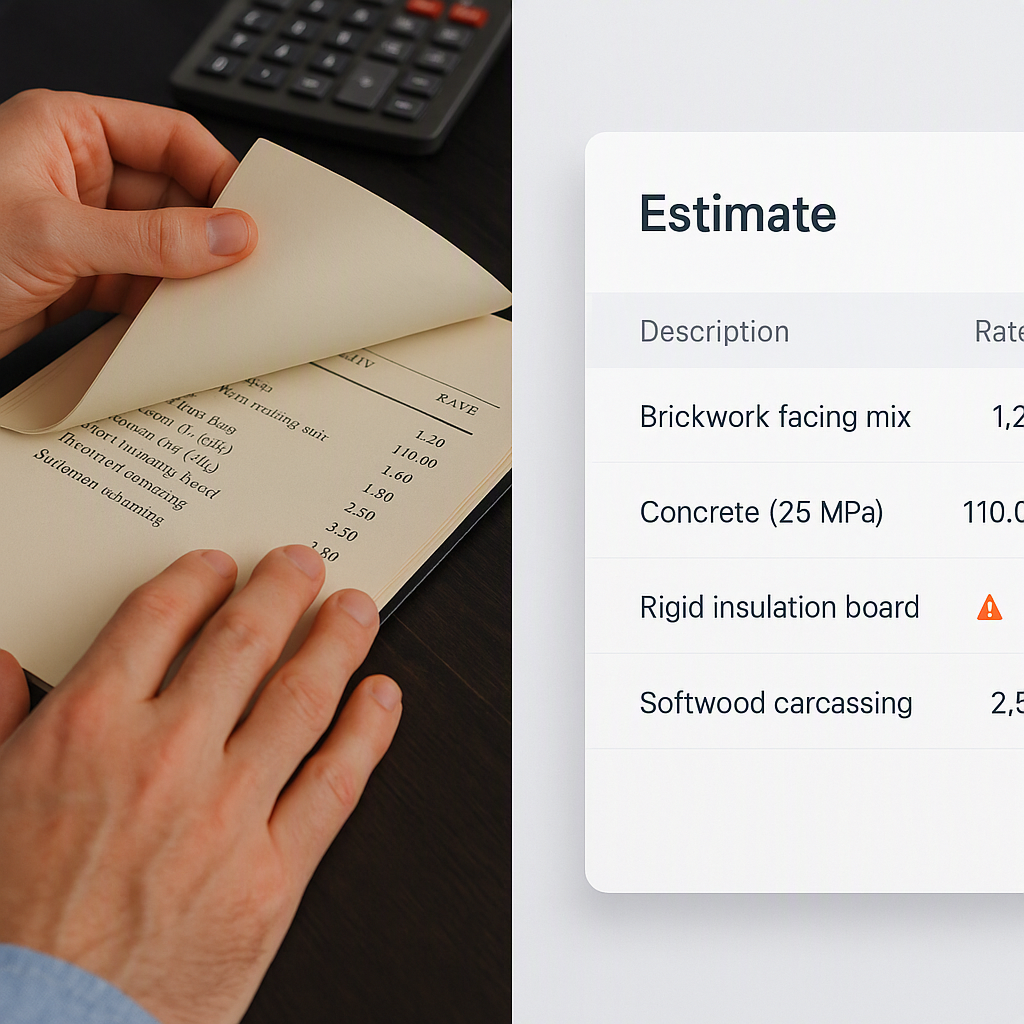
A suggested rate is a starting point for review. Before it becomes part of a construction bid, someone needs to confirm what the line includes, where the price came from and which assumptions still need an answer. Use the checklist below to make that review visible to the next estimator.
This is a practical workflow recommendation, not a report of a customer's results. The worked example uses invented quantities and rates solely to explain the arithmetic. It does not estimate a live project or promise a saving.
Start with the scope, not the suggested price
Read the original bill of quantities alongside the matched description. Highlight the work item, material specification, measurement unit, location and any qualification that affects what is included. Record the source file and revision so a colleague can find the same line later.
For an India project, for example, ask whether a reference comes from the relevant schedule and whether the specification matches the tender. Do not treat a familiar description as proof of a match. An item that sounds similar may assume different materials, access, installation work or testing.
Keep uncertainty explicit. Write a clarification question next to an incomplete description instead of filling the gap with a plausible assumption. A clear unresolved question is more useful at review than a confident number with an invisible qualification.
Check the measurement unit and quantity
Confirm the BOQ unit before comparing prices. A rate per square metre cannot be compared directly with a rate per cubic metre. A unit conversion also needs a stated basis; thickness, density or coverage should come from the actual specification rather than a guess.
Here is a hypothetical arithmetic check: assume a quantity of 100 square metres and an illustrative rate of INR 250 per square metre. Multiplication gives INR 25,000 before any separately stated adjustments. These figures are invented for the example. They say nothing about a market rate, project price or achievable margin.
Ask the reviewer to reproduce that calculation independently. If the result differs, resolve the quantity or unit disagreement before debating whether the rate is competitive.
Identify the reference behind the match
Record the catalog or quote name, applicable geography, reference date and the item identifier. Where a system suggests several candidates, compare their descriptions and exclusions before accepting the first result. Keep the original reference available with the estimate.
Use this review instruction with your team: “Show the source before accepting the rate.” Ask the estimator to point to the reference they actually used, then compare that reference with the tender description. Keep the answer next to the estimate rather than in an unrelated chat thread.
When no suitable reference exists, label the line for further review or a fresh quotation. Do not turn an AI suggestion into a supplier commitment. A named source and a documented question give the next reviewer something concrete to investigate.
Review the breakdown and adjustments separately
Look at material, labour and equipment assumptions separately where a breakdown is available. Ask what is included in each component and what remains outside the rate. Avoid adding an allowance twice because it appears once in the base reference and again in a project adjustment.
Keep overhead, profit and other cost factors visible. For each adjustment, record who selected it and what evidence or project assumption supports it. A reviewer should be able to distinguish the underlying rate from an estimating decision layered on top.
Use a breakdown to ask better questions. If a line combines several activities into one amount, ask what evidence supports that amount and which activity is most uncertain. Keep a breakdown as a review aid rather than treating its presence as proof that the underlying assumptions are right.
Hand over a reviewable bid line
Before approving a line, leave a compact record: original description, accepted description, quantity, unit, selected source, adjustments, exclusions, unresolved questions and reviewer. Keep a rejected alternative when the reason for rejecting it would help another estimator understand the choice.
If a clarification changes the scope, revisit both the quantity and the rate. Do not update the final amount alone and leave the earlier rationale behind. The handover should make the current decision understandable without relying on someone's memory of a call.
Try this process on one representative BOQ line before applying it to a whole package. The useful outcome is a line that a second estimator can trace and challenge. For a product discussion with SoftNext Solutions, visit EstimateNext and bring a representative BOQ with the assumptions you want to review.