The Problem: Manual Quantity Takeoffs Are a Bottleneck
Quantity takeoffs are the backbone of any construction estimate. You can’t price what you don’t measure. But here’s the rub: doing takeoffs manually is painfully slow. Estimators spend significant hours tracing drawings, measuring areas, and double-checking numbers. It’s tedious, repetitive, and prone to errors.
For example, on a mid-sized project, a general contractor might need quantities for concrete slabs, structural steel, and wall finishes across hundreds of drawing sheets. If multiple estimators tackle this, it can take days—and that’s assuming no revisions. Mistakes? Add more time.
This inefficiency doesn’t just cost time. It costs money. Estimators spend valuable hours on tasks that could be automated. Worse, these delays push bid deadlines and leave less time for strategic decisions like subcontractor negotiations.
The AI Solution: Vision AI for Takeoffs
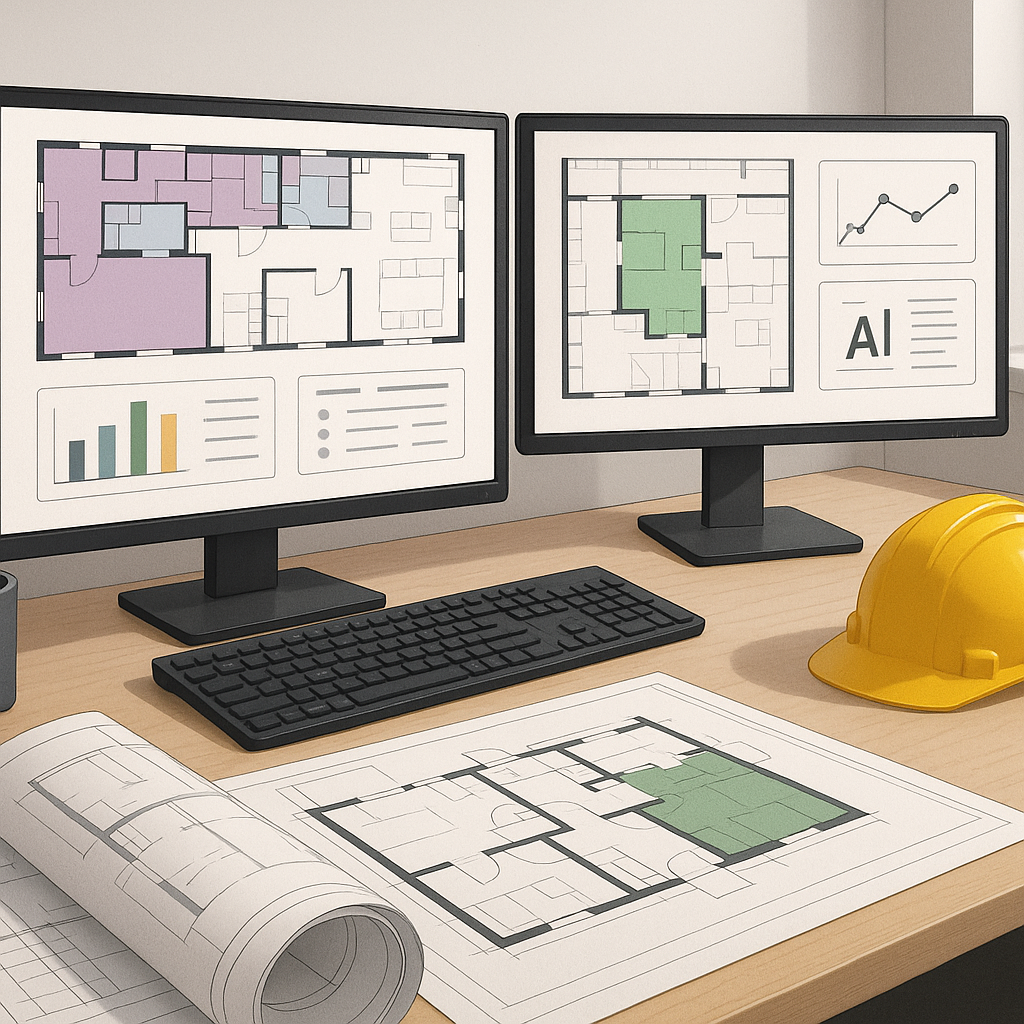
AI-powered tools like EstimateNext’s Vision AI are flipping the script. Instead of manually tracing drawings, Vision AI scans PDF plans and extracts quantities in a fraction of the time. Wall lengths, room areas, door counts—it’s all done automatically.
Here’s how it works:
- Upload Drawings: You upload your PDF plans into the platform.
- AI Extraction: Vision AI identifies and measures key elements (e.g., areas, linear lengths, counts) based on the drawing’s metadata.
- Confidence Scoring: Low-confidence measurements are flagged for human review, ensuring accuracy.
- Revisions: If new drawings arrive, you upload them, and the system compares changes automatically.
Illustrative example — What used to take days can now take minutes. This speed improvement allows estimators to focus on higher-value tasks. And it’s not just about speed—it’s about reliability. AI reduces takeoff discrepancies, leading to fewer revisions and more accurate estimates.
The Obvious Objection: “But AI Can’t Think Like an Estimator”
You might be thinking, “Sure, AI is fast, but it doesn’t understand the nuances of construction.” That’s partially true. AI doesn’t replace your expertise; it amplifies it. You’re still the one making judgment calls, negotiating with subs, and deciding on markup. The AI just handles the grunt work—like takeoffs and rate matching.
In my view, AI is like having an apprentice that never sleeps and never makes calculation errors. The human estimator remains the decision-maker, but now they have time to focus on the big-picture strategy instead of counting tiles.
Common Mistakes to Avoid
- Ignoring Confidence Scores: AI takeoffs aren’t perfect. Low-confidence measurements need manual review to ensure accuracy. Don’t skip this step.
- Overloading the System: Uploading messy or incomplete PDFs can confuse the AI. Clean up your files before uploading.
- Underestimating Training Time: Most AI tools take some time to learn. Invest the time upfront to avoid frustration later.
Call to Action
If manual takeoffs are slowing your team down, AI-powered tools like EstimateNext can help. Get started free →


