The Hidden Time Sink in Construction Estimation
Every estimator knows the pain of manual rate lookup. You’ve got a Bill of Quantities (BOQ) with dozens—if not hundreds—of line items. Each one needs a rate: materials, labor, equipment, overheads. Where do you start?
Most of the time, you’re flipping through a massive rate book like RSMeans or CPWD DSR, trying to find the closest match. Or worse, you’re hunting through spreadsheets and old project files, hoping someone saved the exact cost breakdown for a similar item.
It’s tedious, error-prone, and eats up hours. According to a McKinsey report, inefficiencies like this are why preconstruction accounts for nearly 40% of overall project costs, yet remains one of the least digitized phases in construction.
But what if you could replace all that manual work with a single search bar? That’s where AI-powered rate matching comes in.
What Is AI-Powered Rate Matching?
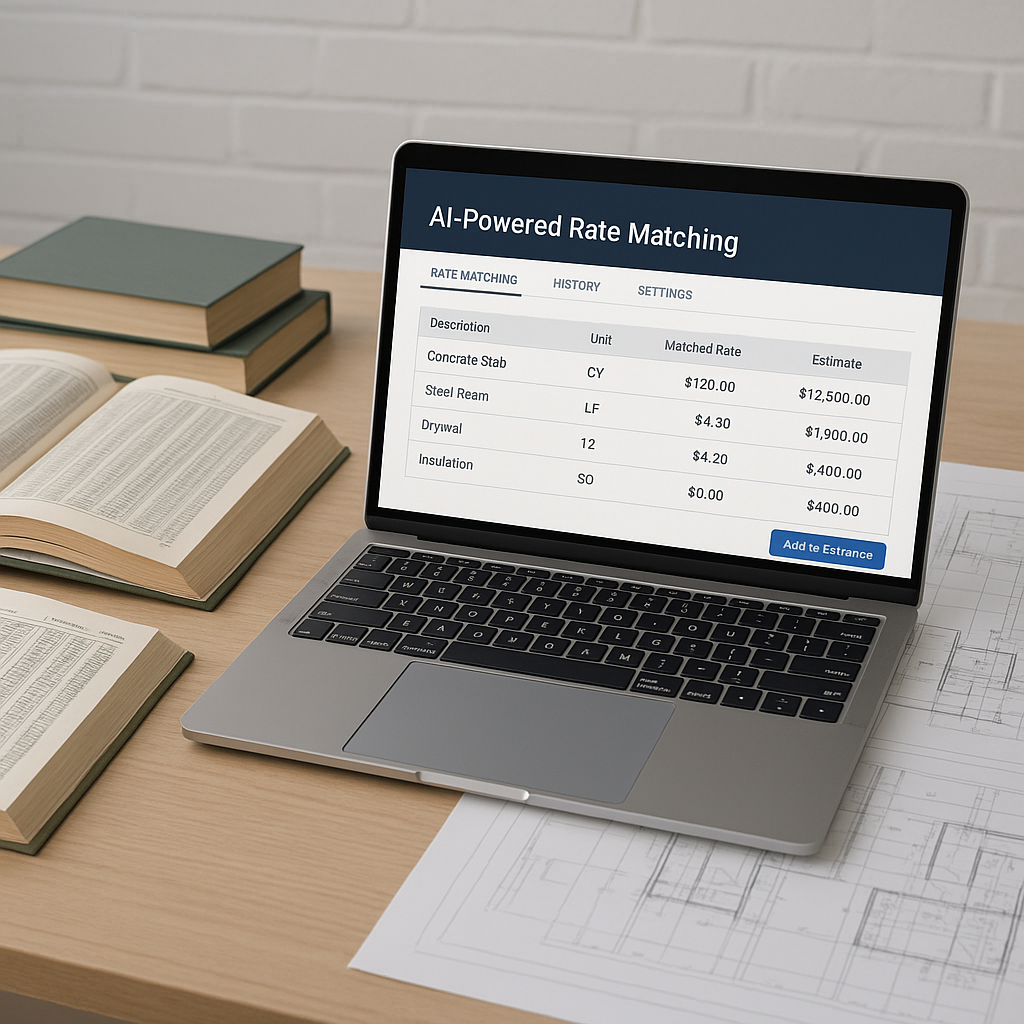
Think of it as Google for construction rates. Instead of manually searching through PDFs, Excel sheets, or rate books, AI uses semantic search to find the best match for your BOQ line items in seconds. It doesn’t just look for exact wording—it understands context. For example:
- Manual method: You search for “concrete slab 4-inch thickness” and sift through pages of irrelevant results.
- AI-powered method: Type the same query, and the AI suggests rates for similar items like “4-inch slab with rebar” or “light-duty concrete flooring,” ranked by relevance.
Some tools even allow you to upload your own custom rates, integrating them for future use.
Why Traditional Methods Are Broken
Manual rate lookup isn’t just slow—it’s risky. Here’s why:
- Human error: Misreading a rate or applying the wrong one can skew your entire estimate.
- Incomplete data: What if your rate book doesn’t cover a niche item or a custom material? You’re left guessing or calling vendors last-minute.
- Inflexibility: Rate books don’t adapt to inflation, regional variations, or project-specific factors unless you manually adjust them. That’s more time lost.
How AI Solves These Problems
AI-powered tools address these pain points head-on. Here’s how:
- Speed: AI significantly reduces the time spent on rate lookup by automating the process.
- Accuracy: AI learns from user feedback, improving its suggestions over time and reducing rate mismatches.
- Customizability: Got a proprietary mix design or a custom material? Upload it once, and the AI remembers it for future projects.
- Real-time updates: Some platforms factor in inflation and regional cost variations automatically.
A Practical Example
Illustrative example — Let’s say you’re pricing the BOQ for a high-rise project. One line item calls for “supply and install of 12mm tempered glass.” Here’s how the process might unfold:
- Traditional method: Open your rate book, search for “tempered glass,” and scroll through dozens of options. You finally find a rate for 10mm and manually calculate the adjustment for 12mm. This takes significant time per item.
- AI-powered method: Type “12mm tempered glass” into the rate matcher. The AI suggests rates for similar items, considers your location, and highlights the most relevant option. This takes a fraction of the time.
Extrapolate that across a 300-line BOQ, and you’ve saved substantial time. That’s extra capacity for your team to refine bids, negotiate better terms with subcontractors, or work on the next project.
Common Questions About AI Rate Matching
Q: Is it reliable for niche or custom items?
Yes, as long as you upload your own rate catalogs or provide feedback on AI suggestions. The system gets smarter with every project.
Q: Can it handle inflation and regional variations?
Yes, many platforms include inflation adjustments and regional cost indices. You can even set custom cost factor profiles.
Q: Does it replace estimators?
No. AI amplifies your expertise—it doesn’t replace it. You’re still making judgment calls, but with better data at your fingertips.
Watch Out for These Mistakes
- Relying on default rates: Always review AI-suggested rates, especially for high-cost items.
- Ignoring feedback loops: The AI learns from your input. Take the time to accept or reject matches—it pays off in accuracy later.
- Not uploading custom rates: If you frequently work with unique materials, add them to the system. Don’t waste time adjusting generic rates every time.
Conclusion
AI-powered rate matching isn’t a luxury—it’s a necessity. The construction industry is under constant pressure to deliver faster, cheaper, and more accurate estimates. Shaving hours off rate lookup alone can mean the difference between winning or losing a bid.
If you’re still stuck in the manual grind, it’s time to upgrade. AI tools simplify rate matching, improve accuracy, and give you back the time you need to focus on what really matters.