Manual Rate Lookups: The Hidden Time Sink
If you’ve ever spent significant time flipping through a large rate book to find the right labor or material cost, you know the pain. It’s tedious, error-prone, and eats into the time you should be spending on higher-value tasks—like analyzing bids or negotiating with subcontractors.
Take RSMeans as an example. It’s the go-to for US estimators working on public projects, but it’s not exactly quick. Need the cost of installing a pre-stressed concrete girder? You’ll probably dig through several sections, cross-reference labor rates, then manually enter it into your spreadsheet. Multiply that by numerous line items per bid, and you’re looking at a time-intensive process.
Why AI Rate Matching is a Game-Changer
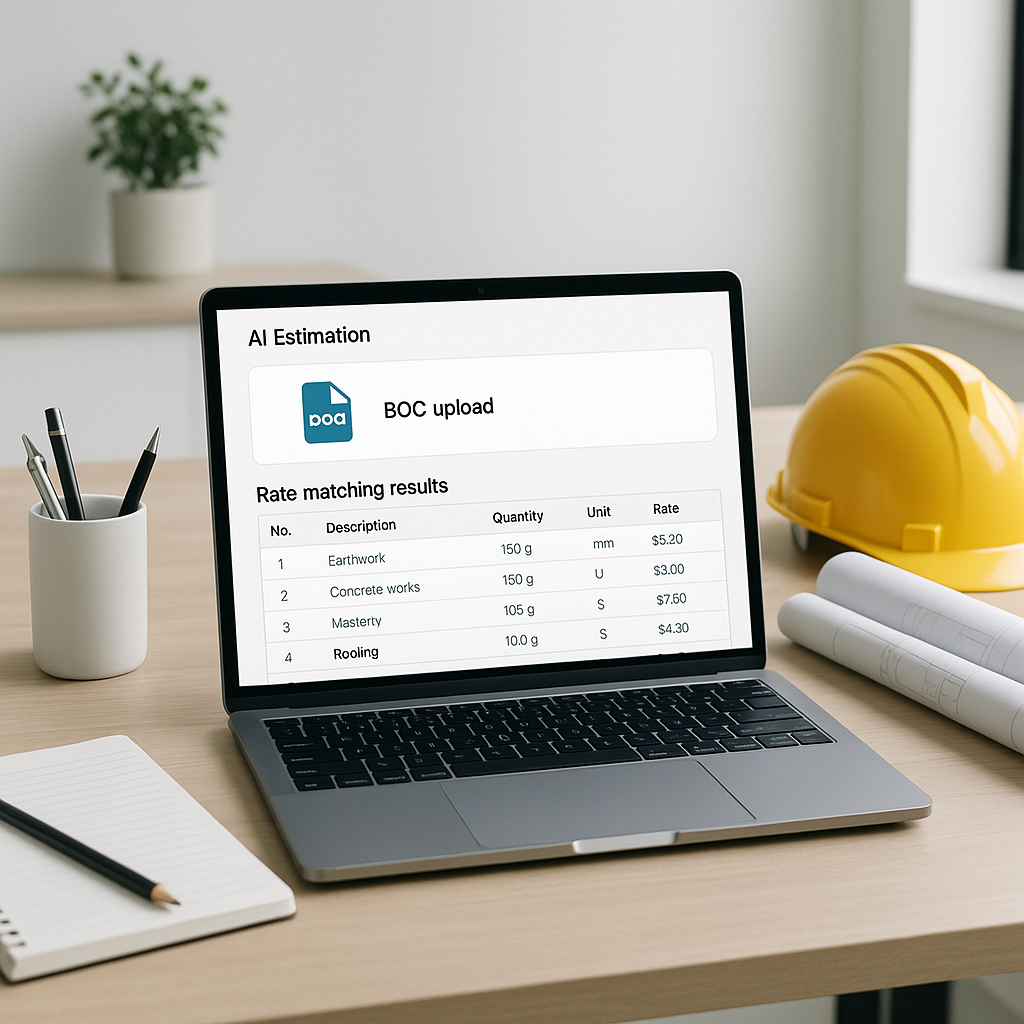
AI-powered rate matching changes the game entirely. Instead of manually searching, you upload your BOQ (Bill of Quantities), and the system uses semantic search to match line items against a database of standard schedule of rates (SOR) items. Need that labor rate for concrete girders? Type it in, and you’ll have it quickly—along with material costs, equipment breakdowns, and even inflation-adjusted figures.
AI systems often follow a structured approach. For instance, they may start by checking your historical data, then move to your custom catalogs, broaden to country-specific standards, and finally use AI fallback for edge cases. These systems can also learn from your adjustments, improving matches over time.
Benefits of AI Rate Matching
AI rate matching offers several advantages:
- Efficiency: Automating rate lookups reduces the time spent on repetitive tasks.
- Accuracy: By pulling rates directly from verified sources, AI minimizes the risk of human error.
- Scalability: Whether you’re working on a small renovation or a large infrastructure project, AI tools can adapt to the scope of your work.
- Customization: Many AI systems allow you to upload custom catalogs or adjust rates manually, which are then integrated for future use.
What to Watch For
AI rate matching isn’t perfect. It’s only as good as the data you feed it. If your source catalogs have outdated or inaccurate rates, your estimate will reflect that. It’s also crucial to review AI matches for edge cases—especially custom items or non-standard materials.
A common mistake? Over-relying on automation. AI tools are incredibly powerful, but they don’t replace your expertise. You still need to review, tweak, and validate the numbers. Think of AI as a tool to amplify your skills, not a replacement for them.
FAQ
Q: How accurate are AI-powered rate matches?
AI tools can become highly accurate over time with feedback loops, but initial outputs depend on the quality of your input data. Always validate edge cases.
Q: Can AI handle custom rates or non-standard items?
Yes. Most AI systems let you upload custom catalogs or adjust rates manually, which are then integrated for future use.
Q: Does AI rate matching work for small projects?
Absolutely. Whether you’re estimating a small renovation or a large infrastructure project, AI scales to match the scope of your work.
Q: How long does it take to learn these tools?
Most platforms are designed to be user-friendly, and training typically takes a short amount of time.
Q: Can AI replace my current software stack?
Not necessarily, but it can integrate with tools like Procore and Bluebeam to streamline your workflow. AI tools are meant to complement your existing systems, not replace them entirely.
The Bottom Line
Manual rate lookups are a time-intensive process. AI-powered rate matching not only saves time but also improves accuracy and reduces stress during preconstruction. If you’re tired of flipping through catalogs, exploring AI tools might be a worthwhile investment.