Why Rate Matching Can Be Inefficient
Rate matching is often a time-consuming and error-prone process. If you’ve ever spent hours flipping through RSMeans or CPWD DSR books to find the right item, you know how tedious it can be. The challenge becomes even greater when dealing with custom BOQs that include vague descriptions.
Rate matching is not just about finding numbers—it’s about ensuring trust in your estimates. If your bid is based on inaccurate rates, you risk either underpricing and losing money or overpricing and losing the bid. Manual processes can waste significant amounts of time that could otherwise be spent refining bids, negotiating with subcontractors, or evaluating risks.
How AI Can Streamline Rate Matching
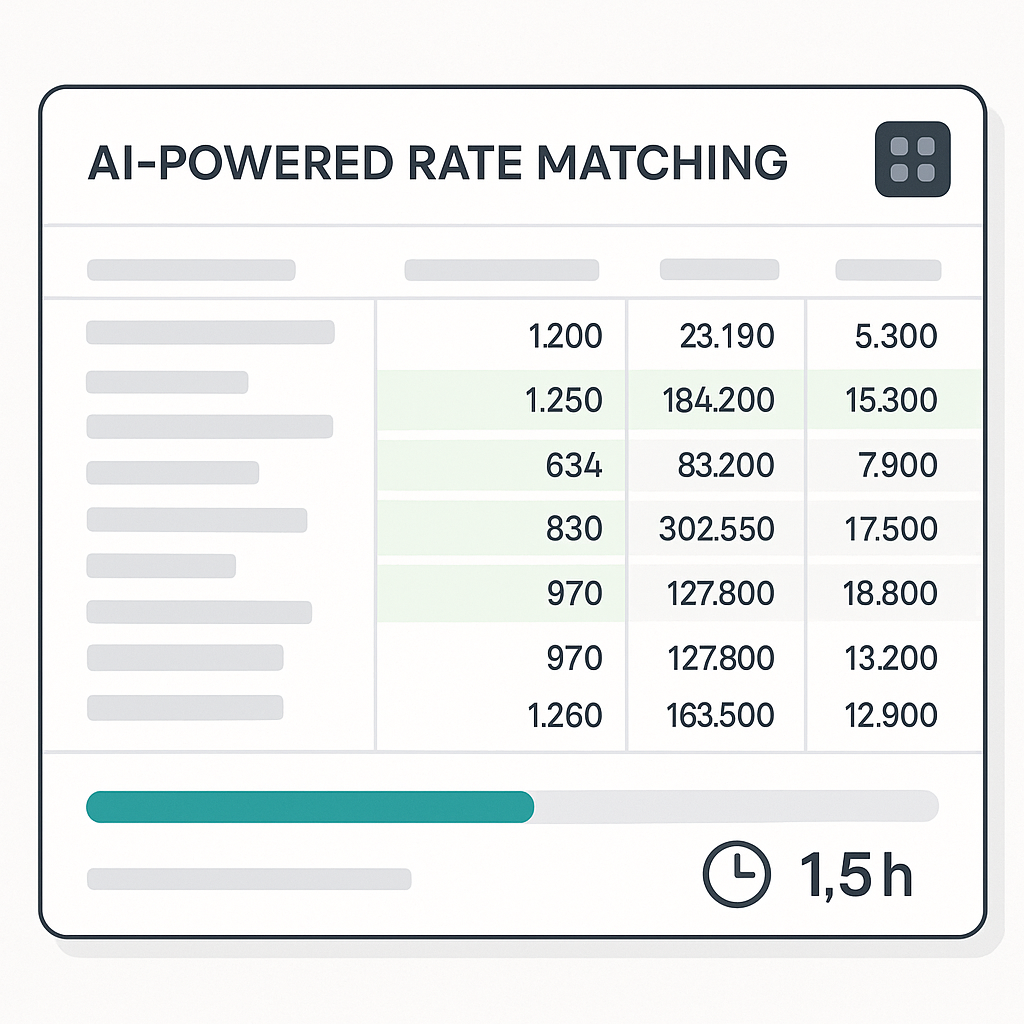
AI-powered tools are transforming the way rate matching is done. Instead of manually searching through extensive rate books, these tools allow you to upload your BOQ and use semantic search to find relevant rates quickly. AI can account for synonyms, regional variations, and even custom catalogs, making the process faster and more accurate.
Illustrative example — Imagine your BOQ includes “8-inch ductile iron pipe.” A traditional search might only look for exact matches, potentially missing variations like “DI pipe” or “ductile iron water pipe.” AI-powered rate matching can identify these variations, saving time and reducing errors.
Why Accuracy Matters More Than Speed
While speed is a significant advantage, accuracy is even more critical. AI tools are only as effective as the data they are trained on. Many platforms allow users to upload custom rate catalogs or adjust rates based on local market conditions. For instance, users in India can integrate CPWD DSR catalogs or state-specific SORs into their workflows.
AI tools also improve over time. When you adjust or approve a rate, the system learns from your input, enhancing accuracy for future projects. This iterative learning process ensures that the tool becomes more reliable with continued use.
The Role of Human Judgment
AI is a tool designed to assist, not replace, human expertise. While it can handle repetitive tasks like pulling rates and cross-checking sources, final decisions still require human oversight. Teams that succeed with AI tools often invest in training, test the tools on smaller projects, and use feedback loops to refine results.
Common Mistakes in Rate Matching
- Relying on Default Rates: Always adjust for inflation, location, and project scope to ensure accuracy.
- Skipping QA: Even the best AI tools require oversight to catch anomalies or edge cases.
- Ignoring Feedback Loops: Providing feedback on incorrect matches helps the system improve over time.
- Not Using Custom Catalogs: Uploading proprietary rates ensures that estimates reflect real-world costs.
FAQ
Q: How accurate are AI-powered rate matches?
A: Accuracy depends on the quality of input data and human oversight. AI tools improve over time with consistent feedback.
Q: Can AI handle custom rates or unique projects?
A: Yes, most platforms allow users to upload custom catalogs and adjust rates manually. The AI learns from these inputs for future estimates.
Q: How quickly can I see ROI with AI estimation tools?
A: ROI varies by team and project size, but many users report significant time savings and improved accuracy within the first few projects.
Q: Is AI hard to integrate into my current workflow?
A: Most tools are designed to integrate seamlessly with platforms like Procore, Bluebeam, and Excel.
Q: Are AI tools accessible for smaller firms?
A: Yes, many platforms offer affordable pricing plans suitable for small contractors.
Conclusion
If you’re spending excessive time on rate matching, it may be time to explore AI-powered tools. These tools can save time, reduce errors, and improve the accuracy of your estimates. Rather than replacing your expertise, they amplify it, enabling you to focus on higher-value tasks.