Manual Rate Lookups: A Time-Consuming Challenge
Rate lookups are one of the most tedious parts of preconstruction estimation. Flipping through extensive rate books like RSMeans or CPWD’s DSR can be both time-consuming and prone to errors. Missing a single line can lead to significant inaccuracies in your estimate.
The challenge becomes even greater when dealing with custom rates or project-specific materials. While some firms maintain their own catalogs, these are often outdated, requiring additional time for cross-checking rates across regions or labor codes. This process can take hours for each estimate, especially for complex projects.
How AI Rate Matching Works
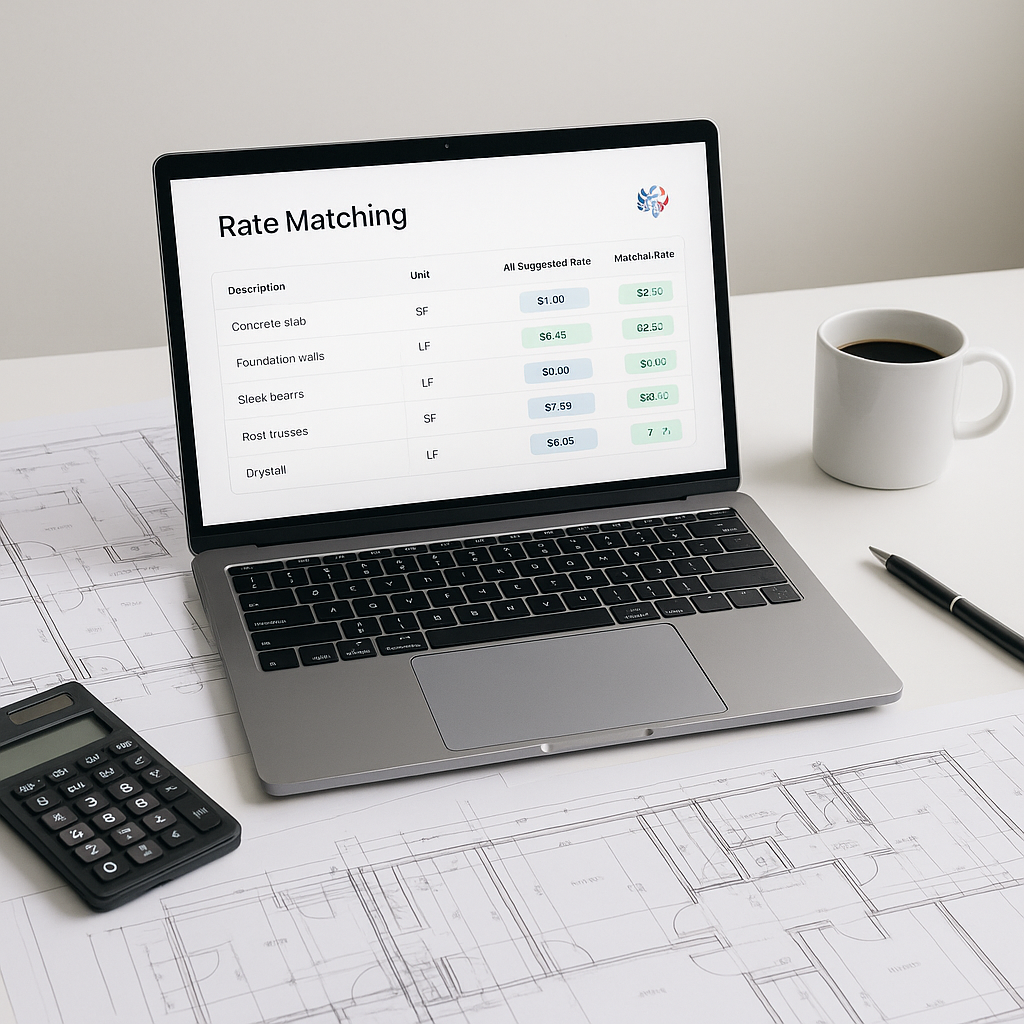
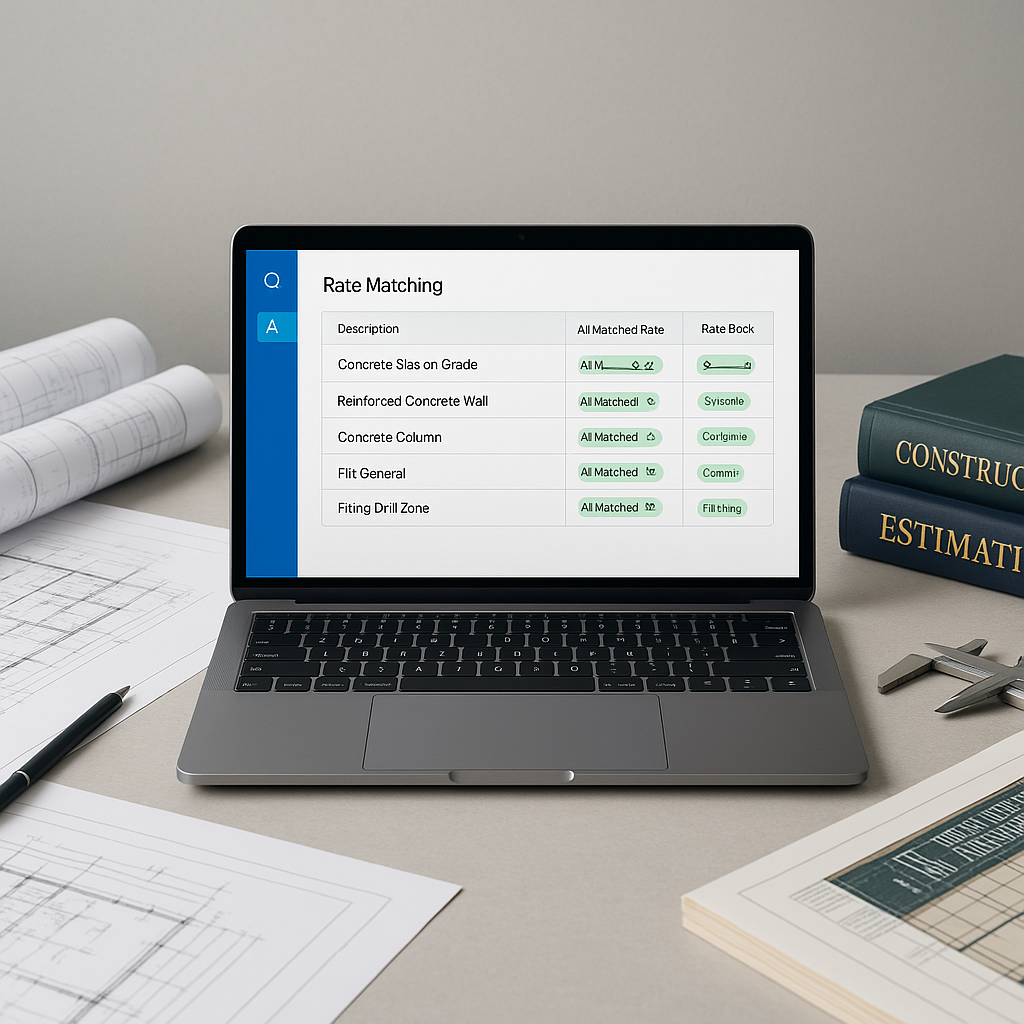
AI-powered tools are transforming this process by using advanced algorithms to match Bill of Quantities (BOQ) items to rates from large databases. These tools employ semantic search, which goes beyond simple keyword matching to understand the context of your input. For example, if you search for "installing pre-stressed concrete girders," the AI can provide relevant matches based on specific parameters like span length or material grade.
Illustrative example — Imagine you’re working on a project requiring rates for "12m span pre-stressed concrete girders." Instead of manually searching through catalogs, an AI tool could instantly provide relevant matches, saving significant time and effort.
Why Accuracy Matters
Accuracy in rate matching is crucial for building trust with clients and stakeholders. Clear and auditable rates make it easier to justify your estimates. Errors or discrepancies discovered after submission can damage credibility and lead to costly revisions.
AI tools not only find rates but also document the entire process. This creates a transparent audit trail, showing exactly how each rate was selected—whether from a standard catalog or a custom addition. Such transparency is increasingly becoming a competitive necessity.
Handling Custom Rates
One common concern is whether AI tools can accommodate highly specific or custom rates. Many AI platforms allow users to upload their own rate catalogs. Once integrated, the system learns from these inputs, improving its suggestions over time.
Illustrative example — A subcontractor specializing in HVAC installations uploads custom rates for ductwork and controllers. By the third project, the AI consistently suggests accurate matches, reducing manual intervention and saving time.
Addressing Common Concerns
- “AI can’t understand the nuances of my projects.” While AI won’t replace human judgment, it eliminates repetitive tasks, allowing you to focus on strategic decisions.
- “Learning a new tool takes too much time.” Most AI platforms are designed for ease of use, with minimal training required.
- “What if the AI matches the wrong rate?” Human oversight remains essential. Many tools include features like manual overrides to ensure accuracy.
FAQ
Q: Can I use AI rate matching for smaller projects?
Yes, AI tools are scalable and can be used for projects of any size, from small fit-outs to large infrastructure developments.
Q: How does AI handle regional rate variations?
AI tools often include region-specific catalogs and cost indices, with options to configure inflation adjustments.
The Bottom Line
Manual rate lookups are inefficient and error-prone. AI-powered tools offer a faster, more accurate, and transparent alternative for preconstruction estimation. By automating repetitive tasks, these tools allow professionals to focus on higher-value activities, improving both efficiency and credibility.
If you’re still relying on outdated methods, it may be time to explore how AI can enhance your estimation process.