The Rate Lookup Problem in Construction Estimation
If you’ve ever priced a bid package, you’ve probably spent more time on rate lookups than you’d like to admit. Whether it’s flipping through a 2,000-page CPWD DSR, scrolling through RSMeans PDFs, or pulling rates from Excel sheets, it’s a tedious process. Mistakes can easily creep in, and a missed line item or incorrect rate can affect your bid's competitiveness.
Rate lookup is often treated as a necessary part of the job, but it doesn’t have to be so time-consuming. This is where AI-powered tools can make a significant difference by reducing manual effort and minimizing errors.
How AI Changes the Game
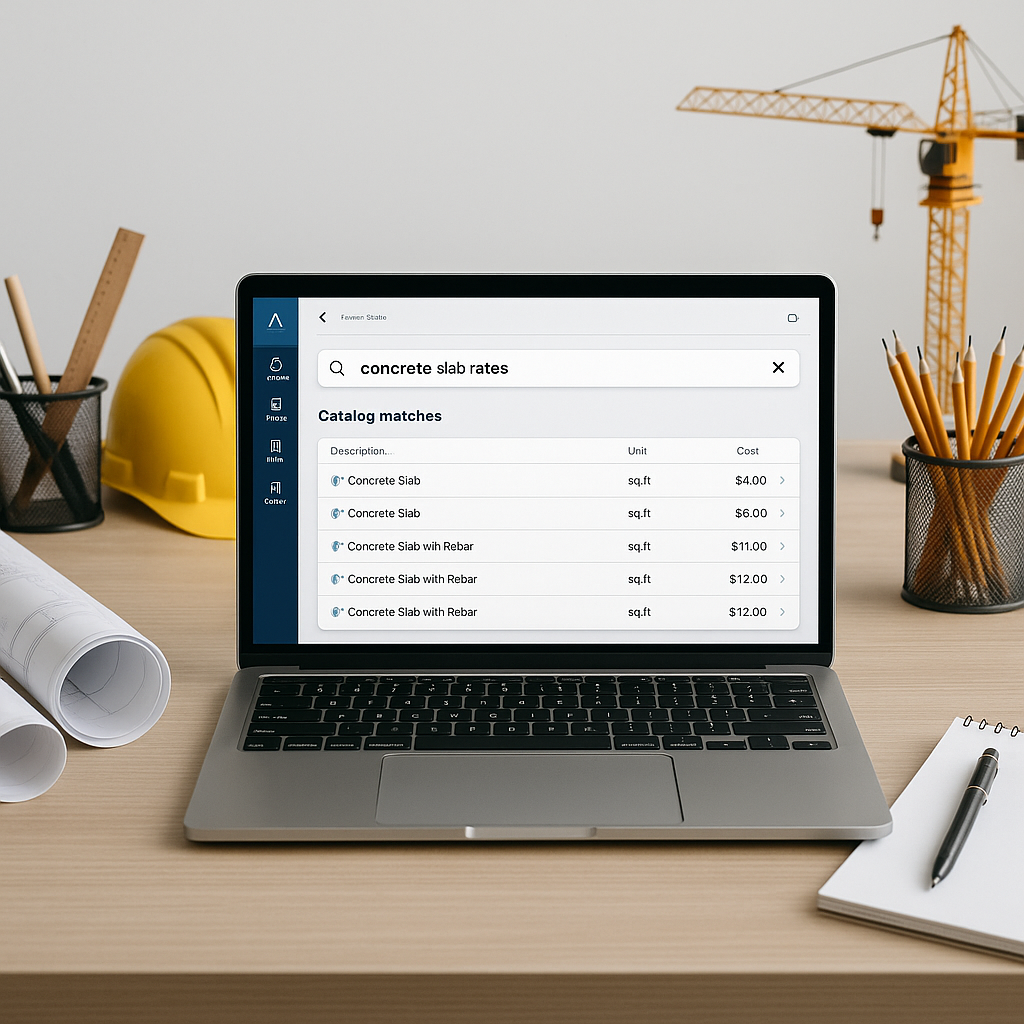
AI-powered preconstruction tools simplify rate lookup with features like semantic search. Instead of manually searching line by line, you can type in what you need — for example, “concrete slab 150mm thick, M25 grade” or “labor rate for duct installation.” The system scans standard catalogs and delivers the closest matches quickly.
Illustrative example — Imagine you’re pricing a mid-sized office fit-out. You need rates for gypsum partitions, ducting, and electrical wiring. With traditional methods, you would:
- Open the relevant catalog (e.g., CPWD DSR or RSMeans).
- Manually search for each item.
- Cross-check with your region’s inflation adjustment tables.
- Ensure you didn’t miss any footnotes specifying exclusions.
An AI tool can streamline this process. You upload your BOQ, and the system identifies matches, adjusts for inflation, and flags items where multiple rates might apply (e.g., differing labor costs by city). This approach significantly reduces the time spent on rate lookup.
Why Accuracy Matters More Than Speed
While speed is a major benefit, accuracy is equally important. A fast tool that provides incorrect rates isn’t helpful. AI tools often include a feedback loop that learns from your corrections. For example, if you reject a suggested rate, the system updates its algorithm to avoid similar mistakes in the future. Over time, this iterative process improves the tool’s accuracy.
For unique cases — such as custom materials or specific project requirements — many tools allow you to upload your own rates or modify the AI’s suggestions. These custom inputs are then integrated for future use.
Common Misconceptions About AI Rate Lookup
Some professionals worry that AI tools may not understand regional nuances or project specifics. However, AI is not designed to replace human expertise but to augment it. You still make the critical decisions on markup, exclusions, and scope clarifications, while the AI handles repetitive tasks.
Another concern is that AI isn’t perfect. While no system is flawless, many tools include built-in mechanisms for human oversight. For example, they may flag items for review if the system is uncertain about the match. This ensures that you maintain control over the final estimate.
What to Watch For
When evaluating AI tools for rate lookup, consider the following factors:
- Catalog Coverage: Does the tool support your region’s standard catalogs (e.g., CPWD DSR, RSMeans, AECOM)?
- Custom Rates: Can you add your own rates for niche items?
- Inflation Adjustments: Does it account for year-on-year cost changes?
- Feedback Loop: Does the tool improve with use, or is it static?
- Integration: Can it export data to your existing software (e.g., Excel, Procore)?
The Bottom Line
Rate lookup doesn’t have to be a bottleneck in construction estimation. AI-powered tools can help you save time, reduce errors, and focus on higher-value tasks like bid strategy and subcontractor negotiations. By automating repetitive tasks, these tools allow you to work more efficiently and accurately.


