Manual Takeoffs Are Killing Efficiency
Let’s face it. Quantity takeoffs are brutal. You’ve got two estimators spending 40 hours tracing drawings, flipping through rate books, and manually building BOQs. It’s tedious, error-prone, and a huge drain on resources. But what’s the alternative? AI-powered tools like EstimateNext turn those 40 hours into 10 minutes. Yes, ten.
Why Takeoffs Are Stuck in the Past
The process hasn’t evolved much in decades. You get drawings, measure the quantities, and input them into a spreadsheet. The tools might have changed—maybe you’ve upgraded to Bluebeam or Procore—but the workflow hasn’t. It’s still manual, and it still wastes time.
Concrete Example: The Legacy Workflow
For example, a mid-sized contractor estimating a retail build-out might spend weeks manually measuring square footage for flooring, wall areas for paint, and fixture counts for lighting. Even with tools like Bluebeam, the process requires constant input, cross-referencing rate books, and double-checking calculations. A single overlooked dimension can cascade into errors that cost thousands in change orders or lost bids.
Real Costs of Mistakes
Mistakes aren’t just common—they’re inevitable. According to a study by the Construction Industry Institute (CII), errors in preconstruction planning account for 4-6% of total project costs. A missed dimension or miscalculated area doesn’t just skew your bid—it can lead to change orders, delays, and strained relationships with clients. That’s why most teams spend even more time reviewing and rechecking. It’s not just inefficient; it’s expensive.
How AI Fixes Takeoffs
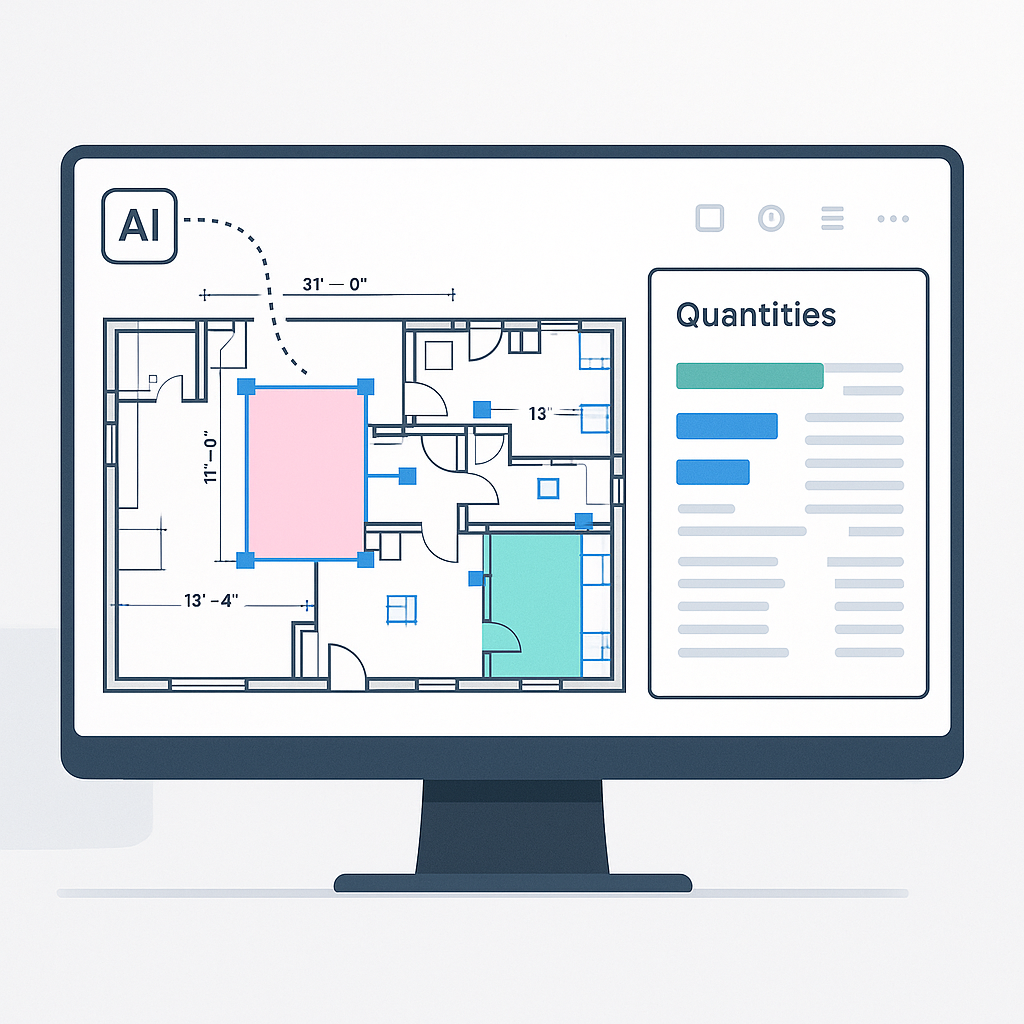
AI tools like EstimateNext use Vision AI to extract quantities directly from PDF drawings. Upload your plans, and the system identifies room areas, wall lengths, door counts—you name it. What used to take two estimators two days now happens in minutes. A mid-sized GC saved 120 hours on a high-rise bid using this exact approach (source).
How It Works: Step-by-Step
- Upload Your Drawings: No complicated formatting required. Just drag and drop PDFs into the system.
- AI Extraction: The tool scans the drawings and pulls quantities—room areas, linear lengths, fixture counts—with confidence scoring for low-certainty items.
- Manual Override: Got a tricky corner or an unusual feature? You can remeasure specific sections with full audit trails.
- Export to BOQ: Once verified, export the quantities to your preferred format—Excel, CSI MasterFormat, or NRM2.
Case Study: High-Rise Estimation
Consider a mid-sized general contractor bidding on a 15-story residential tower. Using traditional methods, the takeoffs for flooring, drywall, and plumbing fixtures alone would take two senior estimators 80 hours. By switching to AI-powered takeoffs, the company reduced this to 4 hours and avoided several critical errors in fixture counts, saving tens of thousands in rework during construction.
The ROI Is Hard to Ignore
Let’s do the math. Saving 40 hours per bid at $130/hour means you’re saving $5,200 per estimate. If your team handles five GMP pursuits a year, that’s $26,000 saved annually—just on takeoffs. And that doesn’t even account for the accuracy improvements or the ability to bid on more projects.
ROI for Small Contractors
For smaller contractors, the ROI might look different but is no less compelling. Saving even 10 hours per bid lets you respond faster, meet tighter deadlines, and win more work. According to a McKinsey report, early adopters of AI in construction see cost savings of 10-20% per project.
Comparison Table: Traditional vs AI Takeoffs
| Feature | Traditional Takeoffs | AI-Powered Takeoffs |
|---|---|---|
| Time Required | 40–80 hours per bid | 10–30 minutes per bid |
| Accuracy | Prone to human errors | Confidence scoring + overrides |
| Scalability | Limited by team size | Scales to any project size |
| Cost per Project | High labor costs | Subscription-based pricing |
Common Objections
“But AI Can’t Think Like an Estimator.”
True, AI isn’t replacing your expertise. It’s amplifying it. You’re still the one reviewing outputs, negotiating with subs, and making judgment calls. AI handles the grunt work—like takeoffs and rate lookups—so you can focus on the strategic stuff.
“What About Accuracy?”
Accuracy depends on input quality, but AI tools include confidence scoring and manual override features. If the system flags low-certainty items, you can step in and adjust. In most cases, AI reduces discrepancies by up to 80% (source).
“Is It Hard to Learn?”
Not really. Platforms like EstimateNext are designed for ease of use, with most teams up and running in under two weeks. The interface is intuitive, and the learning curve is minimal (source).
Actionable Steps
Want to start saving time? Here’s what we recommend:
- Start Small: Test AI tools on a smaller project to validate accuracy and workflow compatibility.
- Pair AI with Expertise: Train junior estimators to use the platform while senior staff focus on high-value tasks.
- Integrate Seamlessly: Choose a tool that works with your existing stack. EstimateNext, for example, integrates with Bluebeam, Procore, and Excel (source).
- Measure Results: Track time saved, errors reduced, and ROI after implementing AI tools.
Closing Thoughts
If you’re tired of wasting 40 hours on takeoffs, it’s time to rethink your workflow. AI-powered tools like EstimateNext let you save time, reduce errors, and focus on winning bids. Get started free →


